
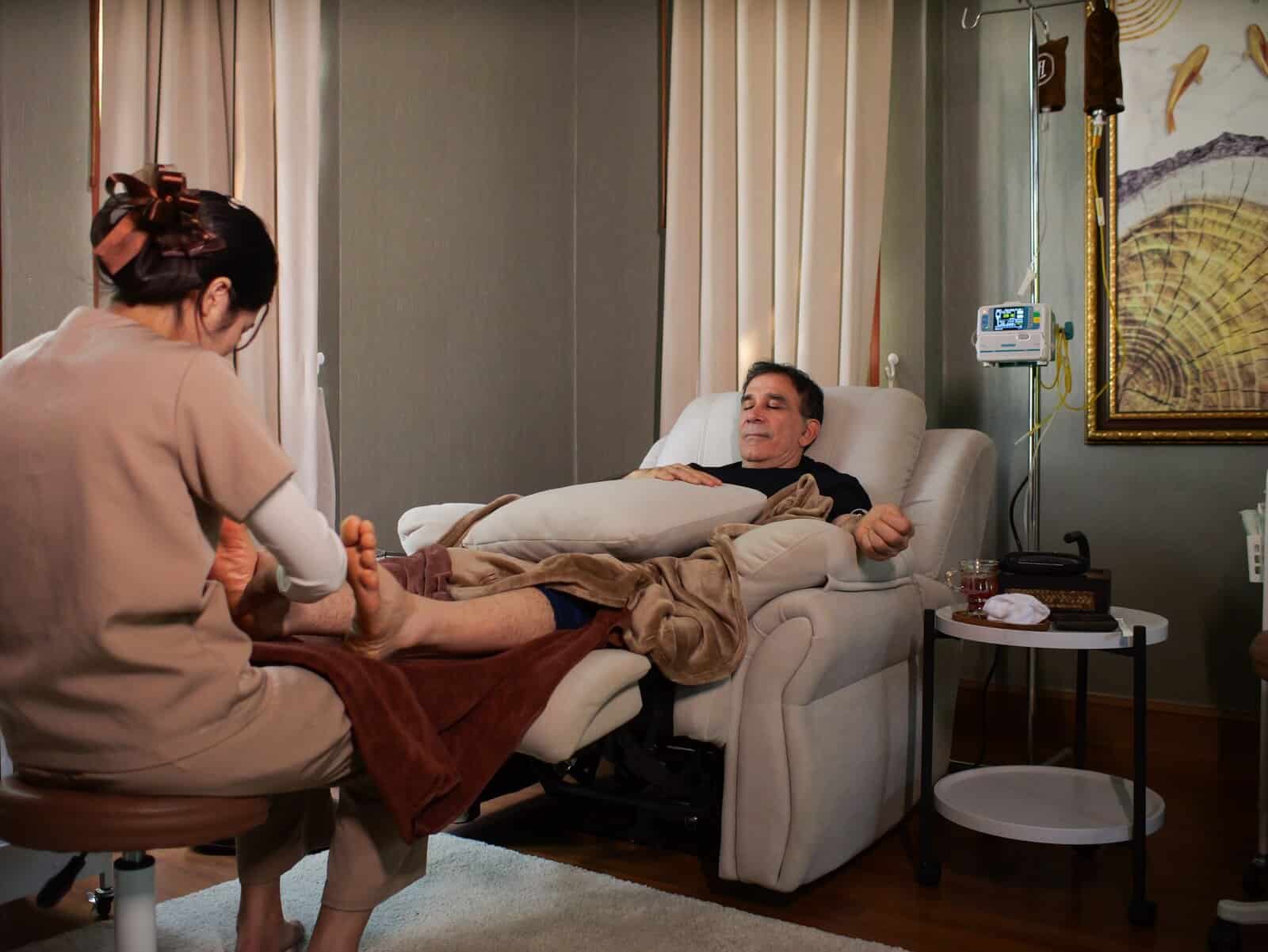
NAD+ is not a supplement story. It is a biology story — one that happens to involve supplements at the end. Most of what patients in their forties have read about NAD+ comes from product pages and Instagram excerpts of David Sinclair op-eds. What I want to do here is the part those leave out: explain, at the level of the enzyme, why a healthy 45-year-old feels metabolically different from the same body at 25. By the end of this article you will understand the why — not the protocol — at a level that lets you ask better questions of any longevity physician you meet.
NAD+ in one paragraph
NAD+ is the small molecule every nucleated cell relies on for two distinct jobs: running energy metabolism and powering longevity-signalling enzymes. It is drawn from one shared pool.
Nicotinamide adenine dinucleotide — NAD+ — is the principal redox carrier of intermediary metabolism. It accepts electrons during glycolysis, fatty acid oxidation, and the Krebs cycle, becoming NADH, which then donates those electrons to the mitochondrial electron transport chain to make ATP. Without NAD+, oxidative phosphorylation cannot run.
Second — and this is the part the longevity literature cares about — NAD+ is the obligatory substrate of three families of signalling enzymes: the sirtuins (SIRT1–7), the poly-ADP-ribose polymerases (PARPs), and the CD38/CD157 NADases. These enzymes consume NAD+ stoichiometrically — they break the molecule apart to do their work — so cellular NAD+ is not just a cofactor that gets recycled, it is a resource that gets spent (Imai & Guarente, npj Aging Mech Dis 2016; Covarrubias et al., Nat Rev Mol Cell Biol 2021).
Both functions require the same molecule, drawn from the same pool. That bottleneck is what the rest of this article is about.
The collapse curve — NAD+ from 20 to 60
Tissue NAD+ falls roughly 50% between ages 20 and 50 in the best human dataset we have, with the steepest absolute drop between 30 and 50. That is why the "40" inflection is a real biological event.
The best human dataset remains Massudi and colleagues' 2012 PLOS ONE study, which measured NAD+ in human skin biopsies across 49 subjects aged 23 to 77 and found a strong inverse correlation with age (r = −0.706 in males, p = 0.001; r = −0.537 in females, p = 0.01). Combined with the tissue-wide synthesis published by Covarrubias and colleagues in Nature Reviews Molecular Cell Biology in 2021, this gives us the following approximate trajectory.
| Age | Tissue NAD+ vs. age 20 baseline | Primary source |
|---|---|---|
| 20 | 100% (reference) | Massudi 2012, human skin n=49 |
| 30 | ~80–85% | Massudi 2012; Covarrubias 2021 synthesis |
| 40 | ~50–60% | Massudi 2012 regression; Covarrubias 2021 |
| 50 | ~40–50% | Massudi 2012; brain ³¹P-MRS cohorts |
| 60 | ~30–40% | Massudi 2012 (61–77 cohort ~50% below 23–30); Covarrubias 2021 |
Two features of this curve deserve attention. First, the decline is non-linear: the steepest absolute drop occurs between roughly 30 and 50. By the time a patient walks into clinic at 45 noticing slower recovery, they have already lost roughly half of their young-adult tissue NAD+ (Massudi et al., PLOS ONE 2012). Second, by age 80 the loss in some tissues approaches 90% of young-adult values (Covarrubias et al., Nat Rev Mol Cell Biol 2021).
This is also where I want to insert a clinical caveat that the supplement industry tends to skip: NAD+ levels vary significantly by tissue, by sex, by metabolic health, and by the assay used. A whole-blood NAD+ reading is not the same as a muscle NAD+ reading, which is not the same as a cerebral ³¹P-MRS measurement. What is consistent across all of those readouts is the direction and the order of magnitude of the decline.
The biological question is then: why does NAD+ fall by half over twenty years in an otherwise healthy adult? The answer is three causes, working simultaneously.
The three drivers of decline — CD38, PARP, NAMPT
NAD+ collapse after 40 is driven by three parallel processes: rising CD38 activity in inflammatory tissue, chronic PARP activation by accumulated DNA damage, and falling NAMPT salvage capacity. Synthesis goes down while consumption goes up.
CD38 — the dominant driver
CD38 is a membrane-bound NADase expressed on macrophages, endothelial cells, and the immune neighbours of senescent cells. Its job is to hydrolyse NAD+ and NMN into nicotinamide plus ADP-ribose, generating second messengers used in immune signalling. In a young, low-inflammation adult, this is a quiet background process.
With age, the picture inverts. CD38 activity rises two- to three-fold between ages 30 and 70 in mouse and human tissue, driven by the senescence-associated secretory phenotype (SASP): senescent cells secrete inflammatory cytokines, which induce CD38 on neighbouring immune cells, which then strip NAD+ and its precursor NMN out of surrounding tissue (Camacho-Pereira et al., Cell Metab 2016; Covarrubias et al., Nat Metab 2020). CD38-knockout mice resist the age-related NAD+ decline almost entirely, which is why most researchers now identify CD38 as the single largest quantifiable contributor.
PARP — the chronic DNA-damage tax
PARP1 and PARP2 are nuclear enzymes that detect single- and double-strand DNA breaks and decorate them with poly-ADP-ribose chains to recruit repair machinery. Each ADP-ribose unit costs one NAD+. In a young cell, DNA damage is episodic; PARP fires, repairs the break, and the NAD+ cost is small.
After age 40, cumulative oxidative damage, replication errors, and exogenous insults (UV, alcohol, chemotherapy) raise the background rate of DNA breaks. PARP becomes a chronic sink rather than a transient one. Massudi's 2012 human-skin data captured this directly: PARP activity was inversely correlated with NAD+ (r = −0.639, p = 0.0003), and PARP activity climbed significantly with age in men (r = 0.768, p < 0.0001). As you age, more NAD+ is spent on damage repair, leaving less for everything else.
NAMPT — the failing salvage pump
NAD+ in mammalian tissue is mostly regenerated, not synthesised de novo. The rate-limiting enzyme in that salvage loop is nicotinamide phosphoribosyltransferase (NAMPT), which converts nicotinamide back into NMN — the immediate precursor of NAD+.
NAMPT expression falls with age in skeletal muscle, adipose tissue, liver, and brain (Imai & Guarente 2016). Extracellular NAMPT, secreted by adipose tissue into circulation, also declines. The clinical consequence is straightforward: NAD+ synthesis is going down at the same time that CD38- and PARP-driven consumption is going up. This is a two-sided collapse, not a one-sided one — and it is why a single intervention rarely fixes the problem in isolation.
The Sirtuin / PARP / CD38 axis — why NAD+ is the bottleneck
NAD+ is not primarily a "fuel" in the longevity story. It is a substrate that three classes of enzymes compete for. When the pool shrinks, the enzyme with the lowest affinity loses first — and that enzyme is the sirtuins.
Sirtuins (SIRT1 through SIRT7) are NAD+-dependent deacylases. SIRT1 and SIRT6 in the nucleus maintain chromatin silencing, regulate the DNA-damage response, and coordinate the metabolic switch to fasting. SIRT3, SIRT4, and SIRT5 sit in mitochondria and tune fatty-acid oxidation, electron transport chain assembly, and reactive oxygen species suppression.
The Km of most sirtuins sits very close to physiological NAD+ concentrations, which means a 50% drop in NAD+ translates almost directly into a 40–50% drop in sirtuin enzymatic activity (Imai & Guarente 2016). Lose sirtuin tone and you lose mitochondrial quality control, you lose epigenome stability, and — in the Sinclair group's framing — you lose the "youthful information" that distinguishes a 25-year-old cell from a 55-year-old cell.
Their 2023 Cell paper goes further, arguing that "mammalian aging is, at least in part, an epigenetic process driven by a loss of youthful information," in which "sirtuins are diverted away from their normal role of maintaining the epigenome, causing dysregulation of gene expression" (Yang et al., Cell 2023).
PARPs have much higher affinity for NAD+ than sirtuins. When DNA damage is present, PARP wins the competition — it has to, because unrepaired strand breaks would kill the cell. The cost is that PARP starves the sirtuins of NAD+ in the same nucleus.
CD38, expressed on neighbouring inflammatory cells, removes NAD+ and NMN from the extracellular and tissue pools entirely — these are molecules the sirtuins will never see.
The bottom line for clinicians: below age 40, sirtuins, PARPs, and CD38 share NAD+ without meaningful competition. Above 40, CD38 and PARP outcompete the sirtuins, and the body's longevity-program enzymes go quiet even when total NAD+ is still measurably present. The cell is not "out of NAD+." The cell is out of sirtuin-accessible NAD+. That distinction is what makes restoring NAD+ status a worthwhile clinical question rather than a marketing one.
What insufficient NAD+ looks like clinically at 40+
The symptoms of NAD+ insufficiency are unglamorous and easy to mis-attribute to "just getting older." That is part of the clinical problem. The mechanistic mapping below is what I look for when reviewing a patient panel.
Fatigue and reduced exercise tolerance. SIRT3 underperformance in mitochondria reduces fatty-acid oxidation and impairs complex I assembly in the electron transport chain. The patient describes a longer warm-up window, slower recovery between sessions, and a flatter ceiling on VO2 work. Elhassan and colleagues showed that 1 g/day of nicotinamide riboside for 21 days in aged men raised the muscle NAD+ metabolome and lowered circulating IL-6, IL-5, and IL-2 — implicating both bioenergetic and inflammatory pathways (Elhassan et al., Cell Reports 2019).
Metabolic slowdown and creeping insulin resistance. SIRT1 modulates AMPK signalling and skeletal-muscle GLUT4 sensitivity. In the only well-controlled human NMN trial to date, Yoshino and colleagues gave 250 mg/day of NMN for 10 weeks to postmenopausal prediabetic women and saw a measurable increase in muscle insulin sensitivity (M-value on hyperinsulinaemic-euglycaemic clamp) — the first direct human evidence that restoring NAD+ precursors moves a metabolic endpoint that matters (Yoshino M et al., Science 2021).
Impaired DNA repair. When PARP is chronically activated but NAD+-starved, single-strand breaks accumulate and drive the cell toward senescence. This is the molecular substrate of the Yang/Sinclair 2023 thesis on epigenetic aging.
Cognitive fog and slower processing. Cerebral NAD+ falls with age in human ³¹P-MRS studies, and SIRT1 in the hippocampus is required for normal synaptic plasticity. Recent in-vivo MRS work has confirmed that NAD+ precursors reach the brain and produce small but measurable rises in cerebral NAD+ (Covarrubias et al., Nat Rev Mol Cell Biol 2021).
Early sarcopenia. The SIRT1–PGC-1α axis is the master regulator of mitochondrial biogenesis in type II muscle fibres. As it dims, mitochondrial density in fast-twitch muscle falls, and patients describe loss of "snap" before they describe loss of strength.
Sleep architecture changes. NAMPT-driven NAD+ levels oscillate circadianly, and SIRT1 deacetylates BMAL1 — the central clock transcription factor. When NAD+ oscillation flattens, REM consolidation and slow-wave depth can blunt, often before patients report frank insomnia.
None of these symptoms is specific to NAD+ insufficiency. All of them are consistent with it. The clinical task is to rule out the boring explanations — thyroid, iron, B12, sleep apnoea, depression — and then ask whether the NAD+ axis is contributing.
NMN vs NR vs IV NAD+ — bioavailability honestly compared
Oral NMN, oral NR, and IV NAD+ all raise circulating NAD+ in human studies. They differ in route, tissue distribution, evidence quality, and the clinical scenarios where each makes sense.
| Parameter | Oral NMN | Oral NR | IV NAD+ |
|---|---|---|---|
| Cmax (blood NAD+ rise) | ~1.5–2.0× baseline at 250–900 mg/day over weeks | ~1.6–2.7× baseline at 250–1000 mg/day | Sharp rise within a 1–4 h infusion |
| Route to NAD+ | NMN → cell (transporter debated) → NAD+ | NR → cell via ENT/CNT → NRK1/2 → NMN → NAD+ | Bypasses gut and first-pass entirely |
| Tissue distribution | Muscle, liver confirmed; limited BBB penetration orally | Muscle confirmed (Elhassan 2019); small but measurable brain rise | Whole-body; brain effects clinically observed, mechanism still under study |
| Strongest human evidence | Yoshino 2021 Science — NMN raised muscle insulin sensitivity in prediabetic women | Elhassan 2019 Cell Reports — NR raised muscle NAD+ metabolome and lowered inflammatory cytokines | Clinical case series; no large RCT yet |
| Honest limitation | One landmark RCT; oral PK is the published bottleneck | Multiple RCTs but modest functional endpoints | Limited controlled data |
First, both oral NMN and oral NR do raise blood NAD+ reliably. That is settled. The most recent systematic synthesis — Vinten, Houtkooper and colleagues in Nature Metabolism 2025 — concludes that "clinical studies have demonstrated that NAD+ precursor treatment efficiently increases NAD+ levels in various tissues," while noting that "human clinical trials have shown limited efficacy" on functional endpoints so far (Vinten et al., Nat Metab 2025). In plain English: precursors load the substrate; whether the body uses it to move a clinical outcome depends on what else is going on.
Second, the NMN-versus-NR debate is, at the level of published peer-reviewed evidence in 2026, smaller than the internet suggests. A true head-to-head human RCT in the same subjects is still emerging. For now, the responsible position is that both work pharmacokinetically, and the choice between them is influenced more by formulation quality, dose, and patient compliance than by molecular superiority.
Third, IV NAD+ is the right tool when the question is speed and dose rather than daily maintenance. Oral precursors take weeks of compliance to move tissue NAD+, and some clinical scenarios — surgical recovery, chemotherapy support, acute cognitive load, jet lag in executive travellers — call for a different time course. That is a clinical decision, not a retail one.
How HealthiLife measures and addresses NAD+ status
Our approach follows the same logic we use across every longevity axis: MEASURE, UNDERSTAND, DECIDE. Before any infusion is offered, we run a biomarker panel and rule out the boring explanations first.
The panel includes whole-blood NAD+, inflammatory markers (hs-CRP, IL-6 where indicated), metabolic flexibility indicators, and the standard baseline (thyroid, ferritin, B12, fasting insulin, HbA1c). NAD+ is one of six biological pillars we measure and intervene on in our longevity programmes built around your biomarkers — alongside metabolic, hormonal, inflammatory, gut-brain, and cellular aging axes.
If the panel and the clinical picture support intervention, the decision between oral precursors and physician-led NAD+ IV therapy in Bangkok is made on the basis of the question being asked: maintenance versus repletion, ambulatory versus acute, daily compliance versus episodic protocol. We re-measure at defined intervals — restoring NAD+ status without monitoring is, in our view, not a clinical service. If you want the full protocol — dosing logic, frequency, and monitoring cadence — see our complete NAD+ IV protocol guide.
FAQ
Why does NAD+ collapse after 40 if I have a healthy lifestyle?
NAD+ decline is driven by biology that lifestyle slows but cannot cancel. The three dominant drivers are CD38 upregulation in response to age-related low-grade inflammation, PARP activation in response to cumulative DNA damage, and NAMPT salvage-pathway decline (Covarrubias et al., Nat Rev Mol Cell Biol 2021). A clean diet, training, and sleep meaningfully reduce inflammatory load and oxidative DNA damage — that is real — but they do not prevent senescent cells from inducing CD38 on immune cells, and they do not restore NAMPT expression to twenty-something levels. The healthy 45-year-old still has roughly half the tissue NAD+ of their 25-year-old self.
Is NAD+ decline reversible, or just slowable?
NAD+ levels themselves are reversible — oral NMN, oral NR, and IV NAD+ all raise circulating and tissue NAD+ in human studies (Elhassan et al., Cell Reports 2019; Yoshino et al., Science 2021). What is harder to reverse is the underlying drivers — accumulated DNA damage, senescent cell burden, and inflammaging. So raising NAD+ is achievable; making the body behave like a 25-year-old's again is not. The most defensible clinical framing is to restore substrate availability so the sirtuin programme can run, while separately addressing the upstream damage that is depleting it.
NMN vs NR vs IV NAD+ — which one actually works?
All three raise NAD+ pharmacokinetically in human studies. The 2025 Nature Metabolism synthesis concluded that precursors "efficiently increase NAD+ levels in various tissues" while functional endpoints remain modest in current trials (Vinten et al., Nat Metab 2025). Oral NMN has the cleanest single human RCT (Yoshino 2021, muscle insulin sensitivity). Oral NR has the most peer-reviewed PK data. IV NAD+ is used clinically when speed of effect or dose ceiling matters. The right tool depends on the clinical question, not the marketing.
What are the early symptoms of low NAD+ in your 40s?
Low NAD+ in the 40s typically presents as slower exercise recovery, less mental snap, creeping insulin resistance, flatter sleep architecture, and a sense that the engine has lost some idle. Each of these is non-specific and must be worked up against thyroid, iron, B12, sleep apnoea, and depression first. Where those are normal and the picture persists, NAD+ status is a reasonable next question to ask alongside metabolic and inflammatory markers.
How quickly does NAD+ IV therapy show effects, and how often is it needed?
Patients who respond to IV NAD+ typically describe effects within the first one to three sessions, often in the days following infusion. Frequency is individual and depends on baseline biomarkers, the clinical objective, and the response to early sessions. We do not run open-ended infusion schedules. The full protocol logic — including how we decide on cadence and when we stop — is covered in our complete NAD+ IV protocol guide.
If you are over 40 and noticing slower recovery, less mental snap, or stubborn metabolic drift, NAD+ insufficiency is worth measuring before treating. A consultation with our medical team includes a biomarker review and an honest answer about whether IV NAD+ in Bangkok is appropriate — or whether something else should come first.
— Dr. Petch