
GHK-Cu Peptide Injection Before and After: What to Expect

GHK-Cu peptide injection before and after results examined through clinical data, safety profiles, and documented outcomes in 2026.
This page is for general information and does not constitute medical advice, diagnosis, or treatment. Results vary between individuals. BPC-157 peptide is a prescription medicine, dispensed and administered only after assessment by a licensed physician. This page is medical information, not an advertisement or an offer of treatment. Every medicine and peptide listed here is dispensed only after a medical consultation at Healthi Life and on a physician's prescription. Prices are published for transparency, not as an offer to supply. Always consult a qualified physician about your condition. See our full medical disclaimer.
The search for ghk-cu peptide injection before and after evidence leads to a landscape where molecular promise meets clinical reality. GHK-Cu, a tripeptide naturally present in human plasma, has been studied for tissue repair and anti-inflammatory effects. The compound declines with age, dropping from 200 nanograms per milliliter at age 20 to 80 nanograms per milliliter by age 60. That decline has driven interest in supplementation, but the available data comes almost entirely from topical applications and in vitro studies. Injectable use exists in private practice, yet no human clinical trial has tested systemic or subcutaneous GHK-Cu delivery.
What GHK-Cu Is and How It Works
GHK-Cu binds copper ions in a 1:1 ratio.
The peptide interacts with cell surface receptors and modulates gene expression through pathways linked to collagen production, angiogenesis, and oxidative stress reduction. Laboratory studies show it increases synthesis of decorin, a proteoglycan involved in collagen assembly, and reduces transforming growth factor beta-1, which drives fibrotic scarring. This guide is published by the Healthi Life longevity clinic in Bangkok.
A 2024 review of GHK-Cu in soft tissue regeneration examined GHK-Cu among other peptides. The authors noted nearly four decades of animal research on tissue remodeling and wound healing, but very few large clinical studies in humans, and no human data for injected delivery.
Topical Versus Injected Delivery
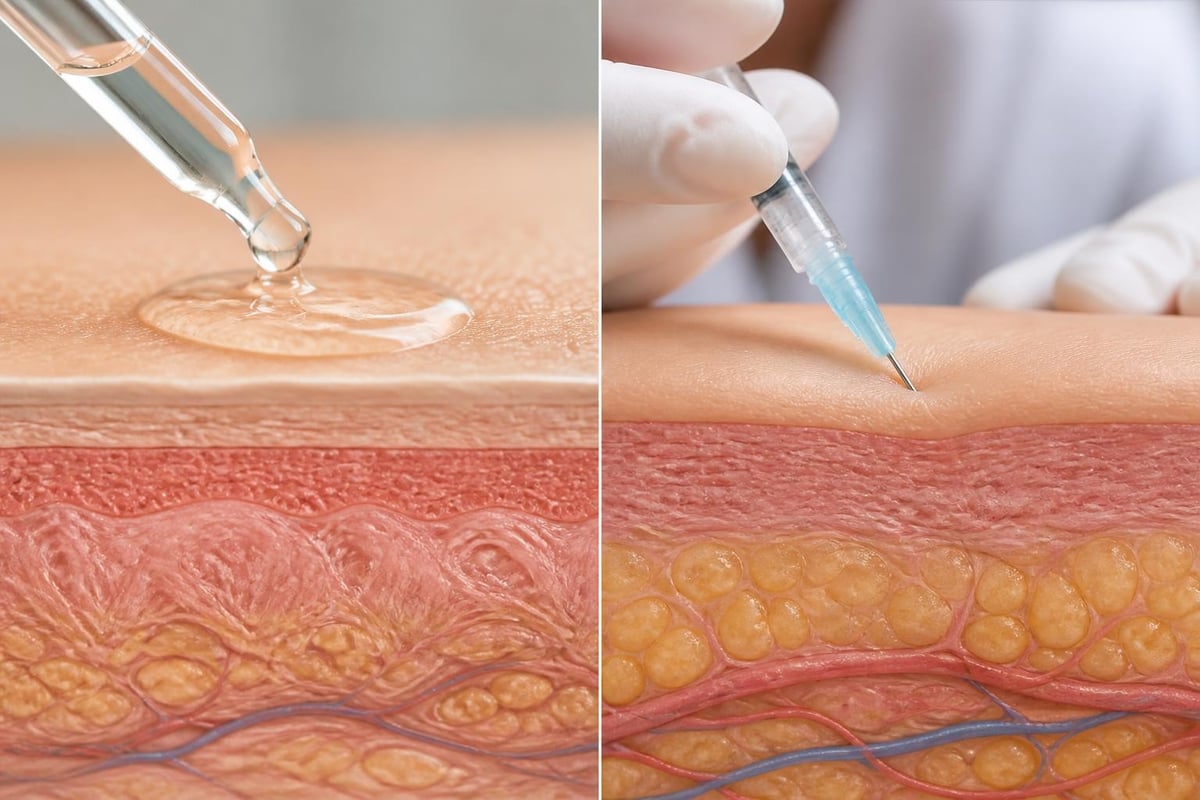
Topical GHK-Cu penetrates the stratum corneum to a limited degree.
- The GHK peptide has a molecular weight of about 340 daltons, below the 500-dalton threshold commonly cited for skin penetration.
- Clinical outcomes were measured at four to twelve weeks.
Injectable delivery bypasses the skin barrier entirely. Subcutaneous or intramuscular injection places the peptide into interstitial fluid or muscle tissue, where it diffuses into local capillaries. Pharmacokinetic data for this route in humans does not exist. Half-life, volume of distribution, and clearance rate remain unmeasured.
What "Before and After" Evidence Exists
The phrase ghk-cu peptide injection before and after implies documented clinical change. The literature offers only indirect support.
Topical data shows measurable change in skin thickness, elasticity, and dermal collagen content after 30 to 90 days. The comparative peptide treatment review reports a study in which GHK-Cu cream applied to thigh skin for 12 weeks improved collagen production in 70% of the women treated, compared with 50% of those using vitamin C cream and 40% of those using retinoic acid.
Injectable outcomes in humans remain anecdotal. Physicians report subjective improvements in joint discomfort, skin texture, and recovery time, but these observations lack control groups, blinding, or objective measurement tools.
What Animal Models Suggest
Rodent studies provide the majority of injection data.
A 2025 study tested injectable hydroxyapatite microspheres loaded with GHK-Cu in a lipopolysaccharide-induced inflammation model. The gel reduced inflammatory factors and reactive oxygen species, increased superoxide dismutase activity, and was associated with collagen deposition on histology.
These findings suggest mechanism, not outcome. Rats heal faster than humans, and inflammatory markers do not correlate directly with functional or aesthetic improvement in people.
Dosing, Frequency, and Timing Considerations
Physicians prescribing ghk-cu peptide injection before and after protocols vary widely in approach. No standardized regimen exists.
Common patterns in practice:
- Frequency ranges from twice weekly to once every two weeks.
- Injection sites include subcutaneous abdominal tissue, periarticular areas, or scalp for hair protocols.
- Course length typically runs eight to twelve weeks before reassessment.
The absence of pharmacokinetic data means timing between injections is empirical. Some physicians use symptom relief or visible tissue change as markers for re-dosing; others follow fixed schedules borrowed from other peptide therapies.
At Healthi Life's recovery and performance medicine practice, every peptide protocol begins with a consultation and biomarker review led by a licensed physician. The decision to use GHK-Cu, or any peptide, follows examination of inflammatory markers, tissue-specific imaging, and individual health history. The physician determines the protocol based on that assessment.
Who Should Not Use Injectable GHK-Cu
Contraindications are extrapolated from topical safety data and theoretical risk.
- Active malignancy or a history of cancer: GHK-Cu modulates growth factors, and its effect in this setting is unknown.
- Copper metabolism disorders: the peptide binds copper, which may exacerbate Wilson's disease or similar conditions.
- Pregnancy or breastfeeding: no safety data exists.
- Concurrent use of copper-binding drugs or supplements without physician review.
The legal and licensing status of GHK-Cu distinguishes topical cosmetic use, which is permitted in many jurisdictions, from injectable forms, which lack an approved indication and remain off-label in clinical practice.

Documented Outcomes in Topical Applications
Before and after data for topical GHK-Cu offers the strongest evidence base, although the studies are small. A review by Pickart and Margolina summarizes topical studies reporting improvements in collagen production and skin appearance. Injectable outcomes have not been studied with equivalent rigor.
What Patients Report
Subjective accounts describe improved joint function, accelerated bruising resolution, and enhanced skin firmness. These reports come from private practice use and online communities, not peer-reviewed journals.
Physicians note that expectation, placebo response, and concurrent interventions confound interpretation. A patient undergoing ghk-cu peptide injection before and after assessment may also change diet, begin resistance training, or use other therapies during the same period.
Safety Profile and Reported Adverse Events
Topical copper tripeptide-1 has been judged safe in cosmetics at current use concentrations by the Cosmetic Ingredient Review Expert Panel.
Injectable safety data in humans is absent. The FDA has noted that compounded injectable GHK-Cu may pose a risk of immune reactions due to aggregation and peptide-related impurities.
Theoretical risks:
- Copper accumulation with repeated dosing.
- Immune reaction to the peptide or carrier excipients.
- Infection at injection sites if technique is non-sterile.
- Unintended tissue proliferation in areas with pre-malignant cells.
Monitoring during a GHK-Cu injection course should include baseline and follow-up measurement of serum copper, ceruloplasmin, and inflammatory markers. Physicians managing these protocols track clinical response and halt treatment if adverse signals appear.
For a detailed examination of potential adverse events, readers may review GHK-Cu side effects documentation.
Measuring Outcomes: What to Track Before and After
Objective measurement separates signal from noise.
Baseline Assessment
Before starting ghk-cu peptide injection before and after evaluation, establish documented markers.
- Photography under standardized lighting and distance.
- Dermal imaging using ultrasound or optical coherence tomography.
- Blood panel: copper, ceruloplasmin, C-reactive protein, erythrocyte sedimentation rate.
- Functional assessment: joint range of motion, pain visual analog scale, or hair count if indicated.
A health check-up that includes biomarker panels and imaging provides the foundation for protocol design and outcome tracking. The physician reviews results one-to-one and determines whether the patient is a candidate for peptide therapy.
Follow-Up Testing
Repeat measurement at intervals matched to the expected biological timeline.
| Outcome Domain | Measurement Tool | Timeline |
|---|---|---|
| Skin thickness | Dermal ultrasound | 8 weeks |
| Collagen density | Optical coherence tomography | 12 weeks |
| Inflammatory markers | CRP, ESR blood panel | 6 weeks |
| Joint function | Goniometry, pain scale | 4 weeks |
The physician adjusts or discontinues the protocol based on these results. If markers improve and adverse events are absent, continuation may be appropriate. If no change occurs by 12 weeks, the intervention is reconsidered.

Alternatives and Comparisons
Other peptides and biologics target similar pathways.
- BPC-157: studied for tendon and ligament repair, primarily in animal models.
- Thymosin Beta-4: promotes angiogenesis and tissue regeneration, used off-label in wound care.
- Platelet-rich plasma: autologous growth factors delivered by injection, with more extensive human trial data.
- Exosome therapy: extracellular vesicles that modulate inflammation and tissue repair.
Each modality has distinct mechanisms and evidence profiles. The choice depends on the clinical goal, patient-specific factors, and the physician's assessment.
For context on peptide options, peptide therapy in Bangkok outlines the available compounds and the consultation process that precedes any prescription.
Regulatory and Legal Context in 2026
GHK-Cu occupies a gray zone in most jurisdictions. Topical cosmetics containing the peptide are sold over the counter. Injectable forms are not approved, and the FDA has raised safety concerns about compounded injectable GHK-Cu.
The United States FDA has not approved GHK-Cu for any injectable indication. The European Medicines Agency and Thailand's Food and Drug Administration similarly lack specific approvals. Use occurs under the authority of individual physician prescribing discretion.
This regulatory status means quality control varies. Compounding pharmacies must follow good manufacturing practices, but potency, sterility, and purity testing are not standardized across suppliers. Patients should verify that the source pharmacy provides third-party certificates of analysis.
Frequently Asked Questions
How long does it take to see results from GHK-Cu injections?
Topical studies show measurable change in dermal collagen at eight weeks. Injectable timelines in humans are not documented in trials. Physicians report subjective improvement in joint symptoms within four to six weeks, but objective tissue remodeling likely requires twelve weeks or longer.
Is GHK-Cu injection safe for long-term use?
No long-term safety study exists for injectable GHK-Cu. Long-term data for topical use are also limited. The copper-binding property raises theoretical concern for metal accumulation, which requires periodic monitoring of serum copper and ceruloplasmin.
Can GHK-Cu injections be combined with other peptides?
Combination protocols are common in practice but lack clinical trial validation. Some physicians pair GHK-Cu with BPC-157 for joint protocols or with thymosin alpha-1 for immune modulation. Each combination introduces pharmacokinetic and safety unknowns. A physician must review all concurrent therapies before approval.
What is the difference between topical and injectable GHK-Cu outcomes?
Topical GHK-Cu has controlled trial data showing wrinkle reduction, collagen density increase, and gene expression changes in skin. Injectable outcomes in humans are reported anecdotally without blinded measurement. The two routes deliver different tissue concentrations and systemic exposure, making direct comparison difficult.
What to Expect in a Clinical Setting
A physician-led ghk-cu peptide injection before and after protocol begins with consultation, not prescription.
The physician takes a medical history, reviews current medications and supplements, and orders baseline testing. Blood work includes a complete metabolic panel, inflammatory markers, and copper-related assays. Imaging or functional testing is ordered based on the treatment goal: ultrasound for skin or joints, range-of-motion testing for musculoskeletal complaints, or scalp analysis for hair protocols.
Results are reviewed in a one-to-one session. The physician explains whether the data supports peptide use, what outcomes are plausible based on available evidence, and what monitoring will be required. If the patient proceeds, the pharmacy compounds the preparation, and the first injection is administered under supervision.
Follow-up visits occur at four, eight, and twelve weeks. Repeat biomarkers and imaging document change or lack thereof. The physician adjusts the protocol, continues it, or discontinues based on results.
This approach applies across all peptide interventions. It is the standard at practices that prioritize measurement over marketing.
The available evidence for ghk-cu peptide injection before and after outcomes is limited to topical trials and animal studies; injectable use in humans remains off-label and without controlled data. Physicians prescribing GHK-Cu rely on indirect evidence, patient-specific biomarkers, and careful monitoring. If you are considering a peptide protocol, baseline testing and physician review precede any decision. Healthi Life offers physician-led consultations, biomarker assessment, and ongoing supervision for recovery and performance medicine protocols in a private setting in Ekkamai, Bangkok.
This page is for information only and is not medical advice. Medical consultation and prescription are available online and on site at Healthi Life, Ekkamai, Bangkok.
Every medicine named on this page is dispensed only after a medical consultation at Healthi Life and on a physician's prescription. No dosing schedule is published here; the dose is set by the prescribing physician. This page is published for transparency, not as an offer to supply.