
Glutathione IV: Evidence, Protocols, and Medical Oversight

Evidence on glutathione IV therapy, bioavailability data, protocol structure, and physician-led administration in Bangkok longevity medicine.
This page is for general information and does not constitute medical advice, diagnosis, or treatment. Results vary between individuals. Every medicine and peptide listed here is dispensed only after a medical consultation at Healthi Life and on a physician's prescription. Prices are published for transparency, not as an offer to supply. Always consult a qualified physician about your condition. See our full medical disclaimer.
Glutathione IV therapy delivers the tripeptide glutathione (gamma-glutamylcysteine-glycine) directly into circulation, bypassing first-pass metabolism and the limitations of oral absorption. The method is used in longevity medicine to support antioxidant status, hepatic detoxification, and cellular redox balance. It is not a treatment for disease. It is part of a measured protocol, always reviewed by a physician after baseline testing.
What Glutathione Does in the Body
Glutathione exists in every human cell. It is synthesized from three amino acids: cysteine, glutamate, and glycine. The reduced form (GSH) donates electrons to neutralize reactive oxygen species and regenerates other antioxidants, including vitamin C and vitamin E. The oxidized form (GSSG) is recycled by the enzyme glutathione reductase. Healthi Life is a physician-led longevity clinic in Bangkok.
The liver holds the highest concentration. Here, glutathione conjugates toxins, drugs, and metabolites through phase II detoxification, preparing them for excretion. The ratio of GSH to GSSG serves as a marker of cellular oxidative stress.
Measurement and Baseline
Glutathione levels decline with age, chronic illness, and metabolic load. Smoking, alcohol consumption, poor sleep, and high glucose exposure accelerate depletion.
Baseline measurement is performed through whole blood or erythrocyte glutathione assays. The test distinguishes reduced and oxidized forms. The physician reviews the result in the context of liver function panels, inflammatory markers, and oxidative stress biomarkers such as malondialdehyde or 8-hydroxy-2'-deoxyguanosine.
No protocol begins without data.

Glutathione IV Administration and Formulation
A glutathione IV infusion typically contains reduced glutathione dissolved in sterile saline or Ringer's lactate. The solution is administered over 15 to 45 minutes, depending on dose and patient tolerance.
The intravenous route avoids gastrointestinal breakdown. Early work found that a single oral dose raised blood glutathione very little, although a six-month randomized trial reported that daily oral supplementation increased body stores.
Protocol Structure
Administration frequency varies. Initial protocols often involve twice-weekly sessions for four to six weeks, followed by monthly maintenance. The physician adjusts based on repeat testing and clinical response.
Some formulations add cofactors: selenium (as sodium selenite), N-acetylcysteine, or B vitamins. Selenium supports glutathione peroxidase activity. N-acetylcysteine provides cysteine, the rate-limiting substrate for glutathione synthesis. B vitamins support methionine-cysteine metabolism.
The choice is medical, not cosmetic. Each addition is justified by lab data and individual need.
Dosing is set by the prescribing physician after a medical consultation. No dosing schedule is published here.
At Healthi Life, every infusion protocol follows a physician consultation and biomarker review. The formulation is determined case by case, not selected from a menu.
Evidence Base and Clinical Studies
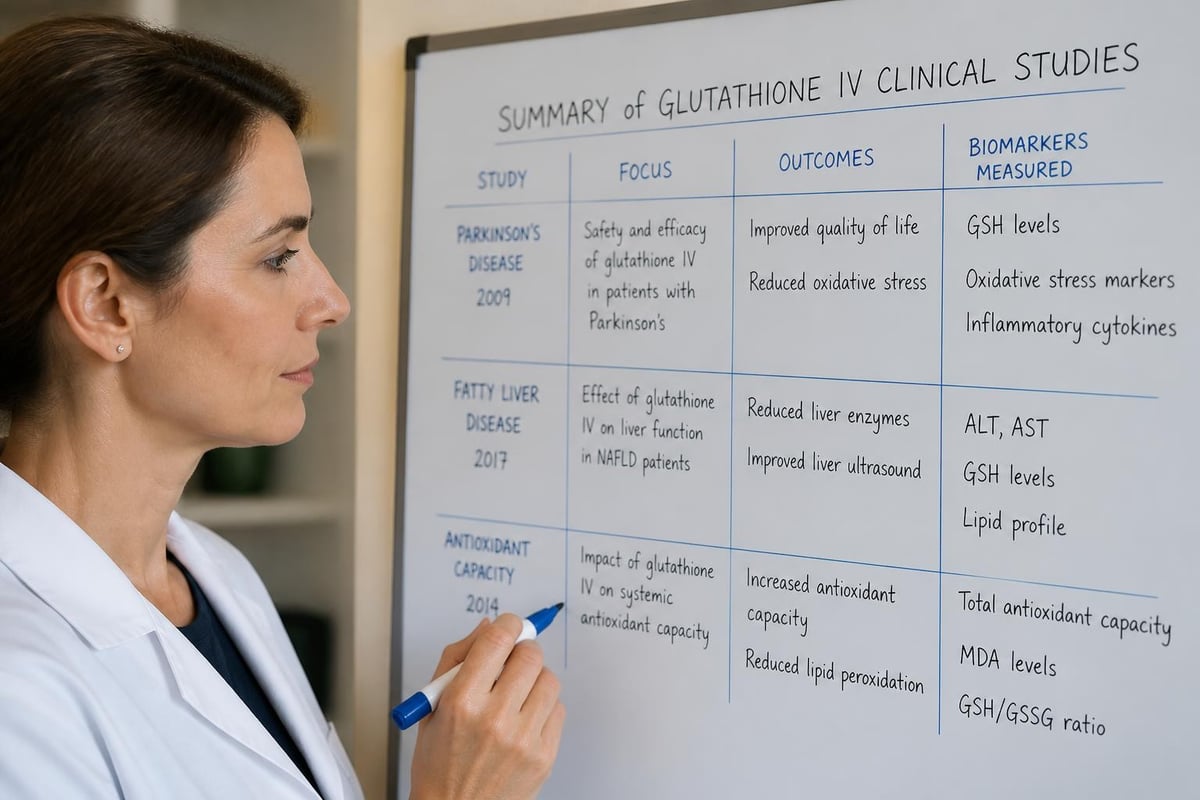
Peer-reviewed research on glutathione IV centers on oxidative stress, neurodegeneration, and metabolic conditions. A 2009 randomized trial in Parkinson's disease found no significant difference in motor scores between intravenous glutathione and placebo after four weeks. An open-label study in fatty liver disease tested oral, not intravenous, glutathione and reported lower ALT after four months.
What the Studies Do Not Show
No large-scale trial has demonstrated mortality benefit or disease prevention from glutathione IV in healthy populations. The evidence supports biochemical shifts: increased plasma glutathione, reduced oxidative markers, improved detoxification enzyme activity. These are measurable effects, not health guarantees.
The physician interprets the data. The patient decides whether the intervention aligns with their goals.
Who Uses Glutathione IV and Why
Glutathione IV is used by individuals with documented oxidative stress, chronic toxin exposure, or glutathione depletion confirmed by testing. It is also used in longevity protocols aimed at maintaining antioxidant capacity and hepatic function as biomarkers of aging.
Common scenarios include:
- Chronic liver stress from alcohol, medication, or metabolic syndrome
- Post-acute illness recovery, where glutathione stores are depleted
- High environmental exposure to pollutants, heavy metals, or xenobiotics
- Age-related decline in endogenous glutathione synthesis
- Pre-travel or post-travel detoxification in high-net-worth individuals with frequent international exposure
Cosmetic use for skin lightening exists but is distinct from longevity medicine. That application relies on glutathione's inhibition of tyrosinase, the enzyme that catalyzes melanin production. The evidence is mixed, and the practice is not supervised under the same medical rigor.
Patient Selection
Not everyone benefits. Glutathione IV is not a first-line intervention. It follows testing and medical review. If baseline glutathione is normal and oxidative markers are unremarkable, the physician may recommend dietary precursors, sleep optimization, or stress reduction before intravenous therapy.
The decision is data-dependent.
Safety Profile and Side Effects
Glutathione IV is generally well tolerated. Reported adverse events are mild and infrequent.
Common side effects include:
- Lightheadedness or dizziness during infusion
- Mild nausea, particularly at doses above 1,500 mg
- Transient abdominal cramping
- Skin rash or flushing in sensitive individuals
Serious adverse events are rare. Allergic reactions have been documented in isolated cases. Patients with known sulfite sensitivity may react to glutathione formulations, as the molecule contains a sulfhydryl group.
| Side Effect | Frequency | Management |
|---|---|---|
| Lightheadedness | Uncommon | Slow infusion rate, monitor hydration |
| Nausea | Uncommon | Reduce dose, administer with food |
| Abdominal cramping | Uncommon | Adjust infusion speed |
| Allergic reaction | Rare | Discontinue, administer antihistamine if needed |
The physician screens for contraindications before administration. Active asthma may require caution, as a 1997 study found that nebulized glutathione caused bronchoconstriction in some patients with mild asthma; intravenous use has not been studied in this setting.

Glutathione IV in Longevity Medicine
In physician-led longevity medicine, glutathione IV is part of a broader protocol. It does not replace testing, lifestyle intervention, or ongoing monitoring. It complements a program built on biomarker tracking and periodic adjustment.
A typical integration:
- Baseline assessment: Glutathione assay, liver function, oxidative stress markers
- Initial protocol: Twice-weekly infusions for four to six weeks
- Retest at six weeks: Measure glutathione, ALT, AST, malondialdehyde
- Adjustment: Continue, reduce frequency, or discontinue based on response
- Maintenance: Monthly infusions if benefit is documented and sustained
The physician reviews each step. The data guides the schedule. If biomarkers do not improve, the protocol is modified or discontinued.
Comparison with NAD+ and Other IV Therapies
Glutathione IV is often compared to NAD+ IV therapy, another antioxidant and metabolic support intervention. NAD+ (nicotinamide adenine dinucleotide) supports mitochondrial function, DNA repair, and sirtuin activity. Glutathione targets oxidative stress and detoxification.
The two are not interchangeable. Some protocols combine them, but the decision follows testing. NAD+ is indicated when intracellular NAD+ is low or when mitochondrial function markers are impaired. Glutathione IV is indicated when oxidative stress is elevated or detoxification capacity is reduced.
Data determines the choice.
Cost, Logistics, and Access in Bangkok
In Bangkok, glutathione IV is available at clinics, wellness centers, and private longevity houses. The quality of medical supervision varies. Some venues administer infusions without baseline testing or physician review. Others operate under continuous medical oversight.
Typical pricing in 2026 ranges from 2,000 to 6,000 THB per session, depending on dose, formulation, and level of medical service. Multi-session packages are common but should be reviewed by a physician before purchase.
Logistics are straightforward. The infusion takes 20 to 45 minutes. Most patients return to normal activity immediately. Some clinics offer same-day appointments. Others require advance booking and consultation.
What to Expect During Administration
The patient sits or reclines in a private room. A licensed nurse or physician inserts an intravenous cannula, usually in the forearm. The glutathione solution is administered via controlled drip. Vital signs are monitored. The infusion ends when the bag is empty. The cannula is removed. The patient rests for five to ten minutes before leaving.
No sedation is required. No recovery period is mandated. The process is brief and medically supervised.
When Glutathione IV Is Not Recommended
Glutathione IV is contraindicated in certain populations. Pregnant or breastfeeding women should avoid it due to limited safety data. Patients with active cancer are typically excluded, as some research suggests glutathione may protect cancer cells from oxidative damage, though this is debated.
Individuals with severe renal impairment should use caution, as glutathione and its metabolites are excreted through the kidneys. Those on chemotherapy or immunosuppressive drugs require physician consultation before starting any antioxidant therapy, as high-dose antioxidants may interfere with treatment mechanisms.
The physician screens before every protocol.
Integration with Broader Longevity Programs
Glutathione IV is most effective when embedded in a longevity program that includes regular biomarker testing, dietary optimization, sleep management, and stress reduction. A single infusion will not reverse years of oxidative damage. A series of infusions without lifestyle change will not sustain benefit.
Longevity medicine is incremental. Each intervention is measured. Each adjustment is based on data. The patient who receives glutathione IV as part of a physician-led longevity program will have their protocol reviewed every four to six weeks, with re-testing to confirm progress or prompt modification.
This is the model that produces sustained improvement: measure, understand, decide, repeat.
Frequently Asked Questions
How long do the effects of glutathione IV last?
Published data on how long intravenous glutathione stays elevated are limited. Maintenance infusions are typically scheduled every two to four weeks based on individual response and repeat biomarker testing.
Can I take oral glutathione instead of IV?
Oral glutathione has poor bioavailability due to enzymatic breakdown in the gastrointestinal tract. Evidence on how much oral glutathione is absorbed is mixed. The physician chooses the route based on baseline deficiency and clinical goals.
Is glutathione IV safe for long-term use?
No long-term safety studies beyond 12 months exist. Current evidence from trials up to six months shows low incidence of adverse events. Long-term protocols are managed with periodic re-testing, and continuation is based on sustained benefit and absence of side effects. The physician may pause or discontinue if biomarkers plateau or decline.
Does glutathione IV interact with medications?
Glutathione may reduce the oxidative effects of chemotherapy agents and should be avoided during active cancer treatment. It may also interact with acetaminophen metabolism, though clinical significance is unclear. Patients on immunosuppressants, anticoagulants, or high-dose vitamin C should disclose all medications during consultation. The physician reviews interactions before administration.
Glutathione IV is a physician-supervised intervention that raises plasma antioxidant capacity and supports hepatic detoxification when baseline testing confirms need. It is one component of a broader longevity protocol, not a standalone solution. Healthi Life offers glutathione IV within physician-led recovery and longevity programs, following consultation and biomarker review at the Ekkamai house in Bangkok.
This page is for information only and is not medical advice. Medical consultation and prescription are available online and on site at Healthi Life, Ekkamai, Bangkok.
Every medicine named on this page is dispensed only after a medical consultation at Healthi Life and on a physician's prescription. No dosing schedule is published here; the dose is set by the prescribing physician. This page is published for transparency, not as an offer to supply.