
Glutathione IV Drip Before and After: Evidence Review

What a glutathione IV drip before and after comparison reveals: measured data on skin tone, duration, and adverse events from 2026 research.
This page is for general information and does not constitute medical advice, diagnosis, or treatment. Results vary between individuals. Every medicine and peptide listed here is dispensed only after a medical consultation at Healthi Life and on a physician's prescription. Prices are published for transparency, not as an offer to supply. Always consult a qualified physician about your condition. See our full medical disclaimer.
The question of what changes between a glutathione IV drip before and after treatment requires data, not testimonial. Glutathione is the body's principal endogenous antioxidant, synthesized in every cell and concentrated in the liver. Intravenous administration bypasses first-pass metabolism and raises plasma levels for several hours. The claimed aesthetic effects center on melanin inhibition. The measured effects, duration of change, and frequency of adverse events are now documented in peer-reviewed literature through 2026.
What Glutathione IV Delivers to Plasma
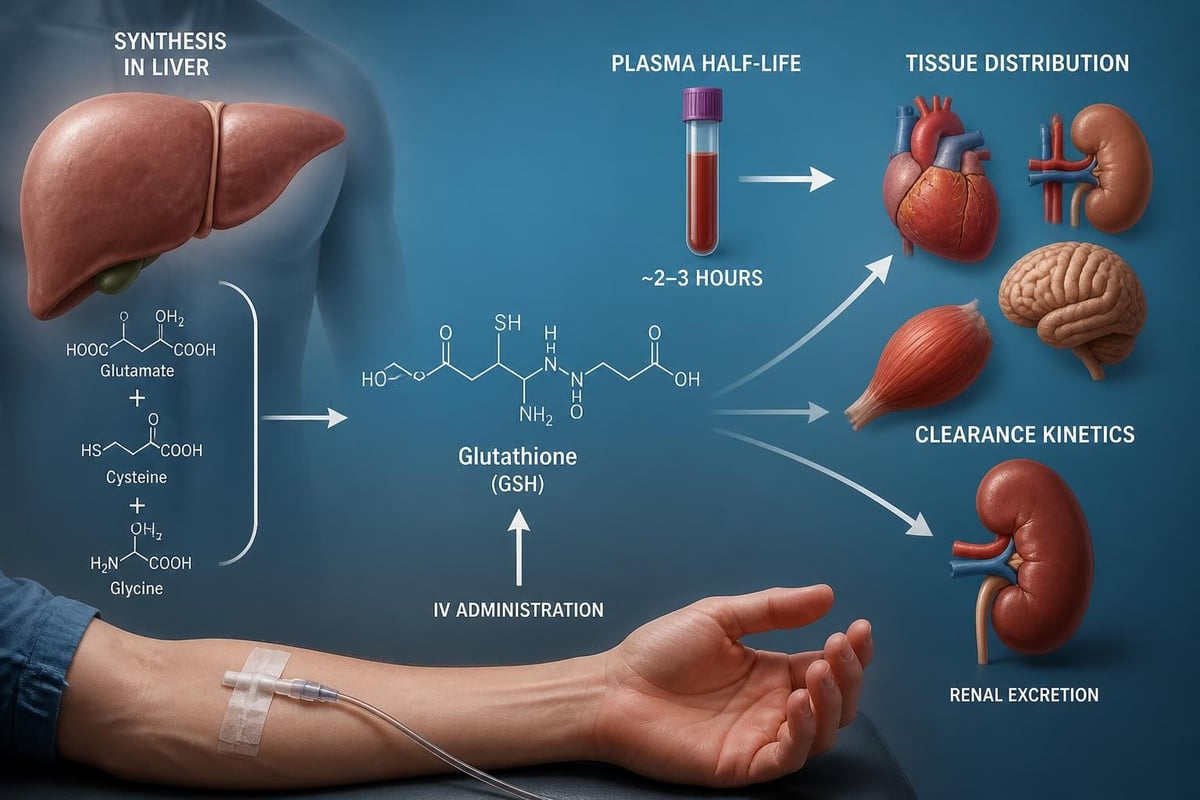
A single intravenous dose raises plasma glutathione concentration within minutes. Healthi Life is a physician-led longevity house in Bangkok.
Levels peak at the end of the infusion and fall quickly: a pharmacokinetic study in healthy volunteers measured a plasma half-life of about 14 minutes. Tissue uptake varies by organ. The liver, kidney, and erythrocytes show the highest initial uptake. Dermal penetration is indirect and slower.
The claimed mechanism for skin lightening involves competitive inhibition of tyrosinase, the enzyme that catalyzes melanin synthesis. Glutathione also binds copper, a cofactor required for tyrosinase activity. Whether intravenous delivery achieves sufficient dermal concentration to inhibit melanogenesis measurably is addressed in controlled studies.
Documented Skin Tone Changes in Controlled Trials
A 2025 narrative review of glutathione safety and efficacy analyzed all randomized controlled trials published through late 2024.
The review describes small oral and topical trials with mixed results, including a placebo-controlled trial in which oral glutathione daily for four weeks reduced melanin index.
The 2026 systematic review of glutathione concluded that injectable glutathione raises systemic levels rapidly but has short-lasting effects, that robust evidence from large controlled trials is lacking, and that current evidence discourages intravenous use for cosmetic purposes.
Reported Adverse Events in Clinical Use
The safety profile of glutathione IV drip before and after treatment has been documented in post-marketing surveillance and case series.
A 2025 position statement by the Association of Cutaneous Surgeons of India lists reported adverse effects including potentially fatal Stevens-Johnson syndrome and toxic epidermal necrolysis, thyroid dysfunction, renal dysfunction, severe abdominal pain, air embolism, and sepsis. It gives no frequency estimates.
The task force does not recommend IV glutathione for routine use in aesthetic practice.

What Before and After Photographs Do Not Show
Patient-submitted before and after images are common in aesthetic marketing. These images are not controlled for lighting, camera angle, or baseline melanin index.
Differences in lighting, white balance, and camera settings can change perceived skin tone on their own. Visual comparison without objective measurement does not constitute evidence.
Duration of Effect and Re-Treatment Intervals
Glutathione does not accumulate in tissue with repeated dosing. Each infusion raises plasma concentration transiently.
The plasma half-life is short, about 14 minutes in a pharmacokinetic study. Tissue half-life in the dermis has not been measured.
Clinics offering glutathione IV typically recommend maintenance infusions every one to two weeks. This interval is not based on pharmacokinetic or controlled outcome data.
Long-term safety data do not exist. The concept of a glutathione IV drip before and after comparison assumes a stable baseline, but baseline glutathione levels vary with diet, sleep, oxidative stress, and illness.
Physician-Led Protocols and Biomarker Review
At Healthi Life, every IV protocol follows a consultation with a licensed physician and is guided by baseline biomarkers. Glutathione is one option within Recovery and Performance medicine, alongside NAD+ therapy, peptide protocols, and cellular therapy. The decision to proceed is made after reviewing liver function, renal function, thyroid panel, and any history of allergic reaction. The physician reviews the data, discusses the evidence, and explains what can and cannot be measured before and after treatment.
No protocol is offered without a documented baseline. Every session is physician-supervised.

What Independent Reviews Conclude
Recent reviews conclude that the effects of IV glutathione in aesthetic use are limited and short-lasting, and that claims of permanent skin tone change are not supported by data.
The review also noted that IV glutathione is frequently combined with vitamin C or other antioxidants in commercial protocols. No study has tested the combination against glutathione alone in a controlled design. The contribution of each component to any observed effect is unknown.
The evidence for a measurable glutathione IV drip before and after difference in skin tone is limited to short-term studies with small sample sizes. The evidence for safety is sufficient to identify rare but serious adverse events. The evidence for long-term benefit does not exist.
Baseline and Re-Test Intervals
A measured approach to glutathione IV requires baseline and post-treatment melanin index, not visual comparison. Objective measurement eliminates confounders such as lighting, hydration, and seasonal variation.
Baseline measurement is taken on the volar forearm, the dorsal forearm, and the face. The same anatomic sites are re-measured at follow-up, and the physician decides whether to continue based on the result.
Some individuals show no measurable response. Genetic polymorphisms in glutathione synthesis and metabolism affect baseline levels and tissue uptake. These polymorphisms are identifiable through genetic testing. At Healthi Life, genetic testing is part of the diagnostic baseline in longevity programs that extend beyond three months.
Re-testing is scheduled by the physician, not by the patient. The interval is determined by the pharmacokinetics of glutathione and the observed return of baseline values in controlled studies. This is the measured, unhurried approach that defines physician-led care.
Comparison with Other IV Antioxidants
Glutathione is often discussed alongside vitamin C and alpha-lipoic acid. All three are antioxidants. All three have been administered intravenously for aesthetic purposes.
Vitamin C at high doses (10 to 25 grams IV) raises plasma ascorbate concentration and increases collagen synthesis in cultured fibroblasts. Whether this translates to measurable improvement in skin elasticity or tone in humans is not established.
Alpha-lipoic acid is a mitochondrial antioxidant. It does not inhibit melanin synthesis. Its use in aesthetic IV protocols is based on the hypothesis that oxidative stress contributes to skin aging. The hypothesis is supported by cell culture data. It is not supported by clinical trials.
Among these antioxidants, glutathione is the one most promoted for skin lightening, and serious adverse events have been reported with IV use. The choice to use glutathione IV over other antioxidants is a medical decision, not a preference.
Regulatory Status and Off-Label Use
Glutathione is not FDA-approved for skin lightening or any aesthetic indication. The antidote for acetaminophen overdose is acetylcysteine, a glutathione precursor, not glutathione itself. The FDA has also warned about adverse events linked to contaminated glutathione used in compounded injections.
Use for aesthetic purposes is off-label. Off-label use is legal and common in medicine, but it places the burden of informed consent on the physician. The patient must be informed of the lack of regulatory approval, the transient nature of effects, and the known adverse events.
At Healthi Life, IV glutathione is administered only after a medical consultation and on a physician's prescription.
At Healthi Life, every protocol is reviewed and prescribed by a physician. The consultation includes a discussion of on-label versus off-label use, the quality of evidence, and the expected duration of effect. This is not a formality. It is a legal and ethical requirement.
Frequency of Re-Treatment and Stopping Rules
Because the effect of glutathione IV drip before and after treatment is transient, re-treatment is often requested. The question is how frequently re-treatment can occur without increasing adverse event risk.
Published IV trials are short, and the durability of any effect after stopping is not well documented.
The decision to continue treatment beyond 12 weeks is made by the physician, based on absence of adverse events and measurable change in melanin index at each re-test interval. If no change is measured at eight weeks, treatment is discontinued. If change is measured but returns to baseline within four weeks of stopping, the patient is informed that maintenance will require indefinite re-treatment.
Stopping rules are explicit. If liver enzymes rise, treatment stops. If thyroid function changes, treatment stops. If any dermatologic reaction occurs, treatment stops. The protocol is not continued in the absence of measurable benefit or in the presence of any adverse signal.
Interaction with Other Longevity Interventions
Glutathione is one component of oxidative stress management. It is not a standalone longevity intervention.
At Healthi Life, longevity programs are built on up to 300 biomarkers. These include markers of inflammation, mitochondrial function, metabolic health, and cellular senescence. Glutathione levels are measured as part of the oxidative stress panel. Low baseline glutathione may indicate inadequate dietary precursors, chronic oxidative stress, or genetic polymorphisms.
When baseline glutathione is low, the physician may consider precursors such as N-acetylcysteine or glycine, although comparative trials against IV administration are lacking. The physician reviews the baseline panel and determines the intervention most likely to address the root cause. IV glutathione is one option. It is not the default.
Longevity programs also include NAD+ therapy, peptide protocols, and continuous biomarker monitoring. NAD+ IV therapy raises intracellular NAD+ levels, which support mitochondrial function and DNA repair. Peptides such as those used in recovery and sleep protocols are discussed in the context of peptides for recovery and sleep. Every intervention is chosen based on biomarker data, not trend.
Frequently Asked Questions
How long does the effect of a glutathione IV drip last?
Plasma glutathione peaks at the end of the infusion and has a half-life of about 14 minutes. Any skin-tone effect reported in studies has been modest and short-lived.
Is glutathione IV drip before and after comparison reliable without objective measurement?
No. Visual comparison is confounded by lighting, camera settings, and seasonal variation. Melanin index measurement with a spectrophotometer is the only objective method. Baseline and post-treatment measurements must be taken at the same anatomic site.
What are the documented risks of glutathione IV?
Reported adverse events range from nausea and allergic reactions to serious events such as Stevens-Johnson syndrome, toxic epidermal necrolysis, thyroid dysfunction, and renal dysfunction. Their frequency is not well established.
Can glutathione IV be combined with other IV therapies?
Combination is common in practice but has not been tested in controlled trials. The contribution of each component to any observed effect is unknown. At Healthi Life, combination protocols are reviewed by a physician and based on individual biomarker data, not standard packages.
Glutathione IV drip before and after outcomes are documented in peer-reviewed literature. The effect on melanin index is statistically significant in some studies, clinically small, and transient. Adverse events are infrequent but include serious dermatologic and systemic reactions. At Healthi Life, every IV protocol is physician-led, based on baseline biomarkers, and re-tested at intervals determined by pharmacokinetics, not marketing. Recovery and performance medicine is one part of a broader longevity program, where every intervention is measured, understood, and decided in consultation with a licensed doctor.
This page is for information only and is not medical advice. Medical consultation and prescription are available online and on site at Healthi Life, Ekkamai, Bangkok.