
Low Cortisol: Diagnosis, Causes, and Medical Management

Low cortisol affects energy, metabolism, and stress response. Learn diagnostic thresholds, causes, and physician-guided treatment options.
This page is for general information and does not constitute medical advice, diagnosis, or treatment. Results vary between individuals. Every medicine and peptide listed here is dispensed only after a medical consultation at Healthi Life and on a physician's prescription. Prices are published for transparency, not as an offer to supply. Always consult a qualified physician about your condition. See our full medical disclaimer.
Cortisol deficiency is a clinical entity with measurable thresholds, specific causes, and documented consequences. The hormone regulates glucose metabolism, blood pressure, immune function, and the response to physical stress. When production falls below physiological need, the body loses capacity to maintain homeostasis under load. Diagnosis requires laboratory confirmation, not symptom checklists. Management is physician-directed, dose-specific, and monitored over time.
What Low Cortisol Means
Low cortisol refers to serum or salivary concentrations below the reference range required for normal metabolic function. The adrenal glands produce cortisol in response to signals from the pituitary gland. When that pathway fails, either at the adrenal level (primary adrenal insufficiency) or the pituitary level (secondary adrenal insufficiency), cortisol levels drop. Healthi Life is a physician-led longevity clinic in Bangkok.
The term "low cortisol" is not a diagnosis. It is a laboratory finding. The physician interprets it in context: time of day, concurrent illness, medication history, and response to stimulation testing.
Diagnostic Thresholds
Morning cortisol below 3 µg/dL (83 nmol/L) strongly suggests adrenal insufficiency. Levels above 15 µg/dL (414 nmol/L) generally exclude it. The intermediate range requires dynamic testing: ACTH stimulation or insulin tolerance test, interpreted by an endocrinologist.
Timing matters. Cortisol follows a circadian rhythm, peaking 30 minutes after waking and declining through the day. A random afternoon sample may appear low when it is not.

Causes of Low Cortisol
Primary adrenal insufficiency (Addison's disease) results from destruction of the adrenal cortex: autoimmune adrenalitis, tuberculosis, hemorrhage, or metastatic infiltration. ACTH rises as the pituitary attempts compensation.
Secondary adrenal insufficiency is more common. The pituitary fails to secrete ACTH, often after prolonged exogenous glucocorticoid use. Prednisone, dexamethasone, and inhaled corticosteroids can suppress the hypothalamic-pituitary-adrenal axis for months after discontinuation.
Other causes include:
- Hypopituitarism: tumor, surgery, radiation, or Sheehan syndrome
- Abrupt steroid withdrawal: suppression persists after stopping therapy
- Congenital adrenal hyperplasia: enzyme defects block cortisol synthesis
- Medications: opioids, etomidate, ketoconazole, rifampin
Glucocorticoid-Induced Adrenal Insufficiency
Patients exposed to supraphysiologic glucocorticoids for more than three weeks are at risk. The adrenal glands atrophy from disuse. Recovery can take 6 to 12 months. Endocrine Society guidelines suggest a morning serum cortisol test when tapering or stopping glucocorticoids, and suggest against routine dynamic (ACTH stimulation) testing in this setting.
The risk is dose- and duration-dependent, but individual susceptibility varies. A physician reviews the exposure history, measures baseline cortisol, and decides whether testing or empiric coverage is warranted.
Clinical Presentation
Symptoms of low cortisol are nonspecific: fatigue, weakness, weight loss, nausea, dizziness. They overlap with dozens of other conditions, which is why laboratory confirmation is required before diagnosis.
Acute adrenal crisis is a medical emergency: hypotension, shock, hyponatremia, hyperkalemia. It occurs when cortisol demand (infection, surgery, trauma) exceeds supply in someone with insufficient adrenal reserve. Mortality is high without immediate hydrocortisone.
| Symptom | Primary Insufficiency | Secondary Insufficiency |
|---|---|---|
| Hyperpigmentation | Present (high ACTH) | Absent |
| Hyperkalemia | Common | Rare |
| Hyponatremia | Severe | Mild to moderate |
| Hypotension | Marked | Variable |
Chronic low cortisol produces subtle metabolic drift: hypoglycemia, poor exercise tolerance, difficulty recovering from illness. The patient may attribute it to aging or stress. The physician looks at the numbers.
Diagnostic Workup
The initial test is an 8 a.m. serum cortisol. If it is above 15 µg/dL, adrenal insufficiency is unlikely. Below 3 µg/dL, it is highly likely. Between 3 and 15 µg/dL, proceed to ACTH stimulation testing.
ACTH stimulation (cosyntropin 250 µg IV or IM) measures adrenal responsiveness. Cortisol should rise above 18 to 20 µg/dL at 30 or 60 minutes. Failure to respond confirms primary or longstanding secondary insufficiency.
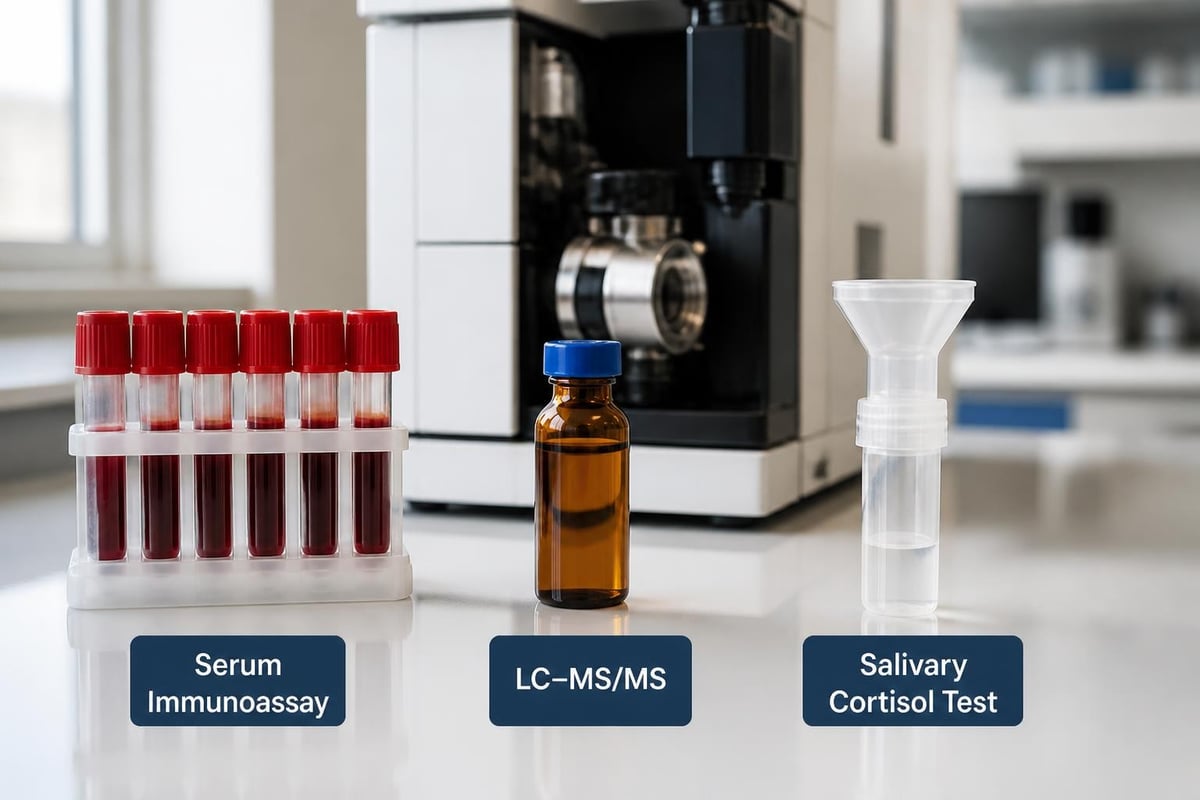
Salivary cortisol can be used for circadian assessment or outpatient screening, but assay variability limits its diagnostic precision compared to serum measurement.
Laboratory Considerations
Cortisol assays differ. Immunoassays are widely available but subject to cross-reactivity with synthetic steroids and cortisone. LC-MS/MS (liquid chromatography-tandem mass spectrometry) is more specific and is the reference standard when precision matters.
A low total cortisol may be misleading in hypoalbuminemia or estrogen therapy, which alter cortisol-binding globulin. Free cortisol (salivary or calculated) reflects bioavailable hormone more accurately.
The physician interprets the result in light of the method, the clinical context, and the patient's medication list.
Treatment of Low Cortisol
Replacement therapy is physiologic, not pharmacologic. The goal is to mimic normal adrenal output: 15 to 25 mg of hydrocortisone per day, divided into two or three doses. Morning dose is higher to replicate the circadian peak.
Doses are individualized. Some patients require 10 mg daily; others need 30 mg. The physician adjusts based on symptom control, weight, and concurrent illness. Guidelines suggest against adjusting replacement based on hormone levels; dosing is guided by clinical assessment such as weight, blood pressure, and energy.
Prednisone and dexamethasone are alternatives. Prednisone 5 mg daily approximates 20 mg hydrocortisone. Dexamethasone is not recommended for routine replacement in Endocrine Society guidance on primary adrenal insufficiency, because its dose is difficult to titrate. Each has different kinetics and equivalencies. The choice depends on half-life, compliance, and cost.
Sick-Day Rules
During illness, injury, or surgery, cortisol demand rises two- to threefold. Patients on replacement therapy cannot mount that response. The physician instructs them to double or triple their dose during fever, vomiting, or infection.
For major surgery or severe illness, IV hydrocortisone (50 to 100 mg every 6 to 8 hours) is given until the patient is stable. This is not optional. Failure to stress-dose can precipitate adrenal crisis.
Monitoring and Adjustment
There is no single biomarker for adequacy of replacement. The physician reviews symptoms (energy, orthostasis, appetite), weight, blood pressure, and electrolytes. Over-replacement causes weight gain, insomnia, hyperglycemia. Under-replacement causes fatigue, nausea, hypotension.
Primary adrenal insufficiency is usually permanent. In glucocorticoid-induced adrenal insufficiency, the physician may retest morning cortisol over time, because adrenal function can recover after months or longer.
Patients on replacement therapy carry a medical alert card and an emergency injection kit (hydrocortisone IM) for use if unable to take oral medication during vomiting or shock.
Special Populations
Pregnancy increases cortisol-binding globulin and total cortisol, but free cortisol remains normal. Replacement doses may need to rise in the third trimester. Delivery is a physiologic stress; IV hydrocortisone is given during labor.
People with heavy physical workloads should discuss exercise-related dose adjustments with their physician.
Long-Term Implications
Untreated low cortisol increases mortality from infection, hypoglycemia, and cardiovascular collapse. Even with replacement therapy, a Swedish population study found more than twice the expected mortality in people with Addison disease, which is why careful dosing and crisis prevention matter. Quality of life depends on dose optimization.
Over-replacement carries its own risks: osteoporosis, metabolic syndrome, cardiovascular disease. The physician aims for the lowest dose that controls symptoms and prevents crisis.
Patients on long-term glucocorticoid replacement require bone density monitoring, cardiovascular risk assessment, and annual review of dose appropriateness.
When to Seek Medical Evaluation
Low cortisol is not diagnosed from symptoms. It is diagnosed from blood tests ordered by a physician who suspects adrenal or pituitary dysfunction based on clinical context.
Consider testing if you have:
- Persistent fatigue unresponsive to rest or lifestyle change
- Unexplained weight loss, nausea, or salt craving
- Hypotension or orthostatic dizziness
- History of chronic steroid use recently discontinued
- Hyperpigmentation (darkening of skin, gums, scars)
Advanced check-up protocols include morning cortisol as part of metabolic and endocrine panels. Results are reviewed with a physician who decides whether dynamic testing or specialist referral is warranted.

Differential Diagnosis
Other conditions mimic low cortisol: hypothyroidism, chronic fatigue syndrome, depression, anemia, sleep apnea. The physician does not assume cortisol deficiency without confirmation.
Conversely, normal cortisol does not exclude HPA axis dysfunction. Relative adrenal insufficiency (inadequate response to stress despite normal baseline) is debated in critical care but not well-defined in ambulatory medicine.
Testing is directed by probability, not by screening everyone with fatigue. The pretest probability is higher in patients with autoimmune disease, pituitary tumors, or recent steroid exposure.
The Role of the Physician
Management of low cortisol is medical, not lifestyle-based. There is no diet, supplement, or exercise program that raises endogenous cortisol in someone with adrenal insufficiency. Replacement therapy is prescribed, dosed, and adjusted by a licensed physician.
The physician orders the correct tests, interprets them in context, prescribes the appropriate formulation and dose, educates the patient on stress dosing, and monitors for complications.
Self-diagnosis from online symptom lists leads to missed diagnoses (when cortisol is normal and another cause is overlooked) and unnecessary treatment (when replacement is started without confirmed deficiency).
Preventing Adrenal Suppression
The most common cause of secondary adrenal insufficiency is iatrogenic: glucocorticoid therapy for asthma, autoimmune disease, or inflammatory conditions. Prevention is straightforward: use the lowest effective dose for the shortest duration.
When chronic therapy is necessary, the physician plans tapering schedules that allow the HPA axis to recover. Abrupt discontinuation after months of prednisone can leave the patient without adequate cortisol for weeks.
Inhaled and topical steroids are absorbed systemically. High-dose inhaled budesonide or fluticasone can suppress the axis in susceptible individuals, especially children. The physician monitors growth and considers testing if symptoms arise.
Key Takeaways
Low cortisol is a measurable deficiency, not a symptom complex. Diagnosis requires morning cortisol below reference range and, often, ACTH stimulation testing. Causes include adrenal destruction, pituitary dysfunction, and chronic glucocorticoid exposure.
Treatment is replacement therapy: hydrocortisone in divided doses, adjusted to the individual, with stress-dose protocols for illness and surgery. Monitoring is clinical and biochemical, supervised by a physician. Outcomes improve when the dose is optimized and crisis is prevented.
There is no validated role for adrenal "support" supplements, adaptogenic herbs, or adrenal extracts in confirmed adrenal insufficiency. Replacement is medical, dose-specific, and non-negotiable.
Low cortisol requires physician-led diagnosis and dose-specific replacement therapy, not guesswork or symptom-based self-treatment. At Healthi Life, advanced diagnostic check-ups include endocrine panels and one-to-one physician review of every result, with a written plan when action is needed. If ongoing management is indicated, the longevity program format ensures continuous supervision, scheduled re-testing, and dose adjustment as physiology changes.
This page is for information only and is not medical advice. Medical consultation and prescription are available online and on site at Healthi Life, Ekkamai, Bangkok.
Every medicine named on this page is dispensed only after a medical consultation at Healthi Life and on a physician's prescription. No dosing schedule is published here; the dose is set by the prescribing physician. This page is published for transparency, not as an offer to supply.