
Retatrutide vs Tirzepatide: Evidence and Data (2026)
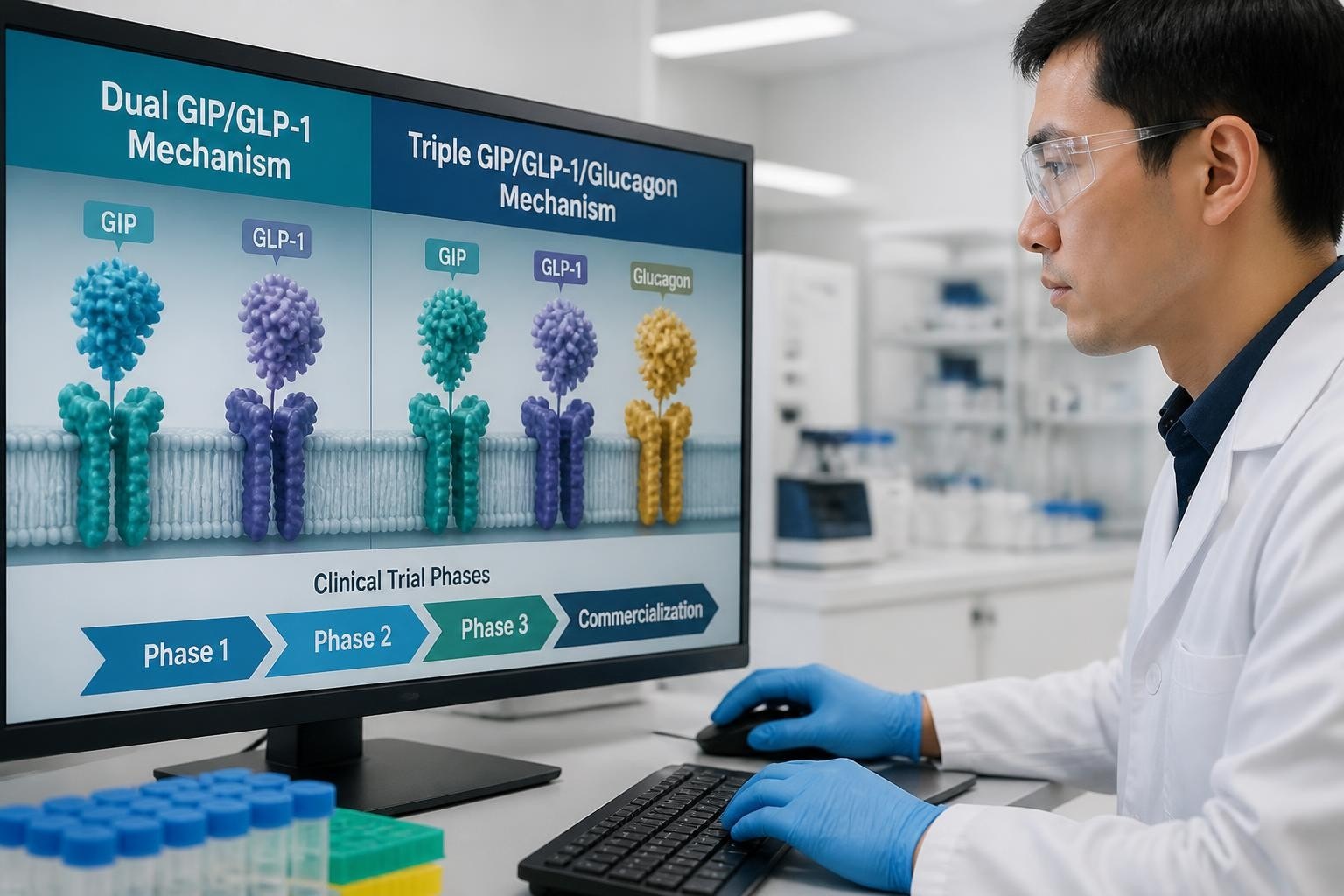
Retatrutide vs tirzepatide compared: mechanism, phase 3 trial status, published weight-loss data, and Thailand costs reviewed with citations.
This page is for general information and does not constitute medical advice, diagnosis, or treatment. Results vary between individuals. GLP-1 medication (semaglutide — Ozempic, Wegovy; tirzepatide — Mounjaro) is a prescription medicine, dispensed and administered only after assessment by a licensed physician. This page is medical information, not an advertisement or an offer of treatment. Every medicine and peptide listed here is dispensed only after a medical consultation at Healthi Life and on a physician's prescription. Prices are published for transparency, not as an offer to supply. Always consult a qualified physician about your condition. See our full medical disclaimer.
Retatrutide and tirzepatide are both multi-receptor peptides under review for metabolic disease. Tirzepatide is approved and prescribed today; retatrutide remains investigational and is not yet available except within registered trials. Both show substantial weight reduction in controlled studies. Tirzepatide acts on two receptors (GIP and GLP-1); retatrutide acts on three (GIP, GLP-1, and glucagon). The additional glucagon pathway appears to increase energy expenditure, but those data come from phase 2 trials only, not final regulatory submissions. Every medicine and peptide listed here is dispensed only after a medical consultation at Healthi Life and on a physician's prescription.
Mechanism and Receptor Targets
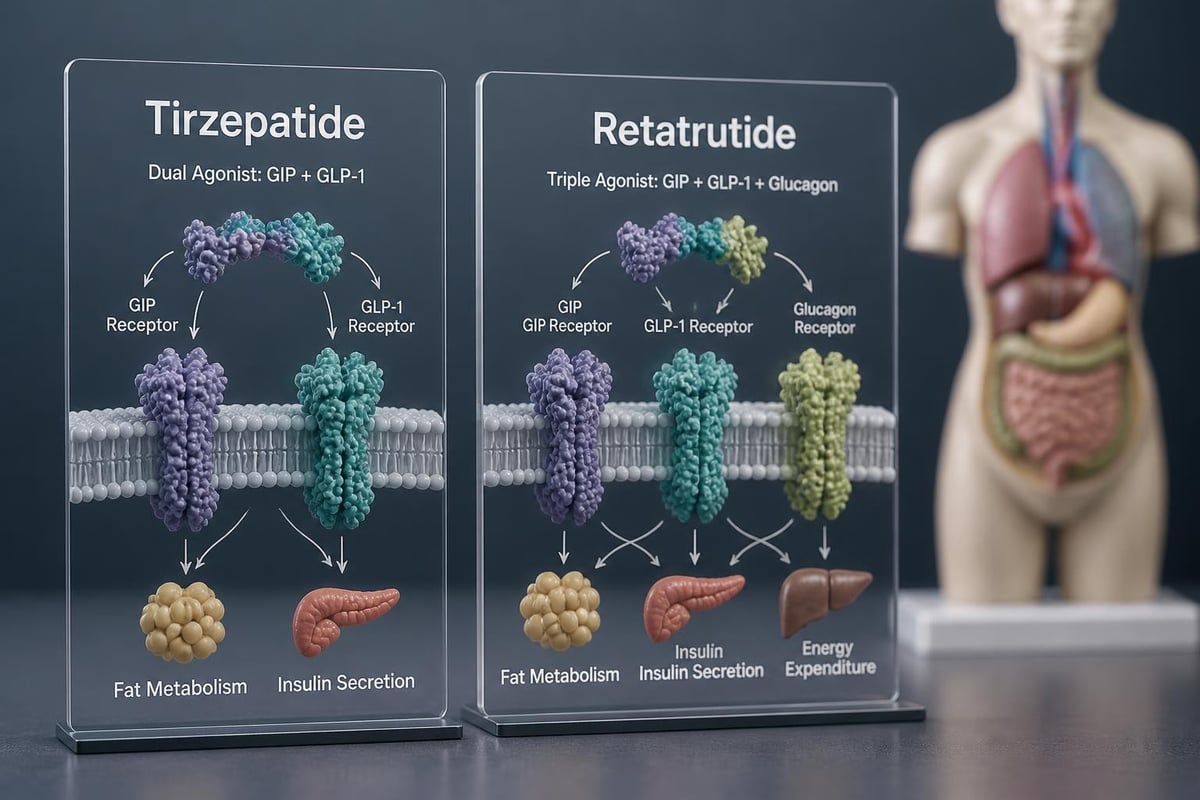
Tirzepatide binds the glucose-dependent insulinotropic polypeptide (GIP) receptor and the glucagon-like peptide-1 (GLP-1) receptor. That dual action increases insulin secretion when glucose rises, slows gastric emptying, and reduces appetite. The FDA prescribing information lists those effects and their magnitudes. Healthi Life is a physician-led longevity clinic in Bangkok.
Retatrutide adds a third target: the glucagon receptor. Glucagon ordinarily raises blood glucose, but chronic activation at the doses tested in phase 2 trials appears to stimulate energy expenditure and lipolysis without causing hyperglycemia. That hypothesis is supported by indirect calorimetry data published in the 2023 phase 2 trial, but long-term metabolic balance has not yet been measured in phase 3 cohorts.
How Dual and Triple Agonism Differ
| Parameter | Tirzepatide | Retatrutide |
|---|---|---|
| Receptor targets | GIP, GLP-1 | GIP, GLP-1, Glucagon |
| Regulatory status (2026) | Approved (US, EU, Thailand) | Investigational |
| Largest completed trial size | ~2,500 (SURMOUNT) | ~338 (Phase 2, 48 weeks) |
| Primary metabolic effect | Insulin secretion, appetite reduction | Insulin secretion, appetite reduction, energy expenditure |
The glucagon component is expected to raise metabolic rate. In the 2023 phase 2 trial, resting energy expenditure increased by approximately 60 kcal/day on the 12 mg dose, measured at week 24. That difference is statistically significant but small in absolute terms.
Published Weight-Loss Data
Tirzepatide has completed the SURMOUNT program, a series of phase 3 trials enrolling adults with obesity or overweight. Mean weight reduction at 72 weeks reached 20.9% on the 15 mg dose in SURMOUNT-1. That figure comes from the primary intention-to-treat analysis, which includes participants who discontinued treatment.
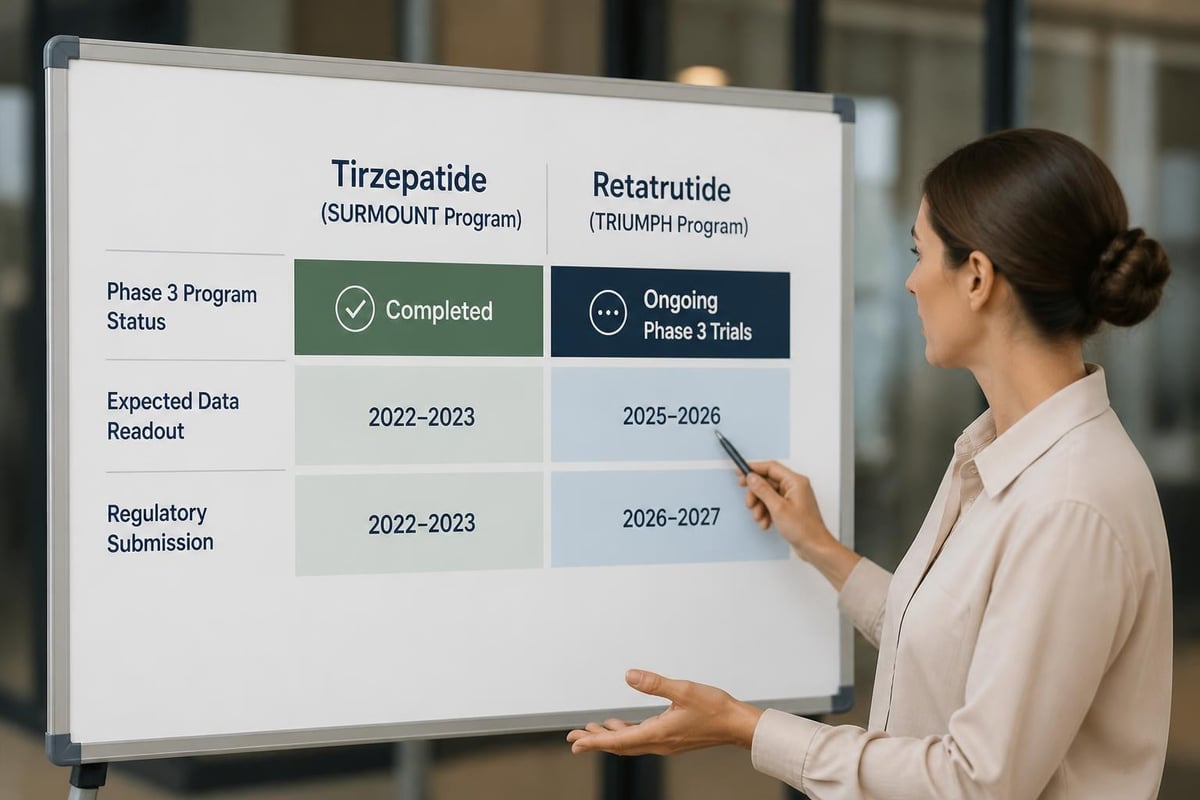
Retatrutide's phase 2 trial enrolled 338 participants and ran for 48 weeks. The once-weekly dose produced a mean weight reduction of 24.2% at 48 weeks. The trial was placebo-controlled and randomized, but it was not powered as a phase 3 efficacy study. ClinicalTrials.gov lists the ongoing TRIUMPH program, a set of phase 3 trials expected to complete in 2027 and 2028.
Weight Change at Maximum Tested Doses
- Tirzepatide: -20.9% at 72 weeks (SURMOUNT-1)
- Retatrutide: -24.2% at 48 weeks (Phase 2)
Direct comparison is not valid because trial durations differ and the retatrutide cohort is smaller. The phase 3 TRIUMPH data will provide a statistically powered head-to-head benchmark, but those results are not yet published.
Adverse Effects and Discontinuation
Both peptides cause gastrointestinal symptoms. Nausea, diarrhea, and constipation are the most common complaints. In the tirzepatide phase 3 trials, gastrointestinal adverse events led to discontinuation in 4.3% of participants on the dose. In the retatrutide phase 2 trial, 8.6% of participants on discontinued due to adverse events, most of them gastrointestinal.
The higher discontinuation rate in the retatrutide trial may reflect dose escalation speed, trial population differences, or the glucagon component. The phase 3 protocol adjusts the titration schedule to reduce early nausea, but those results are not yet available.
Common Adverse Events (Reported in ≥10% of Participants)
| Event | Tirzepatide (15 mg) | Retatrutide (12 mg) |
|---|---|---|
| Nausea | 29% | 38% |
| Diarrhea | 21% | 27% |
| Constipation | 17% | 14% |
| Vomiting | 9% | 16% |
Heart rate increased by a mean of 3 to 5 beats per minute in both trials. That elevation is consistent across GLP-1 and multi-agonist peptides and appears to be mediated by sympathetic activation. Long-term cardiovascular outcome trials (CVOTs) are ongoing for retatrutide; tirzepatide's CVOT data are expected in late 2026.
Regulatory and Trial Status
Tirzepatide is approved under the brand names Mounjaro (for type 2 diabetes) and Zepbound (for obesity) in the United States, the European Union, and Thailand. Prescriptions follow standard protocols for incretin-based therapies.
Retatrutide is investigational. It is not approved in any jurisdiction as of October 2026. Eli Lilly's investor communications confirm that the TRIUMPH phase 3 program is enrolling, with primary completion expected in 2027 and regulatory submissions anticipated in 2028.
Outside of registered clinical trials, retatrutide is available only through research peptide suppliers. Any clinic offering retatrutide as a prescribed medicine is dispensing a compound that has not passed phase 3 review.
If you are comparing weight-management options based on published data, the choice between retatrutide vs tirzepatide depends on whether you accept investigational evidence or require regulatory approval. Tirzepatide has completed the full approval pathway; retatrutide has not.
Cost and Access in Thailand
Tirzepatide is sold in Thailand under prescription. The published pharmacy price for Mounjaro 15 mg (four weekly doses) is THB 12,000. That price is consistent across licensed hospital pharmacies and does not include the consultation fee.
Retatrutide is not approved, so there is no official pharmaceutical price. Some clinics import research-grade retatrutide and dispense it at THB 10,000 per month. That figure reflects a compounded formulation, not a regulatory-approved product. The cost difference is not meaningful when comparing an approved medicine to an investigational peptide.
Thailand Pricing (2026, Published Rates)
| Peptide | Monthly Cost (THB) | Regulatory Status |
|---|---|---|
| Tirzepatide (Mounjaro) | 12,000 | Approved |
| Retatrutide (compound) | 10,000 | Investigational |
Every prescription at Healthi Life in Ekkamai, Bangkok follows a physician consultation and biomarker review. Peptide protocols are integrated into the Recovery & Performance medicine service, which includes pre-treatment metabolic panels, body composition tracking, and scheduled follow-up.
Glycemic Control in Type 2 Diabetes
Tirzepatide reduces HbA1c by 1.9 to 2.1 percentage points at the highest dose when compared to placebo. That reduction is larger than most GLP-1 agonists and reflects the combined GIP and GLP-1 effect. This narrative review summarizes the translational evidence for tirzepatide's dual mechanism.
The phase 3 TRIUMPH-2 trial is specifically designed to test retatrutide in type 2 diabetes, with primary completion expected in mid-2027.
HbA1c Reduction (Mean Change from Baseline)
- Tirzepatide: -2.1% at 40 weeks (SURPASS-2)
- Retatrutide: -2.0% at 48 weeks (Phase 2 diabetes subgroup)
Both peptides increased the proportion of participants reaching HbA1c below 5.7%, the upper threshold for normal glucose metabolism. That effect is clinically significant because it suggests potential disease remission, not simply glycemic control.
Long-Term Safety and Cardiovascular Outcomes
Tirzepatide's cardiovascular outcomes trial (SURPASS-CVOT) is ongoing, with results expected in late 2026. Interim data from the SURMOUNT trials show no increased cardiovascular events compared to placebo, but the trials were not powered for cardiovascular endpoints.
Retatrutide's cardiovascular data are limited to the phase 2 trial, which recorded heart rate, blood pressure, and lipid changes. Systolic blood pressure decreased by a mean of 8 mmHg on the 12 mg dose. Triglycerides fell by 30%, and HDL cholesterol increased by 12%. Those changes are favorable but come from a short trial in a relatively healthy population.
The ICER assessment of tirzepatide notes that longer-term data beyond 72 weeks are sparse and that post-marketing surveillance will be needed to confirm durability.

Who Should Consider Each Peptide
Tirzepatide is appropriate for adults with a body mass index above 27 kg/m² (with a weight-related comorbidity) or above 30 kg/m² (without comorbidity). It is also approved for type 2 diabetes regardless of weight. The prescription decision follows a clinical assessment, including kidney function, history of pancreatitis, and personal or family history of medullary thyroid carcinoma.
Retatrutide is not approved, so it is not appropriate outside of a registered clinical trial. If you are considering retatrutide vs tirzepatide based on the phase 2 data, you are comparing an investigational intervention to a standard treatment. That comparison is only relevant if you are enrolled in a TRIUMPH trial or are willing to use a research-grade formulation, which carries regulatory and quality risks.
Clinical Scenarios
- Type 2 diabetes with obesity: Tirzepatide is approved and supported by phase 3 data.
- Obesity without diabetes: Tirzepatide is approved; retatrutide is investigational.
- Preference for highest published weight loss: Retatrutide's phase 2 data show a higher percentage, but the trial was smaller and shorter.
- Access to regulatory-approved therapy: Tirzepatide is the only option.
Every protocol at Healthi Life begins with a consultation and biomarker panel. If peptide therapy is indicated, the physician will prescribe the agent with the strongest evidence for your clinical profile. That decision is based on published trials, regulatory status, and individual contraindications.
Retatrutide vs Tirzepatide: Summary of Evidence
The comparison between retatrutide vs tirzepatide is uneven because one is approved and the other is not. Tirzepatide's phase 3 data are complete, peer-reviewed, and incorporated into international treatment guidelines. Retatrutide's phase 2 trial is promising, but it does not replace phase 3 evidence.
If you prioritize regulatory approval and long-term safety data, tirzepatide is the only choice. If you are comparing investigational data and are willing to accept the limitations of a phase 2 trial, retatrutide shows a higher mean weight loss at 48 weeks. The phase 3 TRIUMPH results will clarify whether that difference persists in a larger, longer, more diverse cohort.
The cost difference in Thailand is small and does not reflect a meaningful clinical distinction. The decision should follow a physician-led assessment of your metabolic baseline, treatment goals, and tolerance for investigational therapies.
Frequently Asked Questions
What is the difference between retatrutide and tirzepatide?
Tirzepatide is a dual GIP/GLP-1 agonist approved for type 2 diabetes and obesity. Retatrutide is a triple GIP/GLP-1/glucagon agonist still in phase 3 trials. The glucagon component may increase energy expenditure, but that effect is not yet confirmed in phase 3 data.
Is retatrutide approved in Thailand?
No. Retatrutide is investigational and not approved in any country as of October 2026.
Which peptide causes more weight loss?
Retatrutide's phase 2 trial showed a mean weight reduction of 24.2% at 48 weeks on the dose. Tirzepatide's phase 3 trials showed 20.9% at 72 weeks on the dose. The trials differ in duration, population, and statistical power, so direct comparison is not valid.
Can I get retatrutide in Bangkok?
Some clinics dispense research-grade retatrutide, but it is not a pharmaceutical-grade product and carries regulatory risk. At Healthi Life, every prescription follows a physician consultation and is limited to approved or clinically justified interventions.
How much does tirzepatide cost in Thailand?
The published price for Mounjaro 15 mg (four weekly doses) is THB 12,000. That figure is consistent across hospital pharmacies and does not include consultation or monitoring fees.
Retatrutide and tirzepatide both reduce weight and improve metabolic markers, but only tirzepatide has completed the regulatory pathway. The choice depends on your tolerance for investigational data and your clinical profile. At Healthi Life, every peptide protocol is prescribed by a licensed physician after a full biomarker review, body composition scan, and discussion of trial evidence. If you are based in Bangkok or visiting for a longevity assessment, schedule a consultation to review your metabolic baseline and discuss which intervention is supported by the data.
Every medicine named on this page is dispensed only after a medical consultation at Healthi Life and on a physician's prescription. No dosing schedule is published here; the dose is set by the prescribing physician. This page is published for transparency, not as an offer to supply.