
Skin Booster vs Filler: What Each Does and Which to Choose

Skin booster vs filler: how each works, how long results last, downtime, and Thailand costs, so you can decide with your physician after reviewing your data.
This page is for general information and does not constitute medical advice, diagnosis, or treatment. Results vary between individuals. Botulinum toxin type A is a prescription medicine, dispensed and administered only after assessment by a licensed physician. This page is medical information, not an advertisement or an offer of treatment. Every medicine and peptide listed here is dispensed only after a medical consultation at Healthi Life and on a physician's prescription. Prices are published for transparency, not as an offer to supply. Always consult a qualified physician about your condition. See our full medical disclaimer.
Verdict: A skin booster improves skin quality: hydration, texture, firmness. A filler restores volume and shape to specific areas such as the cheeks or chin. They solve different problems. Many adults over 40 need one, some need both, and a physician decides after examining the skin and reviewing the data.
The skin booster vs filler question comes down to what has changed in your face. Fine lines, dullness and crepey texture point toward a booster. Hollows, lost contour and deeper folds point toward a filler.
Every medicine and peptide listed here is dispensed only after a medical consultation at Healthi Life and on a physician's prescription. Prices are published for transparency, not as an offer to supply.
What does a skin booster do?
A skin booster is a superficial injection that treats the quality of the skin itself rather than the shape of the face. It is placed in or just under the dermis, in many small points across an area. Healthi Life is a physician-led longevity clinic in Bangkok.
The product is usually a low-concentration hyaluronic acid (HA) or a biostimulating substance. HA attracts water and conditions the tissue. Biostimulators prompt the skin to produce more of its own collagen over weeks.
A 2024 prospective study combined a superficial peel with HA skin boosting. It reported higher satisfaction and improved physician-rated skin-quality scores across hydration, firmness and brightness, according to PubMed. The sample is small. It describes a direction, not a guarantee.
What does a filler do?
A filler adds volume at a chosen depth to change structure. It is injected into deeper layers to lift, fill or contour: the midface, temples, chin line, nasolabial folds.
Most fillers use a cross-linked HA gel, which is firmer and holds its shape. Some use other materials with different durations. The injector selects product, depth and amount for each area.
Duration varies by product, area treated and the individual.
Fillers change what a face looks like. Boosters change how skin behaves. That difference drives most of the decision.
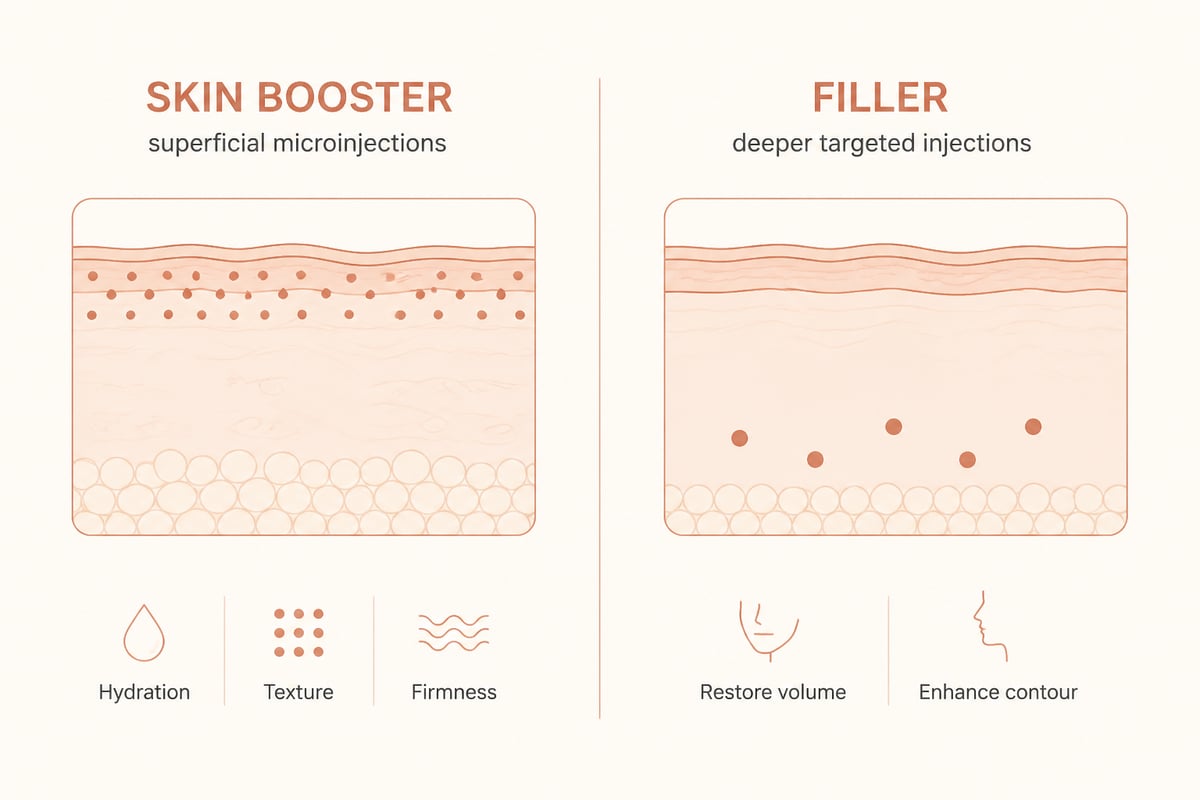
Skin booster vs filler: side-by-side comparison
The table below compares the two approaches on mechanism, evidence, timeline, downtime and cost in Thailand. Evidence and duration differ by product, so treat each row as a general pattern.
| Skin booster | Filler | |
|---|---|---|
| Mechanism | Hydrates or stimulates collagen in the dermis | Adds volume at a deeper level |
| Target | Texture, fine lines, firmness, radiance | Hollows, contour, deeper folds |
| Evidence | Small trials; one 16-participant study reported improved skin-quality scores | Longer clinical record; HA results typically last 6 to 12 months (Mayo Clinic) |
| Timeline | Gradual; collagen-stimulating products build over weeks | Visible shortly after treatment, settling over days |
| Downtime | Small injection marks, minor swelling for a short period | Swelling and bruising possible; varies by area |
| Thailand cost | Juvelook: THB 15,000 per session; two sessions THB 33,000 | Varies by product and volume; confirmed at consultation |
Evidence is stronger for some products than others. Your physician should tell you which category a specific product sits in.
Which one suits which concern?
The right choice follows the concern, not the label. A physician examines the skin, asks what bothers you, and then matches the tool.
Boosters tend to suit:
- Dull, dehydrated or crepey skin
- Fine lines that appear with expression and at rest
- Early loss of firmness, often from the early forties
- Skin quality after sun exposure, travel or weight change
Fillers tend to suit:
- Cheek flattening and midface descent
- Hollow temples or tear troughs
- Weak chin or jawline definition
- Deeper static folds around the mouth
When a face shows both, the sequence matters. Structure is usually addressed first, then skin quality.
A few examples show how the match works. A person who looks tired in photographs but whose cheeks are full may have a surface problem, and a booster addresses it. A person whose skin looks smooth but whose face has begun to look flatter in the midface has a structural problem, and a filler addresses it. Someone with dry, fine-lined skin and deepening folds beside the mouth may need both, and a pilot study of intradermal HA gel reported a 40% drop in mean wrinkle-scale score at week 8, which gives a sense of what a surface treatment can do for fine lines. It cannot replace lost volume.
Frowning lines and forehead creases belong to a third group, and are addressed by the toxin described above.
Do skin boosters and fillers work alike for older skin?
No. For older skin, the choice depends on whether volume loss or tissue quality is the main change, and often both are present. Skin over 50 usually has less collagen, less water retention and a thinner dermis, and the bone and fat beneath it have also moved.
A filler alone can leave the surface looking unchanged. A booster alone cannot rebuild lost volume. Combination plans are common for this reason, and a physician sets the order and spacing.
One point is specific to skin quality. Skin that is chronically dehydrated, sleep-deprived or inflamed responds less predictably to any injectable. Systemic factors such as hormones, glycemic control, sleep and sun exposure shape how skin ages. These are measurable. A plan that ignores them treats the surface only.
How do collagen biostimulators fit in?
A collagen biostimulator is an injectable that prompts the skin to build more of its own collagen instead of simply adding gel. It sits between a classic booster and a filler. The effect is gradual, and it is aimed at skin density and texture.
At Healthi Life, this category is represented by the collagen biostimulator Juvelook. Pricing is published at THB 15,000 for one session and THB 33,000 for two. Whether it is suitable, and how many sessions are appropriate, is decided by the physician after assessing the skin. No outcome is promised.
A related option is exosome-based skin therapy, which Healthi Life describes on its exosome skin therapy page. It is a different mechanism and a different evidence base, and it is discussed in consultation, not assumed.
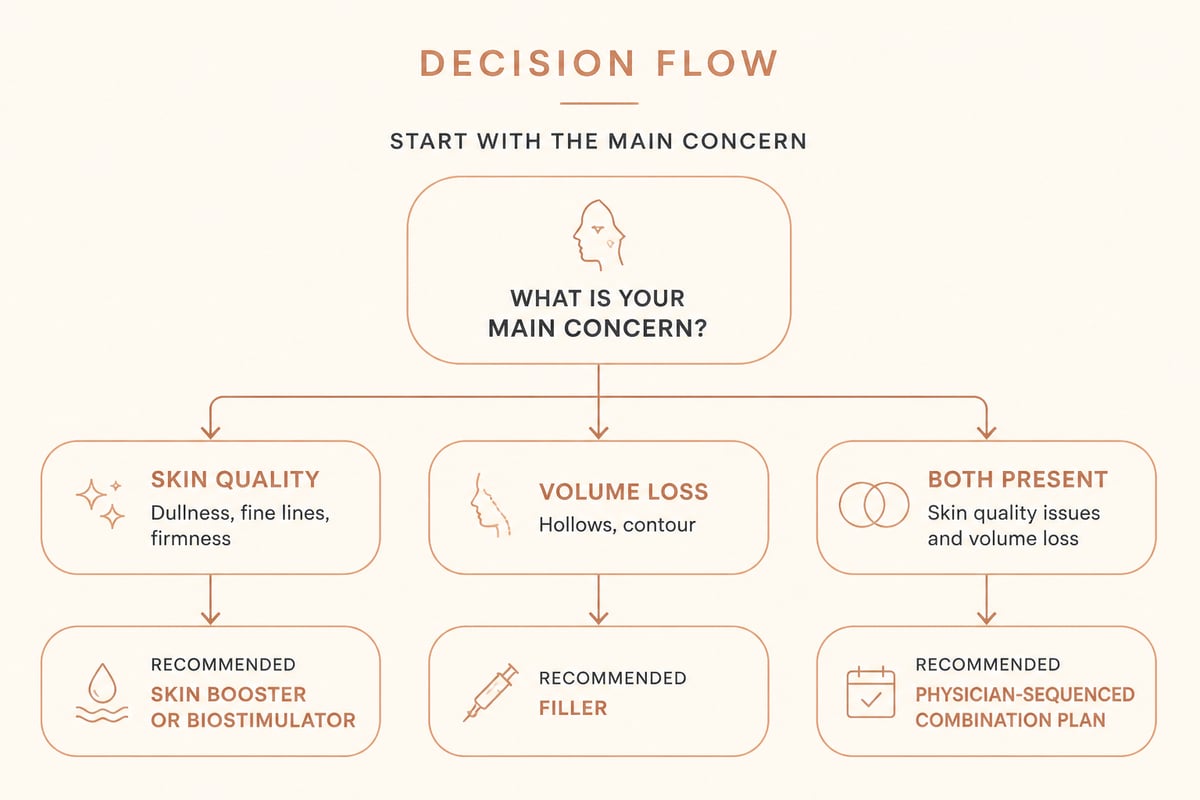
How long do results last, and how fast do they appear?
Fillers show a result within days, once swelling settles. Boosters build more slowly, and biostimulators slowest, over several weeks. Neither is permanent.
Booster HA is generally absorbed faster than structural filler because it is less cross-linked. Biostimulator effects depend on the individual's collagen response.
A pilot study of intradermal HA gel reported a decrease in mean wrinkle-scale score at week 8, in the Journal of Cosmetic Dermatology. It was a single-arm study without a control group. The figure is useful for orientation, not a forecast for any individual.

How safe are these injectables?
Both are medical procedures with low serious-complication rates in published series, but risk is never zero. Common effects are swelling, redness, bruising and tenderness. Rarer events include vascular occlusion, infection and lumps.
An 11-year retrospective analysis reported a small number of serious adverse events, all of which resolved after treatment without long-term effects, according to the American Society for Dermatologic Surgery. That is one dataset from specialist practices.
The numbers describe a population, not a person. Bruising is more likely in those who take blood-thinning medicines or supplements, so the physician needs a full medication list before treatment. Vascular occlusion, where product blocks a blood vessel, is the event that matters most with fillers. It is rare, and it is time-sensitive. Early signs include severe pain, blanching or a mottled color in the skin. A clinic should be able to name its protocol for this and its emergency supplies.
Safety depends on three things: the product, the anatomy and the injector. Ask who performs the procedure, what is stocked to manage complications, and what follow-up is arranged. A named, regulated product with a batch record is easier to trace than an unlabeled one.
What is the difference between Botox and skin boosters or fillers?
Botulinum toxin relaxes muscle. Boosters improve skin quality. Fillers add volume. They act on different tissues, which is why they are often used together and not as substitutes.
Botox targets lines caused by movement, such as the forehead and frown area. A booster cannot stop a muscle from contracting, and a filler does not soften an expression line at its source. Healthi Life describes its toxin service on the Botox Neuronox page.
The distinction shows in the type of line. A line that deepens when you frown and fades when the face is still is a dynamic line, and the muscle is the cause. A fold that stays visible at rest is a static line, and volume loss or skin thinning is the cause. A crosshatch of fine creases on the cheek or under the eye is usually a quality problem of the dermis. Each points to a different tool.
Combination is common because one face can carry all three patterns. A physician may relax the frown muscle, restore a hollow beneath the cheek and treat the surface of the skin, in separate steps with set intervals. Where one product is asked to do another's job, results tend to disappoint, and the examination is meant to prevent that.
How does this fit a wider longevity plan?
Skin ages with the rest of the body, so injectables work best as one part of a physician-led plan. Measured inputs include hormone status, inflammation markers, glucose control and nutrient levels. These influence collagen, repair and hydration.
The approach at Healthi Life is Measure, Understand, Decide. Biomarker panels come first, and treatment decisions follow the data. Skin and hair work sits within Recovery & Performance medicine, reviewed by a physician who follows the guest over months, not a single visit.
A Check-Up Foundation is available at THB 10,500. Peptide consultation is THB 2,500. These are consultation and testing prices, not a recommendation to treat.
FAQ
Is a skin booster the same as a filler?
No. A skin booster improves hydration, texture and firmness by treating the dermis in many small points. A filler adds volume at a deeper level to restore contour. They can be combined under physician guidance.
Which lasts longer, a booster or a filler?
Boosters vary: simple HA boosters are absorbed relatively quickly, while collagen-stimulating products build over weeks. Duration depends on product, area and the individual.
Is there downtime after a skin booster?
Usually small. Pinpoint marks, minor swelling and tenderness are common for a short period. Your physician will explain what to expect for the specific product and the areas treated.
Can I have a skin booster and a filler in the same plan?
Yes, and it is common when a face shows both volume loss and poor skin quality. The physician sets the order, spacing and products after examination. Systemic health is reviewed alongside.
What does a skin booster cost in Thailand?
Prices vary by product and clinic. At Healthi Life, the collagen biostimulator Juvelook is THB 15,000 for one session and THB 33,000 for two. Filler cost depends on product and volume, and is confirmed at consultation.
This page is for information only and is not medical advice. Medical consultation and prescription are available online and on site at Healthi Life, Ekkamai, Bangkok.
The next step is a short conversation about what has changed in your skin and what you want it to do, ideally with recent biomarker results to hand. At Healthi Life in Ekkamai, Bangkok, a physician reviews your data and your concerns before any injectable is considered, and follows your progress over time. To start that process, you can use Book a Discovery Consultation and arrange a time that suits you.
Every medicine named on this page is dispensed only after a medical consultation at Healthi Life and on a physician's prescription. No dosing schedule is published here; the dose is set by the prescribing physician. This page is published for transparency, not as an offer to supply.
- 5.0 Google Rating · 238 reviews
- 2,500+ Guests
- 50+ Countries
- 2025 Regenerative Clinic of the Year in Asia-Pacific — GlobalHealth Asia-Pacific Awards