
SS-31 Peptide Guide: What It Does and How Physicians Use It

An exact look at the SS-31 peptide: how it acts on mitochondria, what trials show, how it compares with other options, and what a physician decides.
This page is for general information and does not constitute medical advice, diagnosis, or treatment. Results vary between individuals. Every medicine and peptide listed here is dispensed only after a medical consultation at Healthi Life and on a physician's prescription. Prices are published for transparency, not as an offer to supply. Always consult a qualified physician about your condition. See our full medical disclaimer.
Verdict: The SS-31 peptide, also called elamipretide, is a small molecule that binds the inner mitochondrial membrane. Its strongest evidence is in Barth syndrome, a rare disease. Evidence for healthy adults is limited. At Healthi Life it is listed at THB 5,000 and is considered only after a physician consultation and biomarker review.
What is the SS-31 peptide?
The SS-31 peptide is a four-amino-acid compound that concentrates in the inner mitochondrial membrane. Its clinical name is elamipretide. Earlier literature also calls it Bendavia or MTP-131. Healthi Life is a physician-led longevity house in Bangkok.
It belongs to a class called mitochondria-targeted peptides. The sequence includes unusual residues that let it cross cell membranes without a transporter.
Three facts define it:
- It is a synthetic tetrapeptide, not a hormone or a growth factor.
- It acts on mitochondria, not on a receptor at the cell surface.
- It has been studied in clinical trials, mostly in rare mitochondrial disease.
Amino acid peptides in general are short chains of amino acids linked by peptide bonds. A chain under about 50 amino acids is usually called a peptide. Longer chains are proteins.
How does SS-31 work inside the cell?
SS-31 binds cardiolipin, a phospholipid found almost only in the inner mitochondrial membrane. Cardiolipin helps hold the respiratory chain complexes in their working arrangement.
When cardiolipin is damaged by oxidative stress, the membrane folds (cristae) lose their structure. Electron transport becomes less efficient and reactive oxygen species rise.
The proposed action is stabilization. SS-31 attaches to cardiolipin and appears to support cristae shape and the coupling of the respiratory complexes. It is not a classic antioxidant that neutralizes free radicals in the cytoplasm.
This mechanism is supported by cell and animal work. Cell culture results do not predict what happens in a healthy adult. They describe a mechanism, not an outcome.
What does the clinical evidence show?
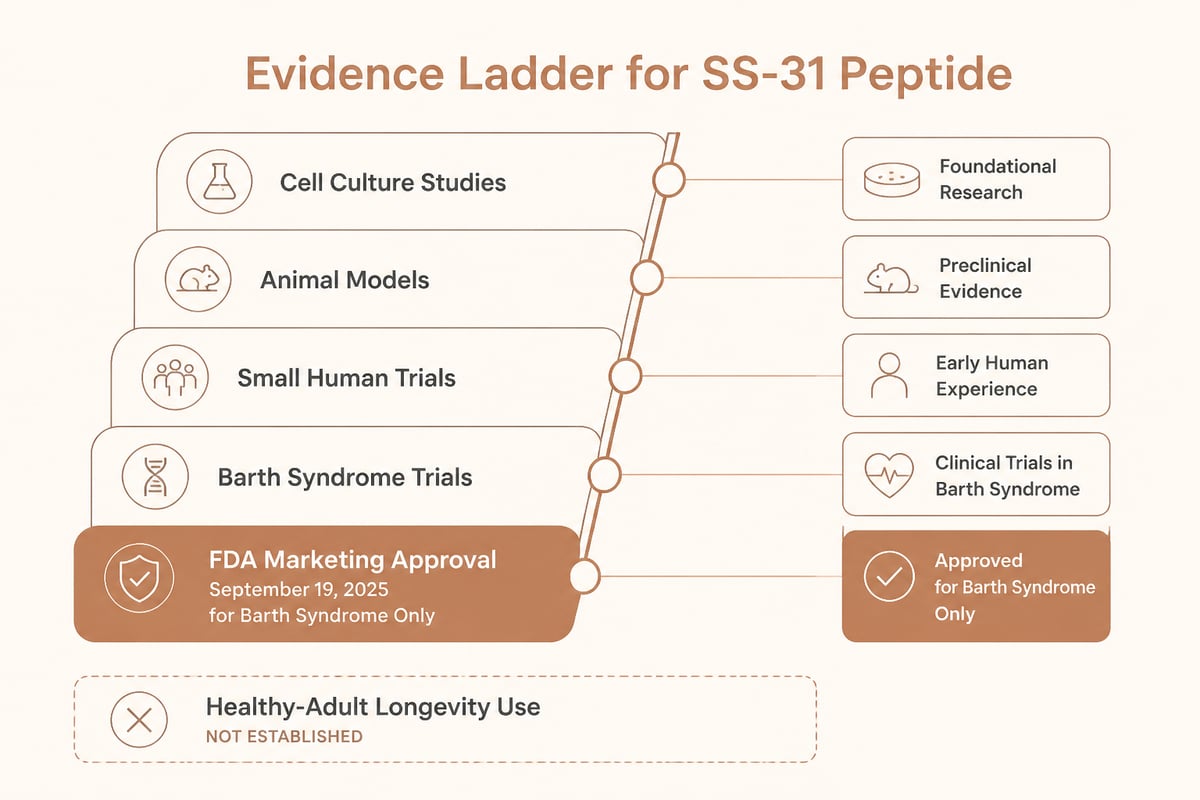
The clinical evidence for elamipretide is concentrated in mitochondrial disease, with the best data in Barth syndrome. Results in other conditions have been mixed.
Barth syndrome is a rare X-linked disorder of cardiolipin remodeling. It causes cardiomyopathy, muscle weakness and neutropenia. Because the underlying defect involves cardiolipin, it was a logical target for a cardiolipin-binding drug.
The FDA's orphan drug listing records that elamipretide received marketing approval on September 19, 2025, for improving muscle strength in patients with Barth syndrome who weigh at least 30 kg.
That accelerated approval is narrow, and the FDA requires a confirmatory trial. It covers one rare disease, one indication and one weight band. It does not cover aging, fatigue, athletic recovery or general longevity use.
In a phase 3 trial in primary mitochondrial myopathy, elamipretide did not improve 6-minute walk distance or fatigue score compared with placebo (Neurology, 2023).
SS-31 compared with other mitochondrial and recovery options
Physicians weigh SS-31 against other tools that act on cellular energy. The table sets out how they differ on the attributes most readers ask about. Cost figures are Healthi Life's listed THB amounts where given.
| Option | Mechanism | Evidence | Timeline | Downtime | Thailand cost |
|---|---|---|---|---|---|
| SS-31 peptide (elamipretide) | Binds cardiolipin in the inner mitochondrial membrane | Trials mainly in Barth syndrome; healthy-adult data limited | Set by the physician after review | None expected after a subcutaneous injection | THB 5,000 |
| NAD+ therapy | Supplies a coenzyme used in energy metabolism and repair enzymes | Human data mostly on blood level changes; outcome data limited | Set by the physician | None expected | Quoted at consultation |
| Peptide consultation | Physician review to decide whether any peptide is appropriate | Not applicable | Single visit, then follow-up | None | THB 2,500 |
| Check-Up Foundation | Biomarker panel to establish a baseline | Established laboratory methods | Results reviewed with a physician | None | THB 10,500 |
Cost is the smallest part of the comparison. The larger question is whether the evidence supports the use.
Who is a candidate for the SS-31 peptide?
A candidate is someone whose data show a reason to consider it and whose physician judges the likely benefit to outweigh the uncertainty. That group is small.
Outside Barth syndrome, use is off-label and the evidence is preliminary. A responsible physician will say so before anything is prescribed.
The usual questions are:
- What symptom or measurable problem is being addressed?
- Do biomarkers point to a mitochondrial or energy-metabolism issue, or to something simpler such as sleep, iron, thyroid or vitamin status?
- Have the lower-risk options been tried or ruled out?
- Is there a way to measure whether it worked?
For many people, fatigue is the reason the question arises. Fatigue has many causes, and they are usually found by testing rather than by choosing a peptide first.
What is measured before any peptide is considered?
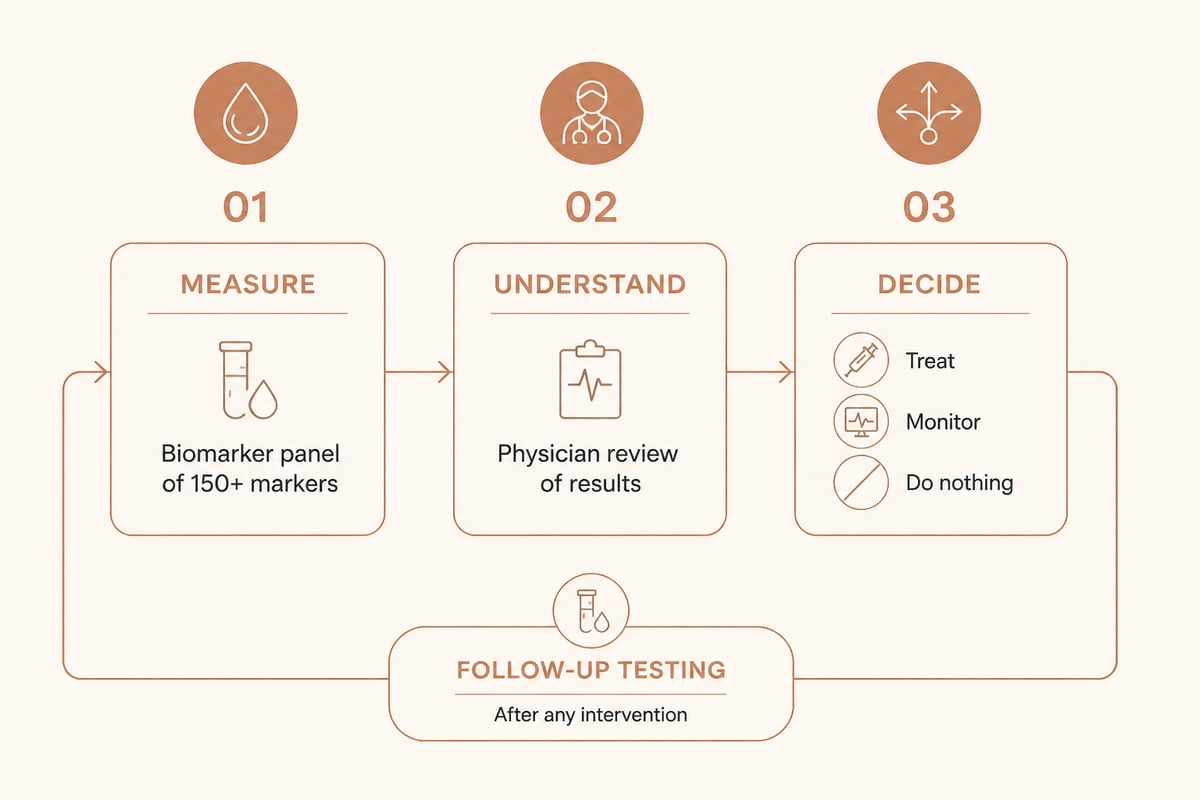
Measurement comes first because the cause of low energy is rarely mitochondrial. A physician starts with a baseline and treats only what the data support.
Healthi Life's approach follows three steps: Measure, Understand, Decide. The Foundation panel covers more than 60 lab biomarkers. Those typically include:
- Metabolic markers such as fasting glucose, insulin and HbA1c
- Thyroid function
- Iron studies and ferritin
- Inflammatory markers
- Lipids and liver and kidney function
- Hormones relevant to the guest's age and sex
The Check-Up Foundation, at THB 10,500, is the entry point. Results are reviewed one-to-one with a physician. If a peptide is then discussed, the baseline allows a later comparison.
What are the safety considerations and side effects?
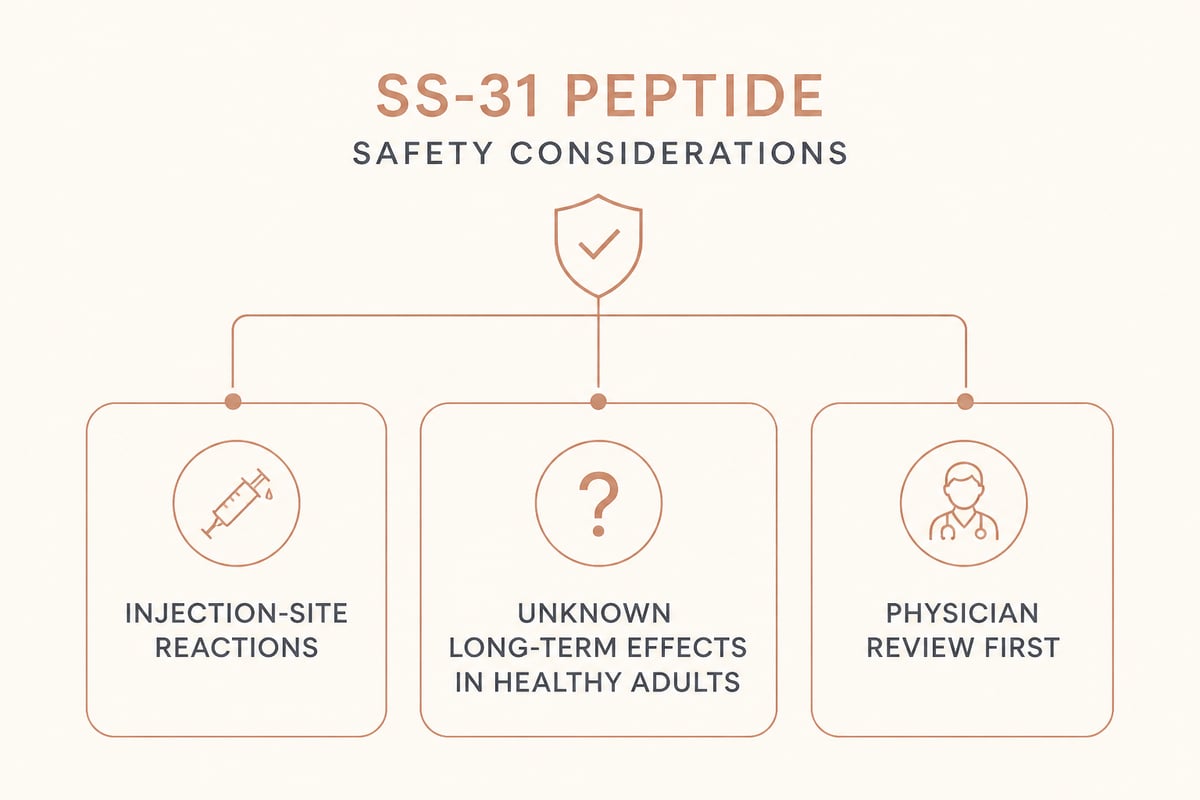
In published trials, the most commonly reported adverse events with elamipretide were injection-site reactions. These include redness, itching, pain or swelling where the drug is given.
Other effects have been reported in some studies, and the full list is in the product labeling and trial publications. Safety in long-term use by healthy adults has not been established.
Several limits apply:
- Use in pregnancy and breastfeeding should be discussed with a physician.
- Product quality matters. Peptides sold online as research chemicals carry no assurance of purity, concentration or sterility.
Because of that last point, Healthi Life dispenses medicines and peptides only after a medical consultation and on a physician's prescription. For the broader range of options, see the clinic's peptide therapy injections and its page on peptides for recovery and sleep.
How is SS-31 given and reconstituted?
SS-31 is given by subcutaneous injection. The approved elamipretide product is a prescription medicine for Barth syndrome only.
Reconstituting a lyophilized peptide means adding a sterile diluent, usually bacteriostatic water, to the powder. It should be done under aseptic conditions, with attention to vial labeling and storage temperature.
This article does not give doses, schedules or reconstitution volumes. Those depend on the product, the person and the physician's judgment. Self-reconstituting peptides bought from an unverified source is the step that carries the most avoidable risk. A physician or a trained nurse should supply and prepare any injectable.
Where does the SS-31 peptide fit in a longevity program?
In a longevity program the SS-31 peptide is a possible adjunct, not a foundation. The foundation is measurement, sleep, nutrition, resistance training, cardiovascular fitness and management of blood pressure, glucose and lipids.
A physician-led program follows guests over months and years, not a single appointment. That allows a change to be tracked against a baseline and stopped if nothing improves.
Healthi Life's Recovery & Performance medicine service covers IV and NAD+ therapy, cellular therapy, skin and hair, peptide protocols and private testing. Every protocol follows a consultation and biomarker review with a licensed doctor.
Readers who want general background on peptide types can consult independent reference sources, not a substitute for a prescription or medical advice.
The advantage of a house like Healthi Life is not access to a compound. It is that a physician looks at the whole picture and decides whether the compound is warranted.
What are the limits of what is known?
Several points are unresolved. They bear on any decision about the SS-31 peptide.
- Healthy-adult benefit: No large randomized trial has shown that it slows aging or improves performance in healthy people.
- Long-term safety: Data beyond trial durations are limited.
- Dose-response outside disease: Not established.
- Biomarkers of response: There is no agreed laboratory test that shows a healthy adult has benefited.
Claims on the internet that run ahead of this evidence should be treated with caution. Where the data do not exist, the honest answer is that they do not exist.
Every medicine and peptide listed here is dispensed only after a medical consultation at Healthi Life and on a physician's prescription. Prices are published for transparency, not as an offer to supply.
SS-31 peptide FAQ
What is SS-31 peptide?
It is a synthetic four-amino-acid peptide, also named elamipretide, that binds cardiolipin in the inner mitochondrial membrane. It was developed for mitochondrial disease. Its FDA accelerated approval, on September 19, 2025, is for Barth syndrome in patients weighing at least 30 kg.
What are amino acid peptides?
They are short chains of amino acids joined by peptide bonds, usually fewer than about 50 amino acids long. Some act as hormones, some as signaling molecules, and some as synthetic drugs. The SS-31 peptide is a synthetic example with four amino acids.
What are the big 3 peptides?
There is no medical standard for a "big 3." The phrase is a marketing shorthand, and different sellers list different compounds under it. A physician chooses a peptide by the indication, the evidence and the patient's data, not by a popularity list.
How is SS-31 reconstituted?
Reconstitution means adding a sterile diluent to a lyophilized vial under aseptic technique. The volume depends on the product and the intended concentration, so this article gives no figures. At Healthi Life, any injectable is supplied and prepared under physician direction after a consultation.
Is SS-31 safe for healthy adults?
Safety in healthy adults over the long term has not been established. Injection-site reactions were the most commonly reported events in trials. A physician should review your history, medicines and biomarkers before any use.
This page is for information only and is not medical advice. Medical consultation and prescription are available online and on site at Healthi Life, Ekkamai, Bangkok.
If you are weighing the SS-31 peptide, start by asking a physician what you are trying to measure, and book the peptide consultation at THB 2,500 or the Check-Up Foundation at THB 10,500 to establish a baseline first. The Recovery & Performance team can review your results and advise whether any peptide is warranted, or whether another step comes first. To arrange that review with a licensed physician, Book a Discovery Consultation at Healthi Life in Ekkamai, Bangkok.
Every medicine named on this page is dispensed only after a medical consultation at Healthi Life and on a physician's prescription. No dosing schedule is published here; the dose is set by the prescribing physician. This page is published for transparency, not as an offer to supply.
- 5.0 Google Rating · 238 reviews
- 2,500+ Guests
- 50+ Countries
- 2025 Regenerative Clinic of the Year in Asia-Pacific — GlobalHealth Asia-Pacific Awards