
Telomere Test: What It Measures and Who Needs It

A telomere test measures the protective caps on your chromosomes. Learn what the results mean, how it's done, and when to order one.
This page is for general information and does not constitute medical advice, diagnosis, or treatment. Results vary between individuals. Every medicine and peptide listed here is dispensed only after a medical consultation at Healthi Life and on a physician's prescription. Prices are published for transparency, not as an offer to supply. Always consult a qualified physician about your condition. See our full medical disclaimer.
A telomere test measures the length of the protective DNA sequences that cap the ends of your chromosomes. Telomeres shorten with each cell division, and their length correlates with cellular age. The test is ordered by a physician as part of a broader assessment, not as a stand-alone predictor of lifespan.
What a Telomere Test Measures
Telomeres are repetitive nucleotide sequences-TTAGGG in humans-that protect chromosome ends from degradation. Each time a cell divides, telomeres lose 50 to 200 base pairs. When they become critically short, the cell enters senescence or dies. This guide is published by the Healthi Life longevity clinic in Bangkok.
A telomere test quantifies average telomere length in leukocytes (white blood cells). Results are reported in kilobases (kb) or as a T/S ratio: the ratio of telomere repeat copy number to a single-copy gene. A T/S ratio of 1.0 represents the median for the reference population.
The test does not measure telomere length in every tissue. It samples circulating immune cells. Telomere length varies by cell type, and leukocyte telomere length is not a direct proxy for heart, brain, or liver cells.
Why Physicians Order the Test
Telomere length is one marker among many. It is ordered when a physician wants to assess cellular aging alongside other biomarkers: inflammatory markers, oxidative stress, DNA methylation clocks, lipid panels, glucose control.
Shorter telomeres are associated with:
- Increased risk of cardiovascular disease
- Higher incidence of type 2 diabetes
- Greater susceptibility to certain cancers
- Cognitive decline and neurodegenerative diseases
These are associations, not causations. A 2025 expert consensus statement on biomarkers of aging notes that telomere length lacks strong consensus as a standalone aging biomarker. It is more useful when interpreted alongside epigenetic age, inflammatory markers, and metabolic panels.
How the Test Is Performed
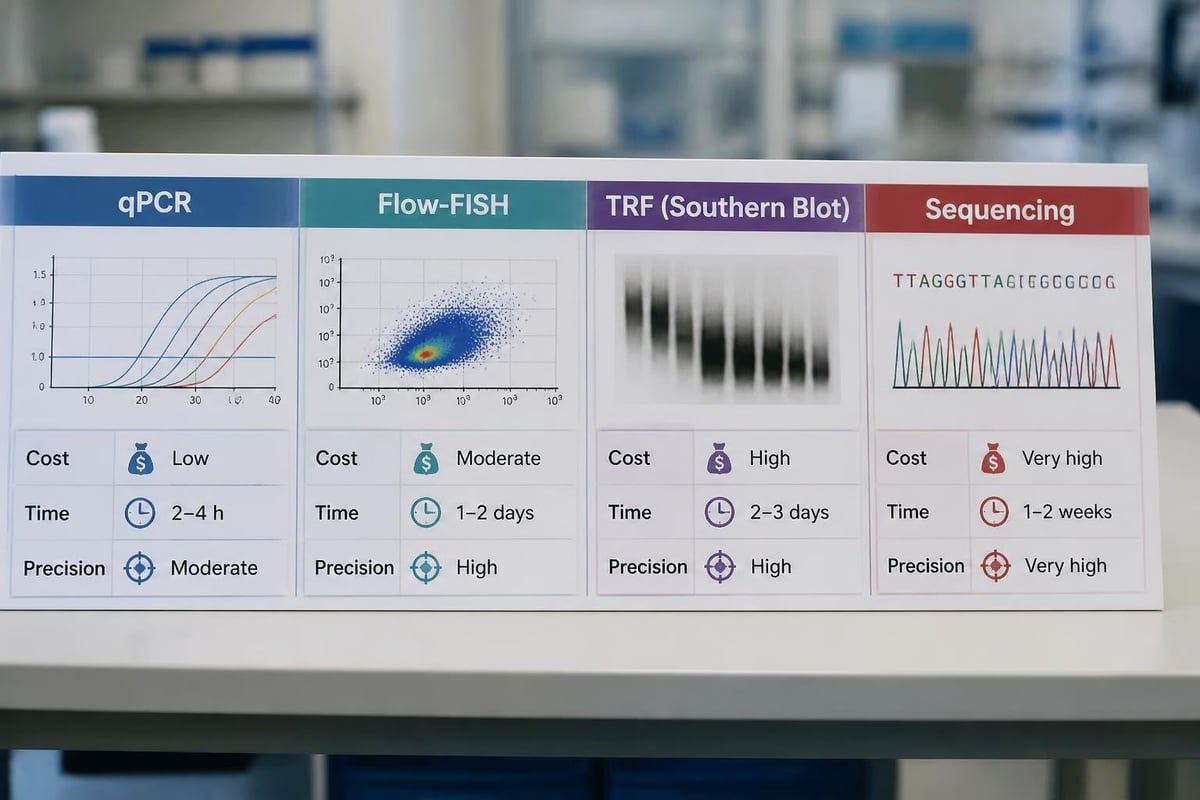
Four methods are used in clinical and research settings. Each has trade-offs in cost, precision, and throughput.
| Method | Precision | Cost | Turnaround | Clinical Use |
|---|---|---|---|---|
| qPCR | Moderate | Low | 1-2 days | Common |
| Flow-FISH | High | Moderate | 2-3 days | Growing |
| TRF (Southern blot) | High | High | 1-2 weeks | Rare |
| Whole-genome sequencing | Very High | Very High | 2-4 weeks | Research |
Quantitative PCR (qPCR)
The most common method. qPCR amplifies telomere DNA and compares it to a single-copy reference gene. Results are expressed as a T/S ratio.
Reproducibility of qPCR-based telomere measurement depends on strict standardization. Coefficient of variation can range from 3% to 15%, depending on lab protocol and reference controls. qPCR is fast and inexpensive, but it measures average telomere length across all cells, masking variation.
Flow-FISH
Flow cytometry combined with fluorescence in situ hybridization. Flow-FISH labels telomeres with a fluorescent probe and measures length in individual cells. It provides a distribution, not just an average.
A direct comparison of Flow-FISH and qPCR showed that Flow-FISH detects differences in telomere length among subpopulations of lymphocytes, which qPCR averages out. Flow-FISH is more precise but requires specialized equipment.
Terminal Restriction Fragment (TRF) Analysis
The original method, still considered the gold standard. DNA is digested with restriction enzymes, separated by gel electrophoresis, and probed with telomere-specific sequences. TRF measures telomere length directly in kilobases.
It is labor-intensive and requires large DNA samples. Few commercial labs offer TRF for routine testing.
Whole-Genome Sequencing
Emerging methods use long-read sequencing to map telomeres at individual chromosome ends. This provides the most detailed data: length, sequence variation, and heterogeneity across chromosomes.
Sequencing-based approaches are not yet routine. A 2025 review of telomere measurement methods outlines the state of the art, noting that cost and bioinformatics complexity limit clinical adoption.
What the Results Mean
Results are compared to age-matched reference populations. Telomere length declines by approximately 20 to 60 base pairs per year in adults, though the rate varies by individual.
A result below the 25th percentile for your age indicates shorter-than-average telomeres. A result above the 75th percentile indicates longer-than-average telomeres.
Short Telomeres
Shorter telomeres are not a diagnosis. They indicate accelerated cellular aging, which may result from:
- Chronic inflammation
- Oxidative stress
- Smoking
- Obesity
- Sedentary lifestyle
- Chronic psychological stress
- Genetic predisposition
The physician reviews the result alongside inflammatory markers (hsCRP, IL-6), metabolic panels (glucose, HbA1c, lipids), and lifestyle history. The telomere test adds one data point to a broader assessment.
Long Telomeres
Longer telomeres are generally associated with better health outcomes, but not always. Extremely long telomeres have been linked to certain cancers, though the mechanism is not fully understood.
A physician does not treat telomere length. The physician treats the underlying conditions that influence telomere attrition: metabolic dysfunction, inflammation, oxidative stress.

Who Should Get Tested
A telomere test is ordered as part of a comprehensive evaluation, not on its own. It is most useful for adults over 40 who are building a longitudinal health record.
High-Net-Worth Individuals in Bangkok and Asia
Residents of Bangkok and international visitors who want their health managed as an ongoing program, not an annual check, often include telomere testing in their baseline assessment. The test is one component of a larger panel that may include up to 300 biomarkers, reviewed in a physician-led consultation.
At Healthi Life in Ekkamai, Bangkok, the Advanced Health Check-Up includes DNA and epigenetic testing alongside biomarker panels and imaging. The physician reviews all results in a one-to-one session and turns them into a written plan.
Individuals with Family History of Age-Related Disease
If cardiovascular disease, diabetes, or neurodegenerative disease runs in your family, a telomere test provides one marker of cellular aging. It is interpreted alongside apoB, Lp(a), fasting insulin, and inflammatory markers.
People on Long-Term Health Optimization Protocols
For those on longevity medicine programs-whether peptide protocols, NAD+ therapy, or metabolic interventions-telomere testing is a baseline marker. Retesting after 12 or 24 months shows whether interventions are slowing cellular aging.
Interventions That Influence Telomere Length
No intervention is prescribed solely to lengthen telomeres. Interventions target the underlying biology that influences telomere maintenance.
Exercise
Moderate to vigorous aerobic exercise is associated with longer telomeres in multiple studies. The effect is dose-dependent: 150 to 300 minutes per week of moderate activity shows the clearest benefit.
Resistance training also correlates with longer telomeres, though fewer studies have examined this.
Diet
Mediterranean diet patterns-high in vegetables, fish, olive oil, nuts-correlate with longer telomeres. The effect is likely mediated by reduced inflammation and oxidative stress, not by the diet acting directly on telomerase.
Caloric restriction in animal models upregulates telomerase activity. Human data are limited.
Stress Reduction
Chronic psychological stress is associated with shorter telomeres. Interventions that reduce perceived stress-meditation, cognitive behavioral therapy, adequate sleep-are associated with slower telomere attrition.
One randomized trial of mindfulness-based stress reduction showed a trend toward preserved telomere length over 12 weeks, though the sample size was small.
Pharmacologic and Peptide Interventions
Several compounds are under investigation for their effects on telomere biology. None are approved specifically for telomere lengthening.
- TA-65: A telomerase activator derived from Astragalus membranaceus. Small human trials show mixed results.
- Rapamycin: An mTOR inhibitor that extends lifespan in animal models. Rapamycin is prescribed off-label by some longevity physicians for age-related conditions, not for telomeres specifically.
- NAD+ precursors: Nicotinamide riboside (NR) and nicotinamide mononucleotide (NMN) support cellular energy metabolism and DNA repair. Some data suggest they may slow telomere shortening indirectly.
Every medicine and peptide listed here is dispensed only after a medical consultation at Healthi Life and on a physician's prescription.
Reference Values by Age and Method
Telomere length declines with age. Reference values depend on the method used and the reference population. Below are approximate values for qPCR (T/S ratio) and Flow-FISH (kb).
| Age Range | qPCR T/S Ratio (Median) | Flow-FISH (kb, Median) |
|---|---|---|
| 20-29 | 1.2 - 1.4 | 10.0 - 11.0 |
| 30-39 | 1.1 - 1.3 | 9.5 - 10.5 |
| 40-49 | 1.0 - 1.2 | 9.0 - 10.0 |
| 50-59 | 0.9 - 1.1 | 8.5 - 9.5 |
| 60-69 | 0.8 - 1.0 | 8.0 - 9.0 |
| 70+ | 0.7 - 0.9 | 7.5 - 8.5 |
Values vary by population ethnicity, sex, and lab protocol. Your result is compared to the lab's own reference range.
Limitations of Telomere Testing
A consensus review on choosing telomere measurement methods highlights several limitations.
Telomere Length Is Not Lifespan
Telomere length correlates with biological age but does not predict individual lifespan. Two people with identical telomere lengths may have very different health trajectories.
Single Time Point Is Limited
One measurement captures telomere length at that moment. It does not show the rate of shortening. Serial measurements 12 to 24 months apart provide more information.
Leukocyte Telomeres Are Not Universal
The test measures white blood cells. Telomere length in other tissues may differ. A short leukocyte telomere does not necessarily mean short telomeres in the heart or brain.
Method Variability
Different labs use different methods. qPCR results from two labs may not be directly comparable. Flow-FISH and TRF are more standardized but less widely available.
Frequently Asked Questions
What does a telomere test cost?
Cost depends on the method and lab. qPCR-based tests range from USD 200 to 500. Flow-FISH and TRF are more expensive. The test is often included in comprehensive biomarker panels rather than ordered alone.
How often should I retest?
Most physicians recommend retesting every 12 to 24 months. Telomere shortening is slow, and shorter intervals may not show meaningful change.
Can telomeres be lengthened?
Telomerase, the enzyme that extends telomeres, is active in germ cells and some stem cells but not in most somatic cells. Some interventions-exercise, stress reduction, possibly TA-65-may slow shortening or modestly increase length. No intervention reliably lengthens telomeres in all tissues.
Is the test covered by insurance?
In most jurisdictions, telomere testing is not covered by insurance when ordered for health optimization or longevity. It may be covered if ordered as part of a diagnostic workup for a specific condition.
What is the difference between biological age and telomere age?
Biological age is estimated from multiple biomarkers: epigenetic clocks, inflammatory markers, metabolic panels, physical performance. Telomere age is one input into biological age, not a synonym. Epigenetic clocks (e.g., Horvath, GrimAge) currently show stronger correlations with health outcomes than telomere length alone.
When to Get Tested
A telomere test is ordered as part of a baseline assessment when you are building a long-term health program. It is not an urgent test and not a screening test for disease. It is one marker in a panel of 50, 100, or more biomarkers that together describe your cellular and metabolic state.
For adults over 40 in Bangkok and across Asia who want their health managed continuously, the test is included in comprehensive check-ups that also measure inflammation, oxidative stress, glucose control, lipid subfractions, and epigenetic age. The physician reviews all results together, not in isolation.
Consider a telomere test if:
- You are starting a longevity program and want a baseline marker of cellular aging
- You have a family history of cardiovascular disease or metabolic dysfunction
- You are on a long-term health optimization protocol and want to track cellular markers over time
- You are undergoing interventions (exercise programs, dietary changes, peptide protocols) and want objective markers of effect
The test is ordered by a physician after a consultation and a review of your health history. It is one data point, not a diagnosis.
Telomere testing measures cellular aging but does not replace a comprehensive biomarker assessment. The result is interpreted by a physician alongside inflammation, metabolism, and epigenetic markers, not in isolation. At Healthi Life, telomere testing is included in advanced diagnostic protocols that measure up to 300 biomarkers, reviewed one-to-one with a physician who turns the data into a written plan. Start with a consultation and a baseline assessment, then decide.
Every medicine named on this page is dispensed only after a medical consultation at Healthi Life and on a physician's prescription. No dosing schedule is published here; the dose is set by the prescribing physician. This page is published for transparency, not as an offer to supply.