
Epitalon Benefits: What the Evidence Says About Use

Epitalon benefits examined: the proposed mechanisms, what animal and human data show, and what a physician reviews first. A measured account.
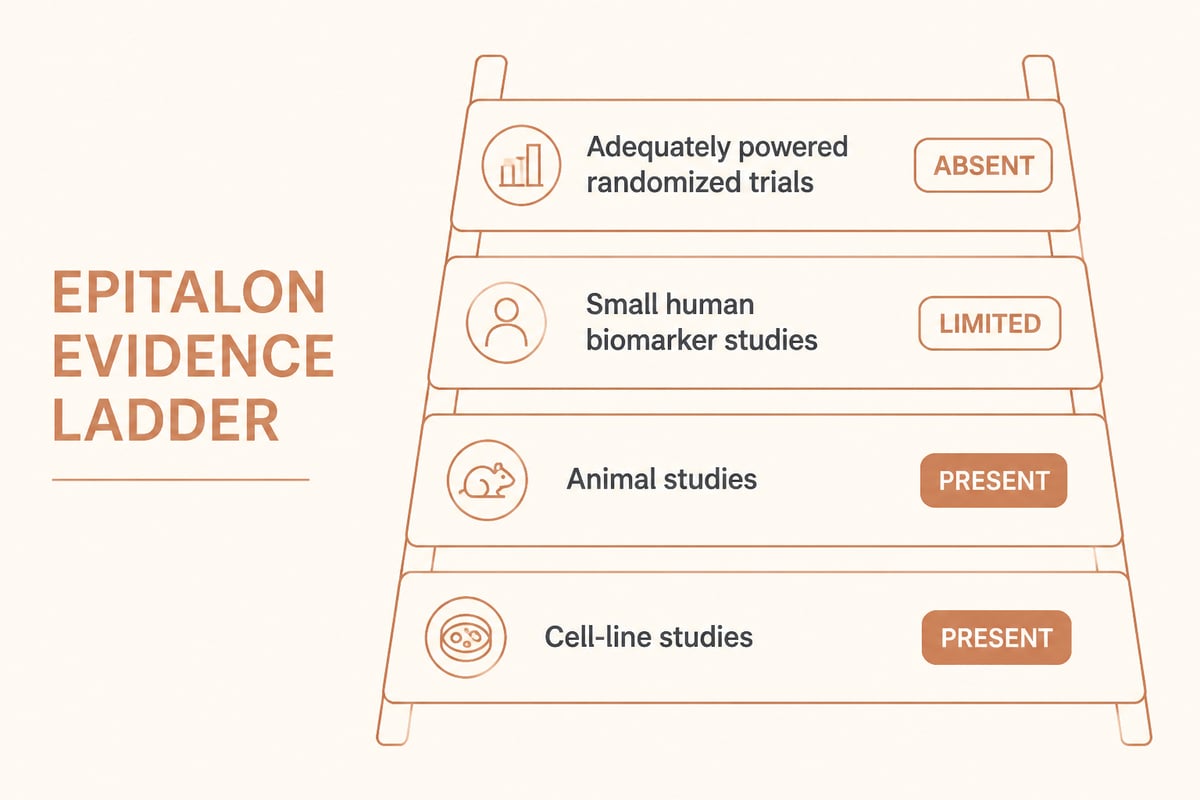
Verdict: Epitalon benefits are proposed, not proven. Laboratory and animal studies suggest effects on telomerase, melatonin rhythm and oxidative stress. Human evidence is limited to small studies, and no adequately powered randomized trial has established therapeutic efficacy. Any decision to use it belongs to a physician, after reviewing your data.
The table below sets epitalon beside the question most readers bring: what is measured, what is assumed, and what it costs.
| Attribute | Epitalon |
|---|---|
| Mechanism | Proposed telomerase activation, pineal and melatonin signaling, antioxidant effects |
| Evidence | Cell and animal data; limited, small human studies |
| Timeline | No established timeline of effect in humans |
| Downtime | None established; long-term safety data are inadequate |
| Thailand cost | Epithalon THB 24,000 |
Every medicine and peptide listed here is dispensed only after a medical consultation at Healthi Life and on a physician's prescription. Prices are published for transparency, not as an offer to supply.
What is epitalon?
Epitalon, also written epithalon, is a synthetic tetrapeptide made of four amino acids: alanine, glutamic acid, aspartic acid and glycine. It was designed from epithalamin, an extract of the pineal gland studied in Russia. Healthi Life is a physician-led longevity clinic in Bangkok.
A tetrapeptide is a very short chain, which is why it can be made synthetically rather than extracted from animal tissue. The pineal gland, a small structure deep in the brain, secretes melatonin and is linked to circadian timing. The reasoning behind the design was that a short fragment might reproduce some of the signaling of the whole extract. That is a hypothesis from the original research, and it has not been settled by independent, adequately powered human trials.
The peptide is not an approved drug for any indication in most regulated markets. It is discussed mainly in aging research, where it is investigated for effects on telomeres and circadian signaling. Readers will also see it sold as a research chemical, which says nothing about quality or safety. Regulatory status and product identity are separate questions from the biology, and both belong in the conversation with a physician.
What are the proposed epitalon benefits?
The proposed epitalon benefits fall into four groups: telomere maintenance, melatonin and sleep rhythm, antioxidant activity and immune modulation. Each rests on a different quality of evidence.
- Telomere maintenance. Telomeres are the protective caps on chromosome ends. They shorten with cell division.
- Pineal and melatonin regulation. The pineal gland secretes melatonin, and its output declines with age.
- Antioxidant effects. Reduced oxidative damage has been reported in some experimental models.
- Immune modulation. Reported mostly in older Russian literature, with limited independent replication.
None of these has been confirmed as a clinical benefit in healthy adults.
How epitalon is thought to work on telomerase
The central claim is that epitalon increases expression of the telomerase gene, hTERT, which lengthens telomeres. A 2025 cell-line study reported dose-dependent telomere-length extension in normal cells, alongside increased hTERT expression and telomerase activity.
These are laboratory findings. They are not evidence of a clinical benefit in people.
There is also a reason for caution. Telomerase is active in many cancers, so any agent that raises it needs long-term safety data. Those data do not yet exist for epitalon.
Does epitalon affect melatonin and sleep?
Epitalon is proposed to restore pineal melatonin output, which could support sleep timing. The human evidence behind this is thin.
Small biomarker studies have measured melatonin and related markers. They do not establish that epitalon improves sleep quality or jet lag in healthy adults. For frequent travelers, that matters. Sleep disruption from crossing time zones has better-supported tools, including light timing, schedule control and, where indicated, physician-guided melatonin. A related discussion of peptides for recovery and sleep covers how peptides are weighed in that context.
What does the animal evidence on lifespan show?
In an animal study summarized in a 2026 review, epitalon did not significantly change mean lifespan. Maximum lifespan rose by 12.3%, and lifespan among the longest-lived 10% rose by 13.3%, according to the narrative review.
Read that carefully. Average lifespan did not move. The change appeared at the long end of the distribution.
The distinction matters because the two measures answer different questions. Mean lifespan reflects the whole group. Maximum lifespan and the longest-lived 10% reflect only the tail. A treatment can lengthen the tail without helping the typical animal, and a tail effect can also arise from a small number of outliers. The review does not show that most animals benefited.
Animal results do not transfer directly to humans. Lifespan in a laboratory rodent is a different question from healthspan in an adult in his fifties. Housing, diet and disease patterns in a laboratory differ from human life, and a rodent's lifespan is measured in months to a few years. No human study has measured lifespan, or an equivalent hard outcome, for epitalon.
What does the human evidence show?
Human evidence for epitalon is limited to small physiological or biomarker studies and an older controlled study in retinitis pigmentosa. The same narrative review states that no adequately powered randomized trial has established therapeutic efficacy.
It also finds that pharmacokinetic, dose-ranging and long-term safety data remain inadequate.
What is known:
- Small studies have measured biomarkers, with modest sample sizes.
- One older controlled study examined retinitis pigmentosa.
- No large trial tests epitalon against placebo for aging outcomes.
What is not known: the effective human dose range, the duration of effect, long-term safety, and whether any biomarker change translates into a clinical outcome.

How much does epitalon cost in Thailand?
Epithalon is listed at THB 24,000. A peptide consultation is THB 2,500. These figures are published for transparency, not as an offer to supply.
The two amounts are separate and are paid at different points. The consultation is the physician's review of your history, current medications and goals. The product price applies only if the physician decides, after that review, that epitalon has a place in your plan and issues a prescription. A consultation does not commit you to a purchase, and in some cases the outcome is a recommendation for a better-supported option.
The listed price should be read against the evidence. Human data are limited to small biomarker studies, so the amount buys access to a compound with an undefined effect size, not a measured result. Ask what will be tracked, and when, so that any change can be judged against your own baseline. A panel such as the Check-Up Foundation, at THB 10,500, is one way to establish that baseline before a peptide is discussed.
Epitalon is dispensed only after a consultation and on a physician's prescription. Product details for Epitalon in Bangkok are on the product page.
How is epitalon given, and where is the injection site?
Epitalon is described in the literature as an injectable peptide, and the site of any injection is set by the prescribing physician. This article does not give doses or schedules, because none is established for humans.
Self-directed use of research peptides from unverified suppliers carries real risks: identity, purity and sterility cannot be assumed. It is not a source of medical guidance. Supervised options are covered under peptide therapy injections.
How a physician would assess whether epitalon is relevant
A physician would begin with measurement, not the peptide. The question is which of your own markers are out of range and what has the strongest evidence for correcting them.
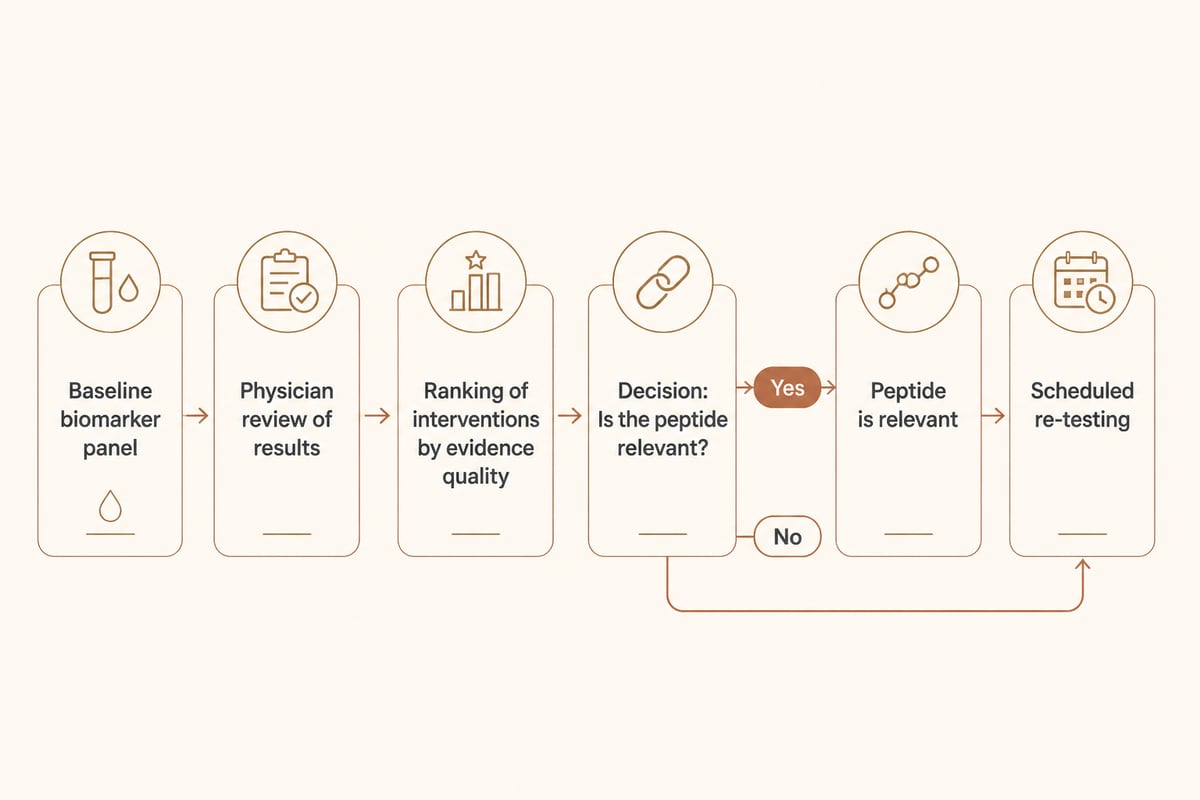
A practical sequence looks like this:
- A baseline panel, including inflammatory, metabolic, hormonal and sleep-related markers.
- A review of biological age measures, such as the BioAge biological age test, interpreted with caution.
- A ranking of interventions by evidence quality.
- A decision on whether a peptide has any place in the plan.
- Re-testing at set intervals to see whether anything moved.
Telomere length alone is a weak target. It varies between tissues and between laboratories, and a single value does not predict an outcome for one person.
Which options have stronger evidence than epitalon?
Several interventions have more human data than epitalon. Resistance training, sleep regularity, cardiorespiratory fitness and metabolic control remain the base. Among supplements and compounds, the evidence differs by agent, and each is a separate conversation with a physician. See, for comparison, these reviews of NMN benefits, creatine benefits and fasting benefits.
For executives and frequent travelers, the constraint is usually continuity rather than a missing compound. A program that tracks markers across months shows whether a change helped. Longevity Programs at Healthi Life run three to twelve months, built on up to 300 biomarkers and supervised by a physician throughout, with scheduled re-testing and adjustment.
What are the risks and unknowns?
The main risk is uncertainty. Dose-ranging and long-term safety data are inadequate, so the risk profile in healthy adults is not defined.
The 2026 narrative review also reports that pharmacokinetic data are inadequate. Pharmacokinetics describes how a substance is absorbed, distributed and cleared. Without it, nobody can state how long epitalon stays active in the body, which makes both dose and duration guesses rather than established values.
A second unknown is whether a laboratory finding carries over to a living person. Increased hTERT expression in a cell line does not show that telomeres lengthen in human tissue, or that a longer telomere is beneficial if it does.
Specific points to raise with a physician:
- Any personal or family history of cancer, given the telomerase question.
- Current medications and supplements.
- Product source, purity and storage, if a peptide is considered at all.
- Whether your goal, such as sleep, recovery or biological age, has a better-supported route.
Frequently asked questions
What are the benefits of taking epitalon peptide?
Proposed benefits include telomerase activation, melatonin regulation and antioxidant effects. They come from cell, animal and small human studies. No adequately powered randomized trial has confirmed a clinical benefit.
How much does epitalon cost?
Epithalon is listed at THB 24,000, and a peptide consultation is THB 2,500. Epitalon is dispensed only after a medical consultation and on a physician's prescription.
Where is the best place to inject epitalon?
There is no established site or protocol for humans. The prescribing physician decides on administration, and this article gives no dosing or schedule.
Does epitalon extend lifespan?
In an animal study, mean lifespan did not change significantly, while maximum lifespan rose 12.3%. There is no human lifespan evidence.
Is epitalon safe for long-term use?
Long-term safety data are inadequate. Because telomerase is active in many cancers, a physician would review your history before considering it.
The next step is a baseline: book a consultation and have your markers measured before weighing any peptide. At Healthi Life in Ekkamai, Bangkok, a physician reviews your results one-to-one, and the Longevity Programs track them over months; Book a Discovery Consultation to begin with your own data. This page is for information only and is not medical advice. Medical consultation and prescription are available online and on site at Healthi Life, Ekkamai, Bangkok.
- 5.0 Google Rating · 238 reviews
- 2,500+ Guests
- 50+ Countries
- 2025 Regenerative Clinic of the Year in Asia-Pacific — GlobalHealth Asia-Pacific Awards