

Medically reviewed by Dr. Petch
Dr. Petch — International Board of Lifestyle Medicine (IBLM) — Diplomate
Last reviewed: September 26, 2026
Fresh stem cells are cells released for treatment without going through a freeze-thaw cycle; frozen, or cryopreserved, cells are stored in liquid nitrogen and thawed before use. Freshness is one of four criteria that decide cell quality, and it only means something alongside the other three: fresh or cryopreserved, the passage number (how many times the culture was expanded), viability at release (the share of living cells when the batch leaves the laboratory), and the cell source with its donor screening. At Healthi Life, cells are used fresh, at passage 3, and each batch is released only after testing confirms 98-99% cell viability, documented on the partner laboratory's certificate of analysis. Ask any clinic for the same four answers in writing. None of these figures predicts an individual result: response to cell therapy varies from person to person.
Key Takeaways
- Four criteria, not one: fresh or cryopreserved, passage number, viability at release, source and donor screening.
- Frozen is not automatically poor, but a thawed product should come with its own post-thaw viability figure.
- Early passage keeps cells closer to the original tissue; ask for the number.
- Viability is a batch figure: ask for the certificate of analysis of your batch.
- Product quality is not a promise of outcome: individual responses vary.
1. Fresh vs Frozen: What the Freeze-Thaw Cycle Changes
Cryopreservation stores cells in liquid nitrogen with a protective agent so they can be banked and shipped. It is a standard laboratory technique, and it has a real use: it lets a laboratory hold stock and deliver on a schedule. The trade-off is the thaw. Some cells do not survive it, and in published laboratory work thawed mesenchymal stem cells can show a temporary drop in some of their functions in the hours after thawing, while other studies report that function recovers after a short period in culture.
A fresh product skips that step: the cells are released from culture and administered without being frozen in between. That removes one source of variability, but it requires tight coordination between the laboratory and the clinic, because a fresh batch has a short window of use.
The honest question is not "fresh or frozen?" in isolation. It is: if frozen, what was the viability after thawing, measured on this batch? If fresh, how long between release and administration? Either answer should be specific.
2. The Passage Number, and Why 3
A treatment dose is counted in millions of cells, and no tissue sample contains that many. The cells are therefore expanded in culture. Each time the culture is split into new vessels, that is one passage. Passage 1 is the first expansion; passage 10 means the cells have been split ten times.
Every passage moves the cells a little further from the tissue they came from. With many passages, cells can drift toward senescence (they stop dividing normally) and their surface profile and behavior can change. Early passages keep more of the original characteristics.
Healthi Life releases cells at passage 3. It is early enough to keep early-passage characteristics and late enough to reach the doses our protocols use (5 or 10 million cells for a local protocol). A clinic that cannot tell you the passage number of its cells cannot tell you how far they were expanded.
3. Where the Cells Come From
Mesenchymal stem cells (MSCs) can be isolated from several tissues. The source shapes the logistics, the screening required and what the cells reflect.
| Source | Origin | Implication |
|---|---|---|
| Umbilical cord (Wharton's jelly) | Cord tissue donated after a healthy birth, with the mother's consent | Young donor tissue; no harvesting procedure on the person receiving them; donor screening is essential because the cells come from another person |
| Adipose (fat) tissue | Usually the person's own fat, collected by liposuction | Requires a harvesting procedure; the cells reflect the person's own age and health |
| Bone marrow | Usually the person's own marrow, aspirated from the hip bone | Invasive collection; MSCs are a small fraction of marrow cells and their number tends to decline with age |
| Placental or dental pulp | Donated placental tissue, or pulp from extracted teeth | Less common in clinical practice; the evidence base is smaller; ask for the same screening and certificate as any other source |
Healthi Life uses umbilical cord MSCs from Wharton's jelly, from screened donors, prepared by an ISO 9001:2015-certified, GMP-grade partner laboratory.
4. How a Clinic Proves Cell Quality
Every clinic describes its cells as high quality. The difference is what it can show. Here is what to ask, what a real answer looks like, and what we answer.
| Ask | A real answer | At Healthi Life |
|---|---|---|
| Fresh or frozen? | A clear yes or no; if frozen, the post-thaw viability of the batch | Fresh only, no freeze-thaw cycle |
| Passage number? | A number, stated for the batch | Passage 3 |
| Viability at release? | A release criterion, and the measured figure for the batch | 98-99% viability confirmed before release |
| Documentation? | A certificate of analysis for your batch, not a generic sheet | A certificate of analysis for every batch |
| Who is responsible? | A named, licensed physician who assesses, prescribes and follows up | Named physicians: Dr. Napat Hunsajarupan (Dr. First), Chief Medical Officer, and Dr. Sarassawadee Suwanjinda (Dr. Petch), Chief Medical Strategy Officer |
A complete certificate of analysis also reports sterility, mycoplasma and endotoxin testing and the cell identity markers; ask which of those results were complete before the batch was released. For the wider checklist (physician and facility licensing, regulatory category, pricing and follow-up), see our guide on how to choose a stem cell clinic in Thailand.
5. Chondrogenic MSCs: When Cartilage Calls for a Different Cell
Standard MSCs are expanded in a general culture medium. Chondrogenic MSCs are prepared with a chondrogenic medium, which steers them toward cartilage-forming activity before release. They are used in cartilage-directed joint protocols and are injected directly into the joint, sometimes combined with an IV component.
The chondrogenic protocol is not an upgrade that suits everyone. Human evidence for pre-differentiated MSCs is still limited. It is considered when cartilage is the focus, and the decision follows a consultation and a review of imaging (MRI or X-ray). For the full joint program, see stem cell therapy for osteoarthritis in Bangkok.
6. How Often: An Interval Counted in Years
There is no standard repeat schedule. Most people are treated again after one to three years; the interval depends on the severity of the condition and on the goal set at consultation. The decision is made at follow-up review, not set on a calendar at the first visit. Be cautious of any plan that sells a series of sessions in advance.
7. Prices at Healthi Life, Bangkok
Prices depend on the protocol and the cell dose. They are published in full; there is no crossed-out price and no time-limited offer.
Before any price: stem cell therapy is administered only after a medical consultation and imaging review, on a physician's prescription. Prices are published for transparency and are not an offer to supply. Results vary from person to person.
| Protocol | 5M cells | 10M cells |
|---|---|---|
| Face or hair | ฿59,000 | ฿89,000 |
| One joint | ฿80,000 | ฿110,000 |
| Chondrogenic (one joint) | ฿86,000 | ฿123,000 |
| Two knees, treated together | ฿198,000 | |
| Discovery Consultation | No charge | |
Protocol, dose and final price are confirmed by the physician after consultation. Full program details: stem cell therapy in Bangkok.
8. The Five Questions to Ask Any Clinic
- Are the cells fresh or cryopreserved? If frozen, what was the viability after thawing, for this batch?
- At what passage number are the cells released?
- What is the viability release criterion, and can I see the certificate of analysis for my batch?
- What is the cell source, and how is the donor screened?
- Which named physician assesses me, prescribes the protocol and follows up?
Specific, written answers are the standard. Vague answers are information too.
Physician-Led Regenerative Medicine at Healthi Life
Our stem cell therapy programs use fresh, passage-3 umbilical cord MSCs, with a certificate of analysis for every batch, within Recovery & Performance medicine at our Ekkamai longevity house.
Every program begins with a physician assessment. No protocol is prescribed without it.
This page is for general information and does not constitute medical advice, diagnosis, or treatment. Results vary between individuals. Every medicine and peptide listed here is dispensed only after a medical consultation at Healthi Life and on a physician's prescription. Prices are published for transparency, not as an offer to supply. Always consult a qualified physician about your condition. See our full medical disclaimer.
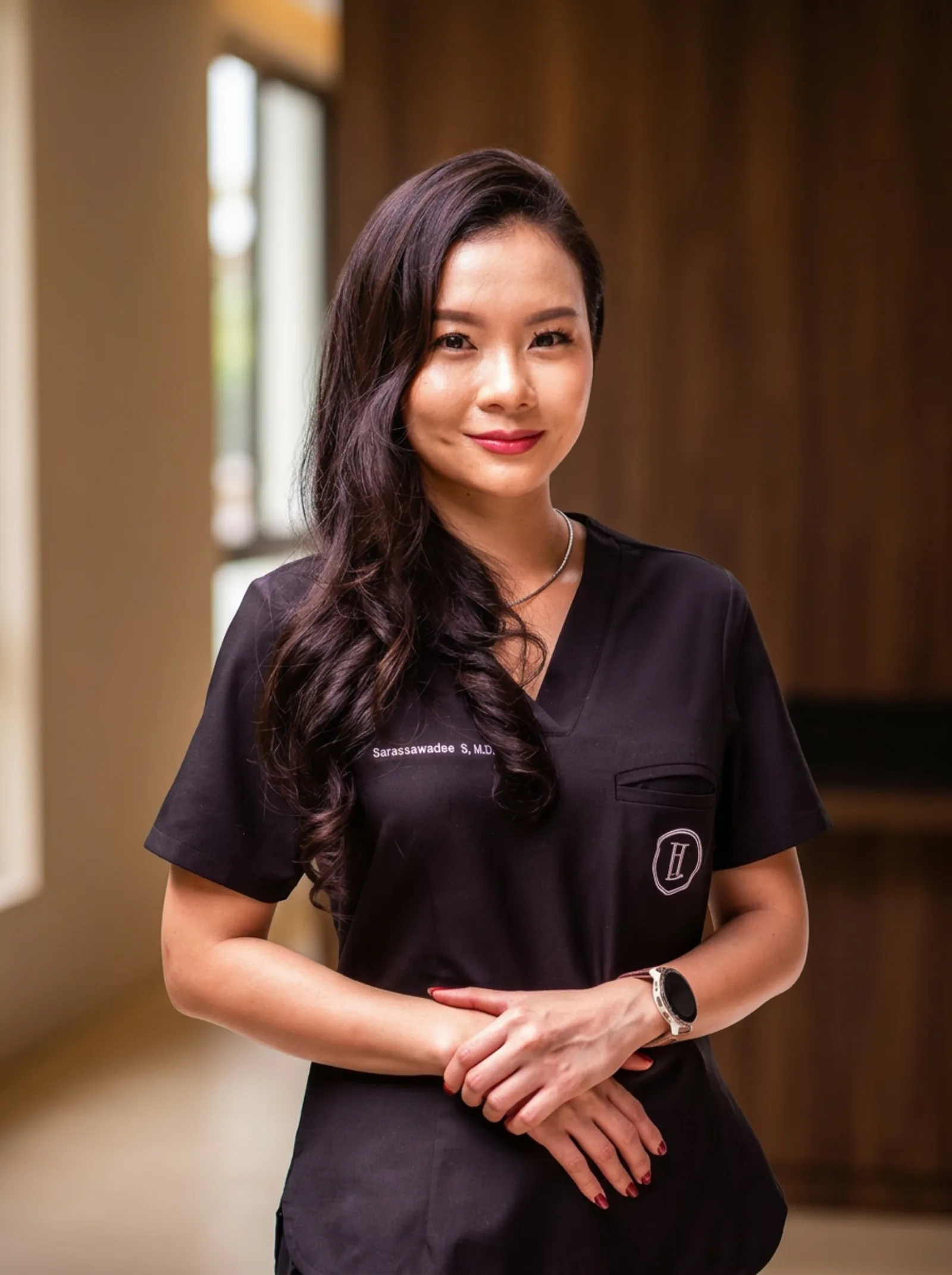
Dr. Sarassawadee Suwanjinda (Dr. Petch)
Verified PhysicianCo-Founder & Chief Medical Strategy Officer
International Board of Lifestyle Medicine (IBLM) Diplomate
Dr. Sarassawadee Suwanjinda (Dr. Petch) is Co-Founder & Chief Medical Strategy Officer at Healthi Life, an International Board of Lifestyle Medicine (IBLM) Diplomate. She leads the longevity programs — biological-age and biomarker-driven protocols designed and re-tested over time.