
Glutathione Injections: What to Know Before You Book

What glutathione injections do, what the evidence supports, and what remains unknown, with fees and safety points to settle with a physician first.
This page is for general information and does not constitute medical advice, diagnosis, or treatment. Results vary between individuals. Every medicine and peptide listed here is dispensed only after a medical consultation at Healthi Life and on a physician's prescription. Prices are published for transparency, not as an offer to supply. Always consult a qualified physician about your condition. See our full medical disclaimer.
Glutathione injections deliver a tripeptide the body already makes, directly into the bloodstream or muscle. The evidence for skin lightening or general anti-aging is limited and mostly small trials, and no glutathione product is FDA-approved in the United States. Any decision belongs to a physician who has seen your data.
This page sets out what is known, what is not, and what to ask before you book. It does not recommend a treatment. It describes the evidence so that a consultation can start from facts.
What glutathione is and what an injection does
Glutathione is a molecule made of three amino acids: glutamate, cysteine and glycine. Every cell produces it. Its main job is to neutralize reactive oxygen species and to help the liver process toxins. Cysteine is the limiting ingredient in its manufacture, which is one reason nutrition and protein intake bear on the body's own supply. This guide is published by the Healthi Life longevity clinic in Bangkok.
An injection or intravenous infusion places the compound in the blood directly. Oral glutathione is largely broken down in the gut, which is why injectable forms exist. A gluta drip is the common name for an intravenous infusion of glutathione, often combined with vitamin C.
Intravenous delivery raises blood levels for a short period. Whether that changes levels inside tissues, and for how long, is less clear. The molecule is made inside cells and is mostly held there, so a rise in the bloodstream does not show that the cells that matter have received more.
The CDC states that there are no FDA-approved glutathione products in the United States. An injection therefore carries no regulator-set dose, indication or label, and those decisions fall to the prescribing physician.
What the evidence shows and what it does not
The evidence for glutathione injections is thin. Most published work is small, short, or run in specific patient groups, and it does not establish effects in healthy adults.
| Area | Known | Unknown | Key studies |
|---|---|---|---|
| Body's own role | Glutathione is central to antioxidant defense and detoxification | Whether raising blood levels helps healthy people | Forman et al., Mol Aspects Med, PubMed |
| Skin tone | Small trials of oral and topical forms report modest changes in melanin index | Effect of injections, durability, long-term safety | Weschawalit et al., Clin Cosmet Investig Dermatol, PubMed |
| Safety | Short-term use is generally reported as well tolerated in small trials | Safety of repeated high-dose courses over years | Sonthalia et al., Indian Dermatol Online J, PubMed |
| Regulation | No FDA-approved glutathione product exists for these uses | Quality consistency across compounded products | CDC |
Small trials of oral glutathione have reported changes in skin melanin index, but these did not test injections. Dermatology reviews note the lack of rigorous data on intravenous use and raise safety concerns for skin lightening.
The table shows the gap. Injections are used widely, but the research behind them is not proportionate to that use.
Why people ask for glutathione injections
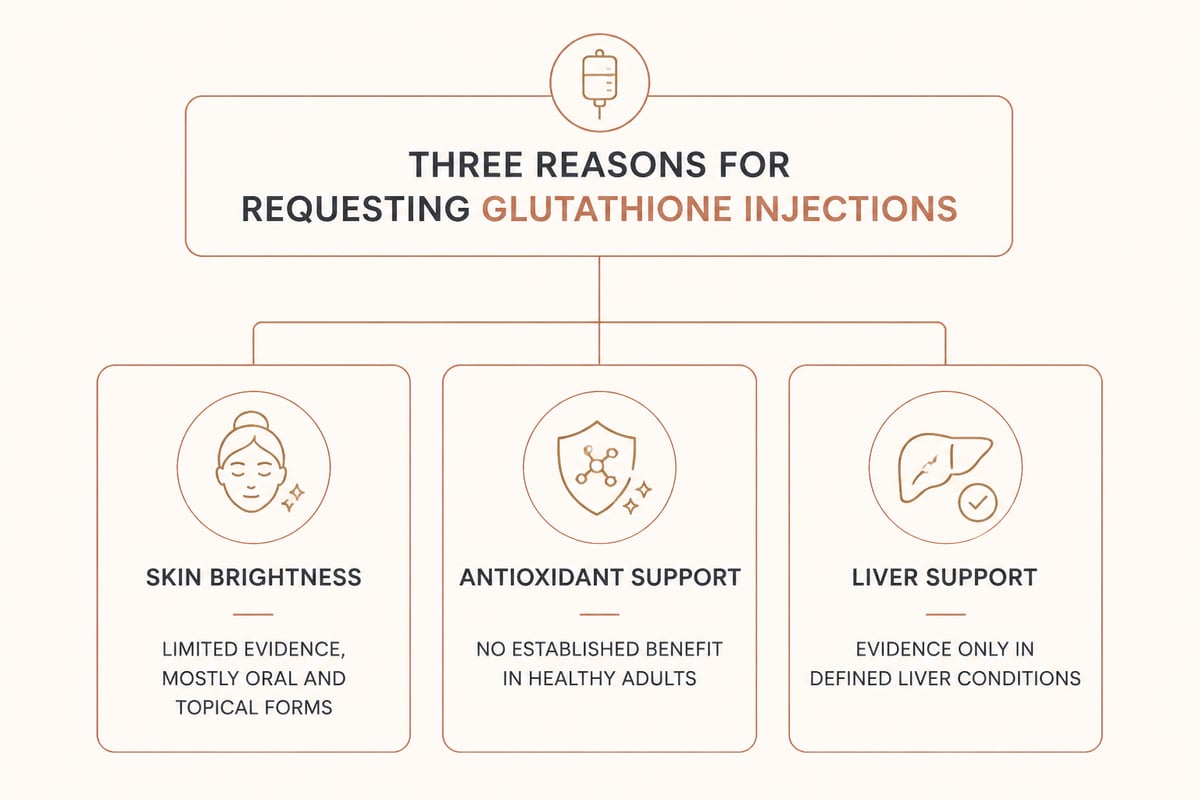
The reasons fall into three groups, and the evidence differs for each.
- Skin brightness. The most common request. Glutathione lowers the activity of tyrosinase, the enzyme that drives melanin production, and this mechanism is why it is discussed for skin tone at all. Evidence exists mainly for oral and topical forms, and it is limited. A guest asking for "whiter skin" and a guest asking for more even tone after sun exposure are making different requests, and a physician will separate them.
- Antioxidant support. Often requested by people with high oxidative stress from travel, sleep loss or alcohol. No trial establishes a benefit in these groups. The request usually rests on the idea that a depleted antioxidant can be refilled, but blood levels and tissue levels are not the same measurement.
- Liver and detoxification support. Glutathione is central to liver metabolism. Evidence in patients with defined liver conditions does not transfer to healthy adults. A person with normal liver enzymes has no documented deficit to correct.
A physician will ask which of these you are after, and whether a measurable marker supports the goal. Some people arrive with a fourth reason: they saw a result on someone else. A single case, with no baseline and no control, is not evidence, and a consultation can say so plainly.
Injection versus IV drip: how they differ
An intramuscular injection delivers a small volume into muscle. An intravenous drip delivers a larger volume over a longer period directly into a vein.
The distinction matters for two reasons. The route changes how quickly blood levels rise. It also changes the practical load: an infusion requires venous access, sterile preparation and monitoring by a nurse or physician.
Neither route has an approved glutathione product behind it in the United States. The CDC states that there are no FDA-approved glutathione products in the United States. The product used in a clinic is therefore a matter of sourcing and compounding quality, and you are entitled to ask where it came from and who prepared it.
For the infusion format in general, see the page on IV drip therapy in Bangkok.
How long glutathione injections are taken
There is no evidence-based schedule for glutathione injections in healthy adults. Published trials differ in length and design, and none sets a standard course. Published trials of oral forms, for example, ran for a few weeks, so they cannot be read as a template for injections.
Clinics often describe courses lasting weeks. That practice comes from convention, not from a trial that tested one course against another. The same applies to the interval between sessions and to any "maintenance" phase afterward. A physician decides whether any course is reasonable for you, how it is monitored, and when it stops.
Two points are reasonable to ask. What marker will be checked before and during treatment? What result would lead to stopping? If neither question has an answer, the course has no measurable purpose.
A third point follows. Ask what happens after the course ends. Small trials of oral glutathione report changes in melanin index that fade after stopping, so an open-ended schedule is a different commitment from a short one. A physician should state in advance whether the plan is a fixed number of sessions or a review at set points, and what you will do if you stop.
The cost of glutathione injections and drips
At Healthi Life, a glutathione IV is priced in the clinic's current list. Infusions are administered only after a medical consultation.
Every medicine and peptide listed here is dispensed only after a medical consultation at Healthi Life and on a physician's prescription. Prices are published for transparency, not as an offer to supply.
Other costs sit around the infusion. The consultation comes first. If your physician wants baseline data, the Check-Up Foundation is THB 10,500. A peptide consultation is THB 2,500. These are separate services and are not required for an infusion unless your physician advises it.
Safety: what is documented and what to ask
Short-term use is generally reported as well tolerated in small trials, but long-term safety data are absent. The documented concerns are specific and worth reading before you book.
- Allergic and skin reactions. Rash and, rarely, more serious reactions have been reported.
- Kidney and liver effects. Case reports exist. A physician should review kidney and liver function first.
- Contamination risk. The CDC warns about compounded and unapproved injectable products. Ask about sterile preparation and sourcing.
- Asthma. Inhaled glutathione has been linked to bronchospasm in people with asthma. Tell your physician if you have it.
- Pregnancy and breastfeeding. Data are insufficient. Treatment is not appropriate without clear medical reason.
Regulators in some countries have issued warnings about high-dose intravenous glutathione for skin lightening. The concern is the absence of safety data, not a proven harm in every user.
What to do before you book
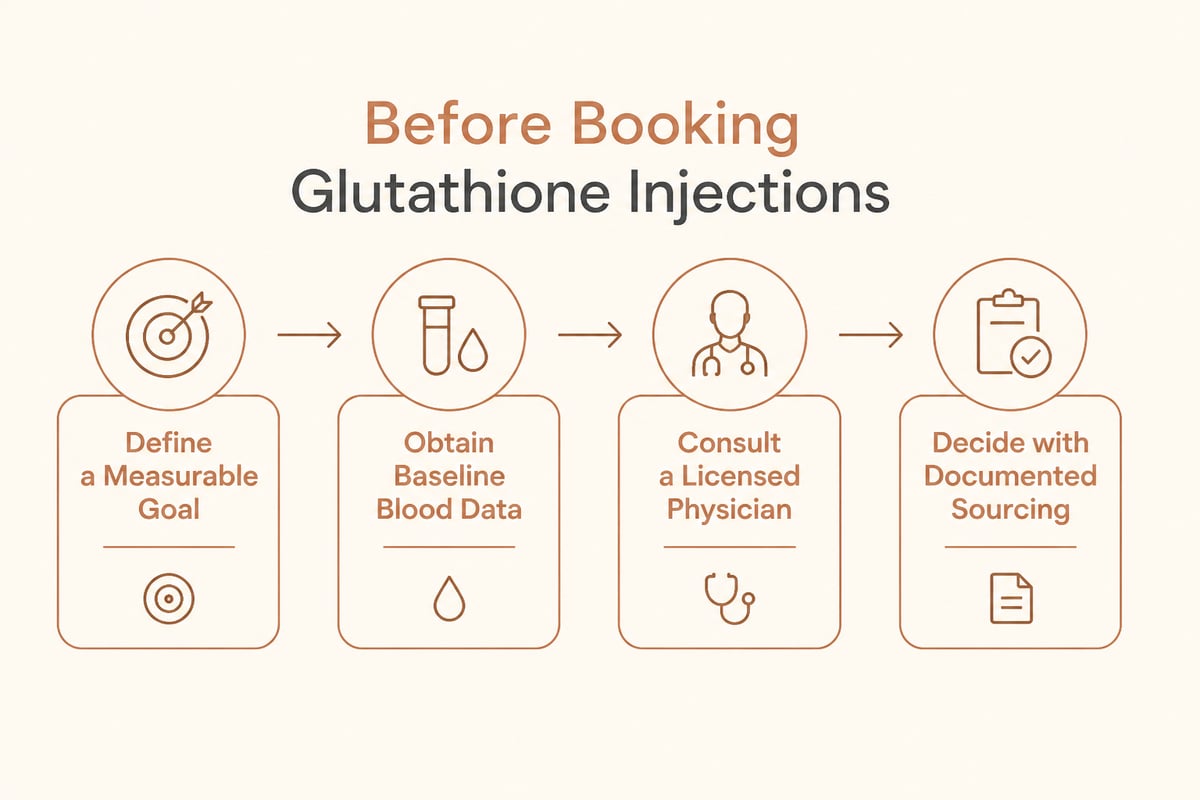
Three steps come first, in this order.
- Define the goal. Name the outcome you want, such as skin tone or recovery after travel. A goal that cannot be measured cannot be reviewed.
- Ask for baseline data. Liver enzymes, kidney function and a full blood count are reasonable starting points. A broader panel gives context for any decision.
- Consult a licensed physician. The physician reviews the data, your medicines and your history, then decides whether glutathione is appropriate.
If your goal is skin, ask whether a different approach fits better. A physician may discuss an IV drip for skin in Bangkok or non-infusion options. For a plain description of what guests report from infusions, the page on glutathione IV before and after is available. It describes experiences, not guaranteed results.
How Healthi Life approaches the question
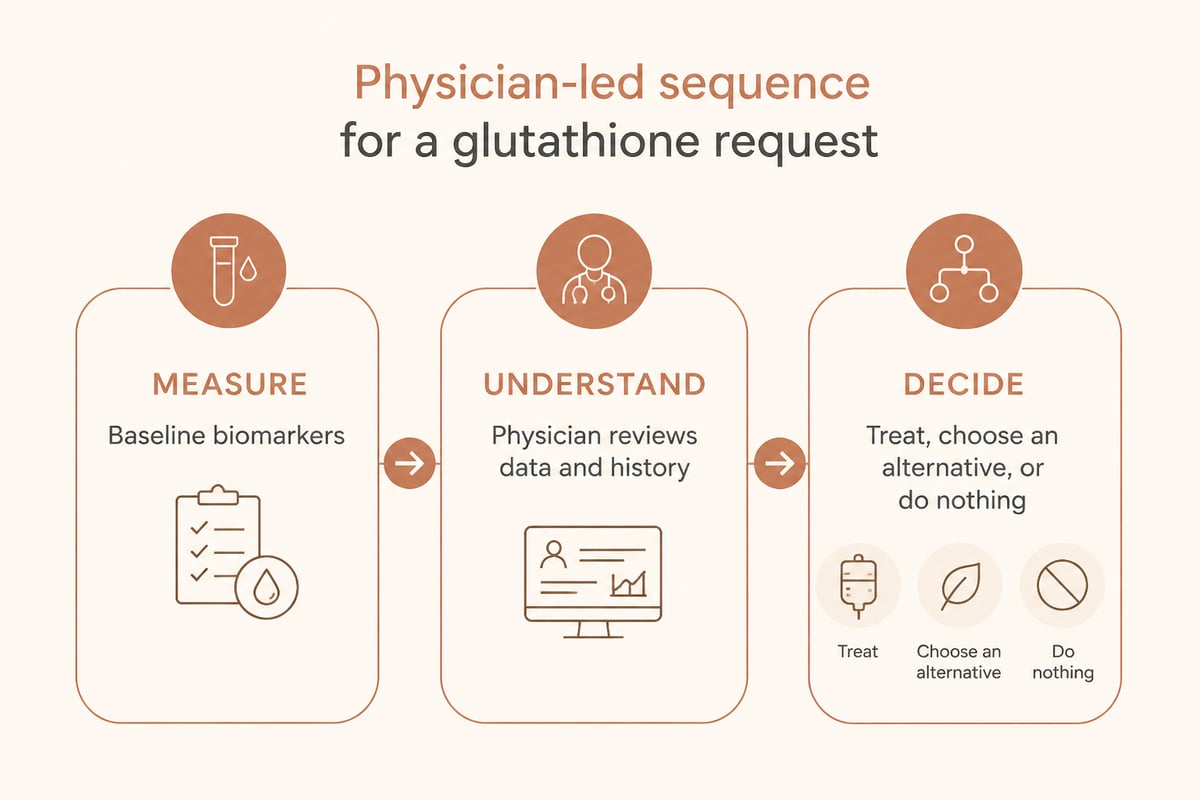
Healthi Life treats a glutathione request as a question to be answered with data, not a menu choice. A physician reviews your history and, where indicated, a biomarker panel before any protocol is proposed. Physicians follow guests over months and years, not a single appointment. That continuity matters here, because a result can only be judged against a baseline that someone recorded.
The house in Ekkamai serves guests from many nationalities and has a 5.0 Google rating from its published reviews. Its Recovery & Performance service covers IV therapy, cellular therapy, skin and hair treatments, and private testing, each following a consultation. Some guests leave a consultation without an infusion, because the data did not support one.
In practice, the consultation covers your medicines, your history of allergies or asthma, and the one outcome you want. Where the goal is skin, the physician may point to a different route. The prescription, if there is one, follows the consultation and not the booking.
FAQ
What is a gluta drip?
A gluta drip is an intravenous infusion of glutathione, sometimes combined with vitamin C. It is given in a clinic by trained staff. No glutathione product is FDA-approved in the United States for this use.
Do glutathione injections lighten skin permanently?
No evidence shows a permanent effect. Small trials of oral glutathione have reported changes in melanin index, and durability after stopping is unclear. Data on injections are limited.
Who should avoid glutathione injections?
People with asthma, kidney or liver disease, known allergies to the preparation, and those who are pregnant or breastfeeding should discuss risks with a physician first. A physician decides after reviewing your data.
Can I get glutathione injections without a consultation?
At Healthi Life, no. A licensed physician sees you first, reviews your history, and prescribes only if treatment is appropriate. Consultation and prescription are available online and on site.
Are there alternatives to glutathione injections?
Depending on your goal, a physician may discuss sun protection, topical agents, nutrition, or other infusion formats. The choice depends on what you want to change and what your data show.
This page is for information only and is not medical advice. Medical consultation and prescription are available online and on site at Healthi Life, Ekkamai, Bangkok.
If you are considering a glutathione infusion, write down the one outcome you want and bring it to a physician before anything else. At Healthi Life in Ekkamai, Bangkok, a licensed doctor reviews your biomarkers and history, then explains what the evidence supports and what it does not. You can arrange this through a Discovery Consultation, where the decision is made after the data, not before it.
Every medicine named on this page is dispensed only after a medical consultation at Healthi Life and on a physician's prescription. No dosing schedule is published here; the dose is set by the prescribing physician. This page is published for transparency, not as an offer to supply.
- 5.0 Google Rating · 238 reviews
- 2,500+ Guests
- 50+ Countries
- 2025 Regenerative Clinic of the Year in Asia-Pacific — GlobalHealth Asia-Pacific Awards