
Juvelook vs Profhilo: Which Skin Booster Suits You

Juvelook vs Profhilo compared on mechanism, evidence, timeline, downtime and Thailand cost, so you can decide with your physician.
Juvelook vs Profhilo comes down to mechanism. Juvelook combines PDLLA and hyaluronic acid to stimulate collagen gradually. Profhilo is a high-concentration hyaluronic acid that hydrates the skin. We do not offer Profhilo. Juvelook is generally considered for texture and quality over months. The choice is made by a physician, after examining the skin.
What is the difference in how each product works?
The difference is the active material. Juvelook contains poly-D,L-lactic acid (PDLLA) with non-cross-linked hyaluronic acid. Profhilo is hyaluronic acid alone, at high concentration, in a hybrid form. Healthi Life is a physician-led longevity clinic in Bangkok.
Hyaluronic acid binds water. It acts quickly on hydration and tissue quality, and the effect is largely physical: more water held in the dermis. Because the molecule is naturally cleared by the body, its effect is generally temporary.
PDLLA works differently. It is a biostimulator. The polymer acts as a signal, and the skin's own fibroblasts respond by laying down collagen. That response builds over several weeks, which is why published work on Juvelook assesses results at 8 and 24 weeks.
That gap in mechanism explains most of the gap in timeline. One product supplies moisture. The other prompts the skin to produce structure. Juvelook includes both elements: its hyaluronic acid component supports hydration while the PDLLA-driven collagen response runs its course.
Is Juvelook a filler or a skin booster?
Juvelook is a skin booster, not a filler. It is injected into the skin, not placed to add volume beneath it.
A filler restores or shapes volume at a specific point, such as a cheek, a jawline or a lip. A skin booster improves the quality of the skin itself: texture, fine lines, elasticity and hydration. Juvelook belongs to the second group. Its PDLLA component signals fibroblasts to produce collagen, and its hyaluronic acid component supports hydration while that process runs.
The distinction shapes how treatment is planned. A filler is judged by the shape it creates on the day. A skin booster is judged over months, against a baseline, by how the skin looks and feels across the whole treated area. Published work reflects this. A 2026 prospective cohort study applied the PDLLA-HA formulation to the tear trough and assessed results one month after each of three sessions, and a 2025 study scored outcomes with the Global Aesthetic Improvement Scale at 8 and 24 weeks.
Our page on Juvelook in Bangkok describes how it is used in practice.
Juvelook vs Profhilo: side-by-side comparison
The table sets both products against the same five attributes. Profhilo details reflect general published characteristics, not a service we provide.
| Attribute | Juvelook | Profhilo |
|---|---|---|
| Mechanism | PDLLA plus non-cross-linked hyaluronic acid; stimulates collagen | High-concentration hyaluronic acid; hydrates and improves laxity |
| Evidence | Small clinical studies and cohorts, including 40 patients over five sessions | Published clinical experience; protocols vary by clinic |
| Timeline | Gradual; assessed at 8 and 24 weeks in published work | Hydration effect generally appears sooner; sessions are spaced weeks apart |
| Downtime | Minor swelling, redness or small bumps at injection points | Injection-site reactions are generally mild and temporary |
| Thailand cost | Juvelook THB 15,000; x2 THB 33,000; Premium THB 45,000-65,000 | Not offered at Healthi Life |
Treat the table as orientation. It does not replace an examination.
What does the evidence say about Juvelook?
The published evidence for Juvelook is real but modest in size. The studies are small and mostly short.
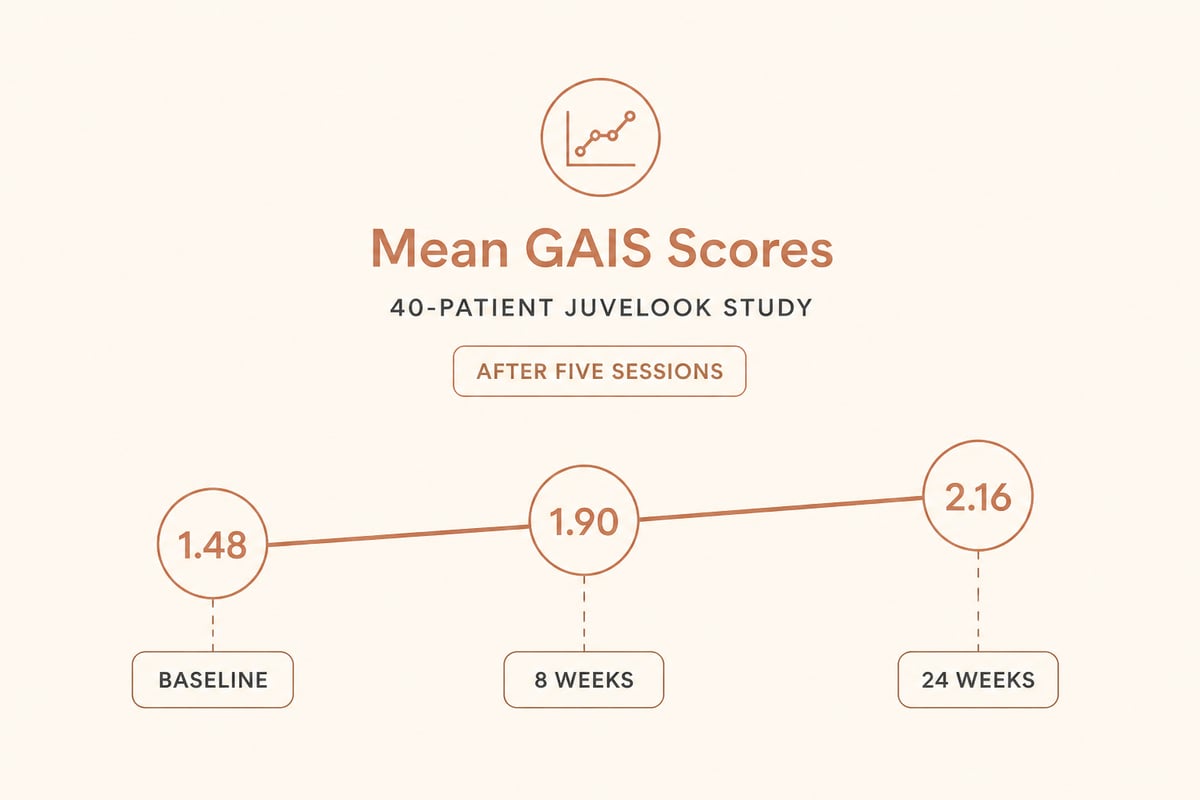
A 2025 study followed 40 patients treated with Juvelook over five sessions. Outcomes were assessed at baseline, 8 weeks and 24 weeks. Mean Global Aesthetic Improvement Scale (GAIS) scores rose from 1.48 at baseline to 1.90 at 8 weeks and 2.16 at 24 weeks, as reported in Aesthetic Plastic Surgery via PubMed. The direction of travel matters here. The score kept rising after the early weeks.
A preliminary 2024 study included 16 patients. They received two or three sessions spaced four weeks apart. The researchers reported no severe adverse events, per the Journal of Cosmetic Dermatology. The formulation studied contained 42.5 mg PDLLA and 7.5 mg non-cross-linked HA.
A 2026 prospective cohort study applied the same PDLLA-HA formulation to the tear trough. It evaluated three injections, with assessments one month after each session, reported in Aesthetic Plastic Surgery.
What is not known: long-term durability beyond these windows, and direct head-to-head results against Profhilo. Neither study compares the two products.
How do the timelines and downtime compare?
Profhilo is generally associated with an earlier hydration effect, while Juvelook builds over weeks. That is a consequence of the mechanisms above.
For Juvelook, the 2025 data above point to a gradual curve across 8 and 24 weeks. Treatment is typically a short series. Published work describes two to three sessions, spaced about four weeks apart in the 2024 study. Your physician sets the number after assessment.
Downtime is generally minor for both. Possible redness, swelling or small bumps at injection points may occur. These are usually short-lived, but individual response varies. For a founder with a board meeting or an executive flying out, the practical step is to schedule the first session with a buffer of several days, then judge your own response.
Is there a downside to Profhilo?
Profhilo has limits, as every injectable does. Because it is hyaluronic acid, it adds hydration but does not stimulate collagen the way a PDLLA product does.
Common effects are generally temporary, such as injection-site bumps, bruising and tenderness. Rarer complications exist for any injectable procedure, including infection and vascular events. These are reasons the injector's training matters more than the product name.
Some people need a short series before judging the result. Others find the effect subtle. Whether it fits you depends on skin condition, goals and medical history. Because we do not provide Profhilo, we will not advise on a protocol for it. A physician who offers it can.
How does Juvelook differ from other collagen-stimulating options?
Juvelook is one of several biostimulators, and each behaves differently. The useful comparison is by active material, not by brand.
Juvelook pairs PDLLA, a synthetic polymer that prompts the skin to build collagen over weeks, with non-cross-linked hyaluronic acid for hydration. The formulation studied in one published work contains 42.5 mg PDLLA and 7.5 mg non-cross-linked HA. Other options in this category rely on a different signal, such as polynucleotides, which support tissue repair by another route. Two products can aim at skin quality and still ask the skin to respond in different ways, on different timelines.
If you are weighing it against another option, these comparisons go deeper:
- Juvelook vs Sculptra covers the two PDLLA products head to head.
- Juvelook vs Rejuran covers the polynucleotide alternative.
Each comparison asks the same question: what does your skin need, and over what period? Fine texture, early laxity and overall skin quality point toward a different choice than a defined area of volume loss. A physician answers it from an examination, not from a product name.
How should a physician decide between them?
A physician decides after assessing skin quality, history and the result you want. The product is the last decision, not the first.
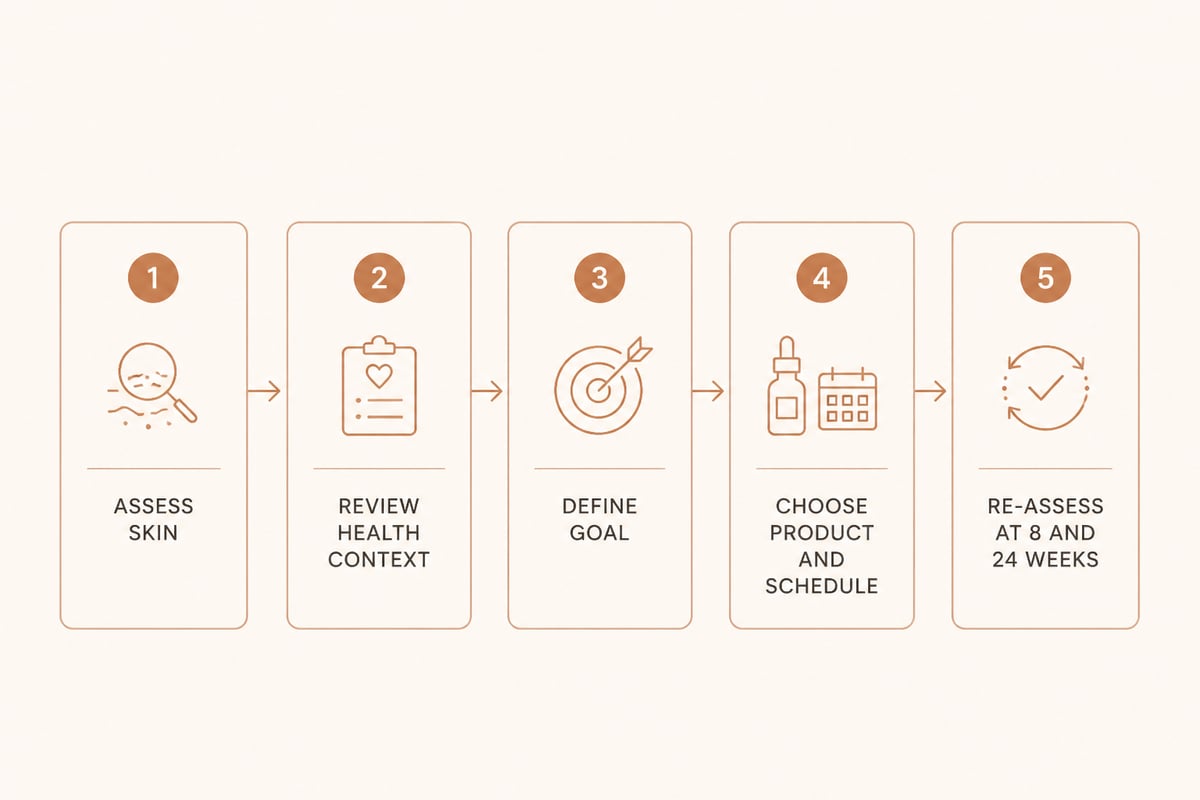
A sensible sequence looks like this:
- Assess the skin. Thickness, laxity, texture, hydration and sun damage.
- Review health context. Medications, autoimmune conditions, prior injectables and healing history.
- Define the goal. Quicker hydration, slower structural change, or a combination.
- Choose the product and schedule. Including the interval between sessions.
- Re-assess. At the points the evidence suggests, such as 8 and 24 weeks.
Skin is one part of how you age. For executives managing their health as an ongoing project, aesthetic treatment sits alongside objective measurement. Our Recovery & Performance medicine service covers skin, IV therapy and cellular work under physician supervision. Where skin quality is a priority, a baseline of biological markers and a plan across months is worth more than a single session. Our Longevity Programs are built on that logic, with up to 300 biomarkers, scheduled re-testing and continuous medical supervision.
What does Juvelook cost in Thailand?
Juvelook costs THB 15,000 for a single treatment. Two treatments are THB 33,000. The Premium option ranges from THB 45,000 to THB 65,000.
Prices are published for transparency, not as an offer to supply. The final plan, including the number of sessions, follows a consultation with a licensed physician. We do not offer Profhilo, so we publish no figure for it.
For peptide-based or other regenerative options discussed during your consultation, the peptide consultation is THB 2,500, and the Check-Up Foundation is THB 10,500. Every medicine and peptide listed here is dispensed only after a medical consultation at Healthi Life and on a physician's prescription. Prices are published for transparency, not as an offer to supply.
What does Healthi Life add beyond the injection?
Healthi Life measures before it treats. Physicians use a panel of 150+ lab biomarkers and follow guests over months and years, not a single appointment.
The house in Ekkamai is private and physician-led. More than 2,500 guests from 50+ nationalities have been served, with a 5.0 Google rating across 238+ reviews. The clinic was named Asia-Pacific Regenerative Clinic of the Year 2025. These are facts about the house, not a claim about any treatment result.
Skin is often the visible end of something systemic: sleep, hormones, inflammation, nutrient status. A physician who sees the data can advise whether an injectable is an appropriate first step. For frequent travelers, our online consultation allows the discussion to begin before you land.

Juvelook vs Profhilo: frequently asked questions
What are the key differences between Viscoderm Hydrobooster and Profhilo?
Both are hyaluronic acid products, but they differ in formulation, concentration and manufacturer. Neither is a PDLLA biostimulator. We do not offer either, so we cannot advise on protocols. A physician who does can compare them for your skin.
Can Juvelook and Profhilo be used together?
Some physicians combine a hydrating product with a biostimulator. There is no published head-to-head or combination data cited here, so the decision rests with the treating physician after examination.
Is Juvelook safe?
A 2024 preliminary study of 16 patients reported no severe adverse events, per the Journal of Cosmetic Dermatology. That sample is small. Suitability depends on your history, which a physician reviews first.
What are the differences between Botox and Profhilo?
They do different jobs. Botox is a neuromodulator that relaxes specific muscles to soften expression lines. Profhilo hydrates and improves skin laxity. They are not substitutes, and they act on different tissues. Our page on Botox explains how it is assessed.
How many Juvelook sessions are typical?
Published studies used two to five sessions, with intervals of about four weeks in the 2024 work. Your physician sets the number after assessment, and none of this is a promise of outcome.
This page is for information only and is not medical advice. Medical consultation and prescription are available online and on site at Healthi Life, Ekkamai, Bangkok.
If you are weighing a skin booster, the next step is to ask a physician what your skin and your baseline data actually show. At Healthi Life in Ekkamai, Bangkok, a physician reviews your history and, where it applies, your biomarkers before recommending anything, and you can arrange this through a Discovery Consultation, where we talk through your goals and plan the first assessment together.
- 5.0 Google Rating · 238 reviews
- 2,500+ Guests
- 50+ Countries
- 2025 Regenerative Clinic of the Year in Asia-Pacific — GlobalHealth Asia-Pacific Awards