
MCV Blood Test: What It Measures and How to Read It
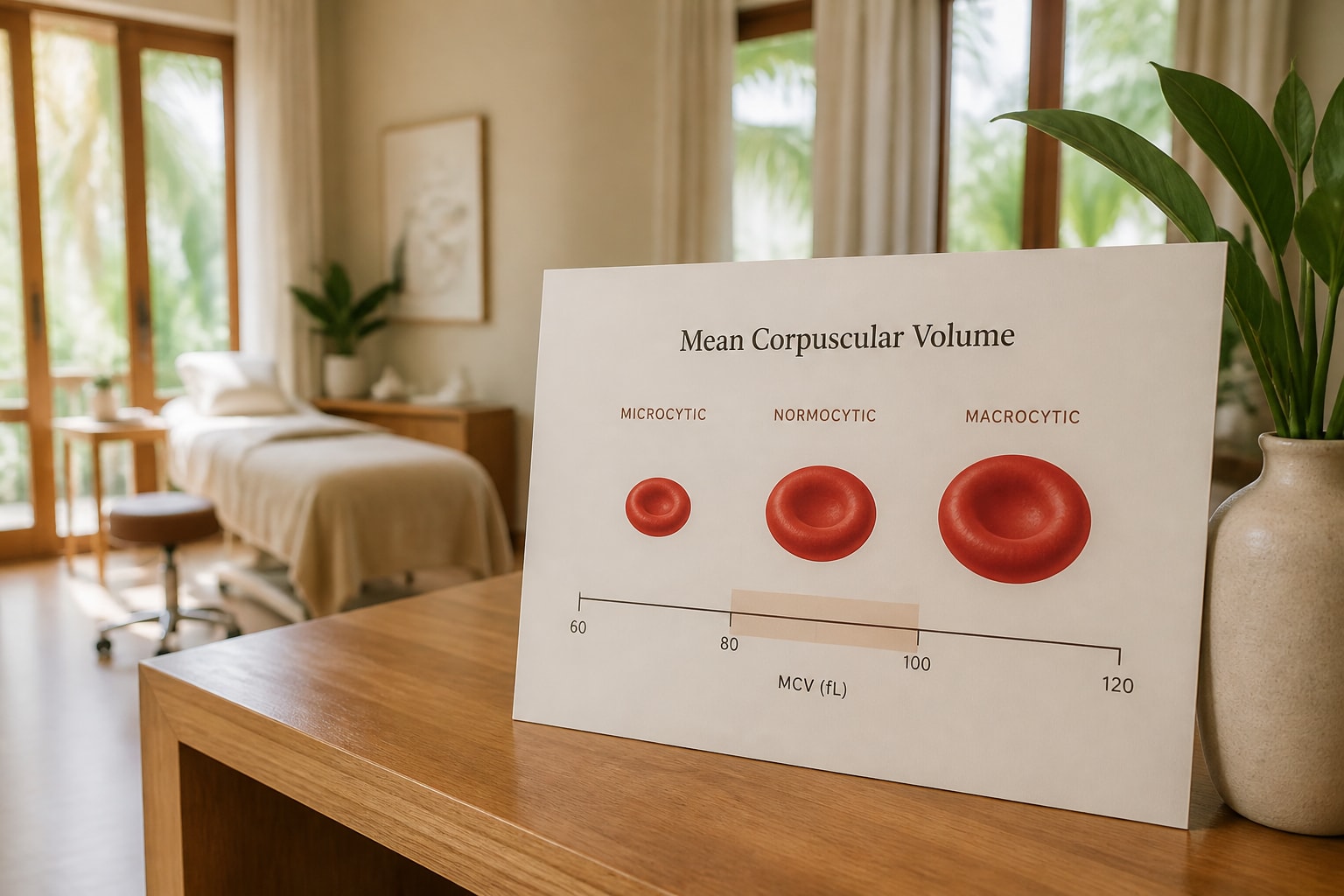
An MCV blood test measures average red blood cell size. See the reference range, what low or high values can mean, and which results need a physician.
This page is for general information and does not constitute medical advice, diagnosis, or treatment. Results vary between individuals. Every medicine and peptide listed here is dispensed only after a medical consultation at Healthi Life and on a physician's prescription. Prices are published for transparency, not as an offer to supply. Always consult a qualified physician about your condition. See our full medical disclaimer.
An MCV blood test measures the average size of your red blood cells, reported in femtoliters (fL). MCV stands for mean corpuscular volume, and it is a standard line on the complete blood count (CBC). A result outside the reference range does not name a disease. It tells a physician where to look next.
This article explains what the number represents, how to read a low or high result, and which companion values change its meaning.
What does an MCV blood test measure?
The test measures the average volume of a single red blood cell. According to MedlinePlus, MCV reflects the average size of red blood cells and is commonly included in a complete blood count. Healthi Life is a physician-led longevity clinic in Bangkok.
A femtoliter is one quadrillionth of a liter. Red blood cells are tiny, so the unit is small too.
The analyzer derives MCV from the volume of the packed red cells and the red cell count. It is a calculated average. A sample can contain a mix of small and large cells and still return a normal MCV, because the two cancel out. This is one reason the number is never read alone.
What is a normal MCV range?
A MedlinePlus reference gives an MCV range of 79 to 95 fL and notes that normal ranges can vary slightly between laboratories, so the limits on your own report apply.
Always compare your result with the range printed on your own report. The table below shows common adult reference values for the red cell indices that are read together.
| Value | What it describes | Typical adult reference | Unit |
|---|---|---|---|
| MCV | Average red cell size | 79 to 95 (MedlinePlus reference) | fL |
| MCH | Average hemoglobin per red cell | Varies by laboratory | pg |
| MCHC | Hemoglobin concentration within red cells | Varies by laboratory | g/dL |
| RDW | Variation in red cell size | Varies by laboratory | % |
| Hematocrit | Share of blood volume made of red cells | Varies by sex and lab | % |
Laboratory methods, instruments and populations differ, so the range on your report governs.
What does it mean if my red blood cells are small?
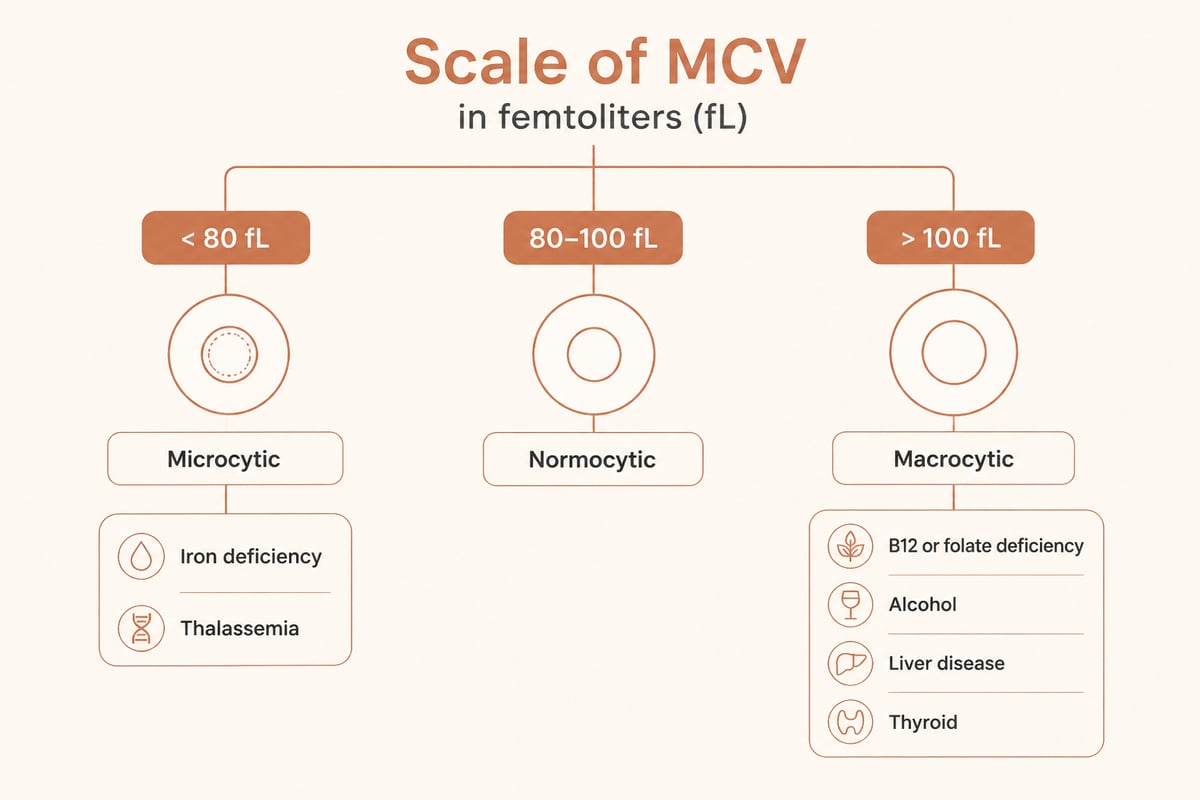
Small red blood cells, called microcytosis, usually means an MCV below the lower limit of the reference range.
According to MedlinePlus, a low MCV can be associated with iron-deficiency anemia or thalassemia. Those are the two most common explanations, and they are separated with further tests.
- Ferritin and iron studies show whether iron stores are depleted.
- RDW tends to be raised in iron deficiency and often normal in thalassemia trait.
- Hemoglobin electrophoresis looks for thalassemia and other hemoglobin variants.
An adult with a low MCV, a normal or near-normal hemoglobin and normal iron stores may carry a trait rather than a deficiency. Giving iron to that person does not correct the finding. This is a decision for a physician after seeing the data.
What does a high MCV mean?
A high MCV, called macrocytosis, means the average red cell is larger than expected. MedlinePlus notes that a high MCV can be associated with vitamin B12 or folate deficiency and liver disease.
An NHS Scotland pathway for isolated macrocytosis lists the considerations a clinician works through:
- Alcohol intake and smoking.
- Current medicines.
- Vitamin B12 and folate levels.
- Blood film and reticulocyte count.
- Liver function.
- Thyroid function.
Not every cause is a deficiency. Regular alcohol use and several medicines can raise MCV, and reticulocytes, which are young red cells, are larger than mature ones, so a recovering bone marrow can also lift the average.
For the formal clinical approach, NHS Scotland also publishes guidance on macrocytic anemia, including possible causes and the investigations used.
What does the MCH value on a blood test indicate?
MCH, mean corpuscular hemoglobin, indicates the average amount of hemoglobin inside one red blood cell, measured in picograms. It often moves in the same direction as MCV, because a larger cell can hold more hemoglobin.
A low MCH with a low MCV supports a picture of small, pale cells. A high MCH with a high MCV supports large cells. When MCH and MCV disagree, the physician looks more closely at the sample.
MCHC is the related value that describes hemoglobin concentration rather than amount. Healthi Life has a separate explainer on the MCHC blood test.
What is a CBC with differential, and where does MCV sit?
A complete blood count measures red cells, white cells and platelets.
A "differential" adds a breakdown of the white cell types: neutrophils, lymphocytes, monocytes, eosinophils and basophils. It concerns infection, inflammation and immune activity. MCV belongs to the red cell section of the same report.
The red cell section usually contains these values:
- Red blood cell count
- Hemoglobin
- Hematocrit
- MCV, MCH and MCHC
- RDW
If the report returns a hematocrit that is far from the reference range, the interpretation depends on sex, altitude, hydration and the rest of the panel. No single hematocrit figure is alarming in isolation. A physician reviews it alongside hemoglobin and symptoms.

Why MCV needs context
An MCV result alone cannot diagnose a disease. MedlinePlus states that clinicians interpret it alongside other test results and medical history.
Three situations show why context matters.
Mixed deficiencies. Iron deficiency shrinks cells and B12 deficiency enlarges them. Present together, they can produce a normal MCV with a wide RDW.
Serial values. A single reading is a snapshot. A slow drift from 88 to 97 fL over several years, still within range, can be informative. A single yearly check rarely shows it.
Travel and lifestyle. Changes in diet, work schedule and alcohol exposure can alter red cell indices over months. The reference range does not account for this. The physician does.
This is where tracking over time earns its place. Healthi Life physicians follow guests over months and years, so a trend in MCV can be read against earlier results rather than against a population average.
What tests usually follow an abnormal MCV?
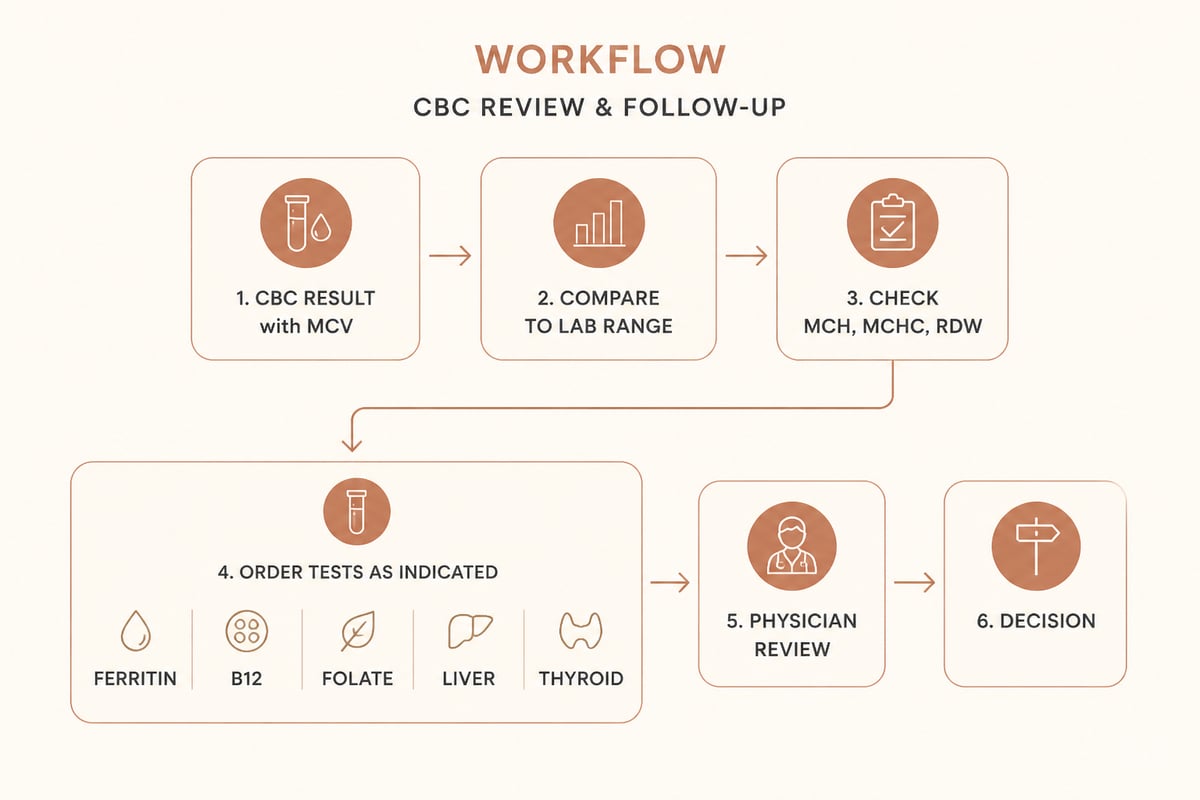
The follow-up depends on the direction of the abnormality. The physician chooses the tests after reviewing the full CBC and history.
| MCV result | Common next tests | Question being answered |
|---|---|---|
| Low | Ferritin, iron studies, hemoglobin electrophoresis | Iron deficiency or thalassemia trait |
| High | B12, folate, liver function, thyroid function, reticulocyte count | Deficiency, liver, thyroid or marrow cause |
| Normal with abnormal RDW | Blood film, iron studies, B12 | Mixed picture hidden by averaging |
A blood film is a slide examined under a microscope. It can show cell shape and size variation that the average conceals.
How an MCV blood test fits a longevity assessment
In a longevity setting, red cell indices are one layer of a larger panel. A CBC sits beside inflammatory markers, metabolic markers, hormone levels and organ function. The aim is to see the pattern, not to chase a single value.
The Advanced Check-Up at Healthi Life measures before treating, using a panel of 150+ lab biomarkers, and results are reviewed one-to-one with a physician who turns them into a written plan. The Foundation check-up costs THB 10,500, published and all-inclusive, with no separate lab fees. The Foundation health check-up in Bangkok is the entry point into longevity medicine, where programs run for three to twelve months and draw on up to 300 biomarkers under continuous medical supervision.
Not every abnormal MCV needs a program. Many are resolved with a single follow-up test and a plain explanation. Some warrant a hematology referral. The physician decides which, after seeing the data.
What is not known
Some limits are worth stating plainly.
- A reference range describes a laboratory population, not you. A value inside it can still be unusual for your own history.
- MCV cannot distinguish between causes that produce the same cell size.
- Sample handling matters. A sample that sits too long can show a falsely raised MCV in some analyzers.
- Medicines and supplements can change results. Tell the physician what you take before the draw.
FAQ
Do I need to fast for a CBC?
A CBC alone does not require fasting. If the draw is combined with glucose, lipids or other fasting-sensitive markers, the physician will tell you. Follow the instructions given for the whole panel.
Can alcohol raise my MCV?
Yes. Regular alcohol intake is a recognized cause of a high MCV, and the NHS Scotland pathway lists alcohol among the first considerations. The change can occur without any vitamin deficiency and may reverse when intake falls.
Is a slightly low or high MCV dangerous?
A small deviation is often benign, but the number alone cannot say. It is read with hemoglobin, RDW, ferritin, B12 and folate, and a physician decides whether further testing is needed.
Can MCV change over time?
Yes. Diet, iron stores, alcohol, medicines and thyroid or liver status can all move it. A repeated measurement shows whether a value is stable or drifting.
Should I take iron or B12 if my MCV is off?
Not before the cause is known. Iron given to someone with thalassemia trait does not correct the finding, and B12 or folate is chosen only when a deficiency is shown. Supplements are a physician's decision after testing.
When to get tested
Ask for a CBC, which includes the MCV blood test, if you are over 40 and notice persistent fatigue, reduced exercise tolerance, pallor, breathlessness on stairs, or slow recovery after travel or training. Also ask for one if you take regular medicines, drink alcohol most days, follow a restricted diet, or have a family history of thalassemia or other inherited blood conditions. If you already have a result outside the range, bring the report to a physician rather than acting on the number alone.
Every medicine and peptide listed here is dispensed only after a medical consultation at Healthi Life and on a physician's prescription. Prices are published for transparency, not as an offer to supply.
This page is for information only and is not medical advice. Medical consultation and prescription are available online and on site at Healthi Life, Ekkamai, Bangkok.
If you have a recent CBC, take the printed report to your next appointment and ask what the MCV, RDW and ferritin say together. If you do not have one, the Foundation health check-up in Bangkok at THB 10,500 includes the blood work and a one-to-one physician review. Healthi Life in Ekkamai, Bangkok is a private, doctor-led house where every protocol follows consultation with a licensed physician.
Every medicine named on this page is dispensed only after a medical consultation at Healthi Life and on a physician's prescription. No dosing schedule is published here; the dose is set by the prescribing physician. This page is published for transparency, not as an offer to supply.
- 5.0 Google Rating · 238 reviews
- 2,500+ Guests
- 50+ Countries
- 2025 Regenerative Clinic of the Year in Asia-Pacific — GlobalHealth Asia-Pacific Awards