
NAD+ IV Dosage: A Physician-Led Guide to Safe Protocols

What the evidence says about NAD+ IV dosage, how infusion rate affects tolerability, and how a physician decides what is appropriate for you.
This page is for general information and does not constitute medical advice, diagnosis, or treatment. Results vary between individuals. Every medicine and peptide listed here is dispensed only after a medical consultation at Healthi Life and on a physician's prescription. Prices are published for transparency, not as an offer to supply. Always consult a qualified physician about your condition. See our full medical disclaimer.
Verdict: No optimal NAD+ IV dosage has been established in controlled human trials. Doses in published work and in clinics vary widely, and infusion rate matters as much as the total amount. A physician should set any dose after reviewing your history and laboratory data. The evidence is preliminary, so treat the dose as a clinical decision, not a preference.
That is the short answer to the question behind the search for a nad iv dosage. The sections below set out what the literature reports, how the main variables interact, what is known about tolerability, and what a physician reviews before choosing a dose.
What does the research say about NAD+ IV dosage?
The research does not name a correct dose. A PMC review of NAD+ biology and supplementation states that no optimal IV NAD+ dose has been established through controlled human dose-finding or clinical-outcome trials. Healthi Life is a physician-led longevity house in Bangkok.
Two small studies give the clearest reference points.
- A small 2019 pilot gave IV NAD+ over six hours, about 3 μmol/min. The narrative review of intravenous NAD+ reports no adverse events during infusion.
- A small 2018 study gave 1,000 mg daily for six days. The same review reports mild flushing and transient nausea.
Both samples are small. Neither measured long-term outcomes. The review describes the IV NAD+ evidence base as preliminary and insufficient to support routine clinical or wellness use.
IV NAD+ compared with other routes
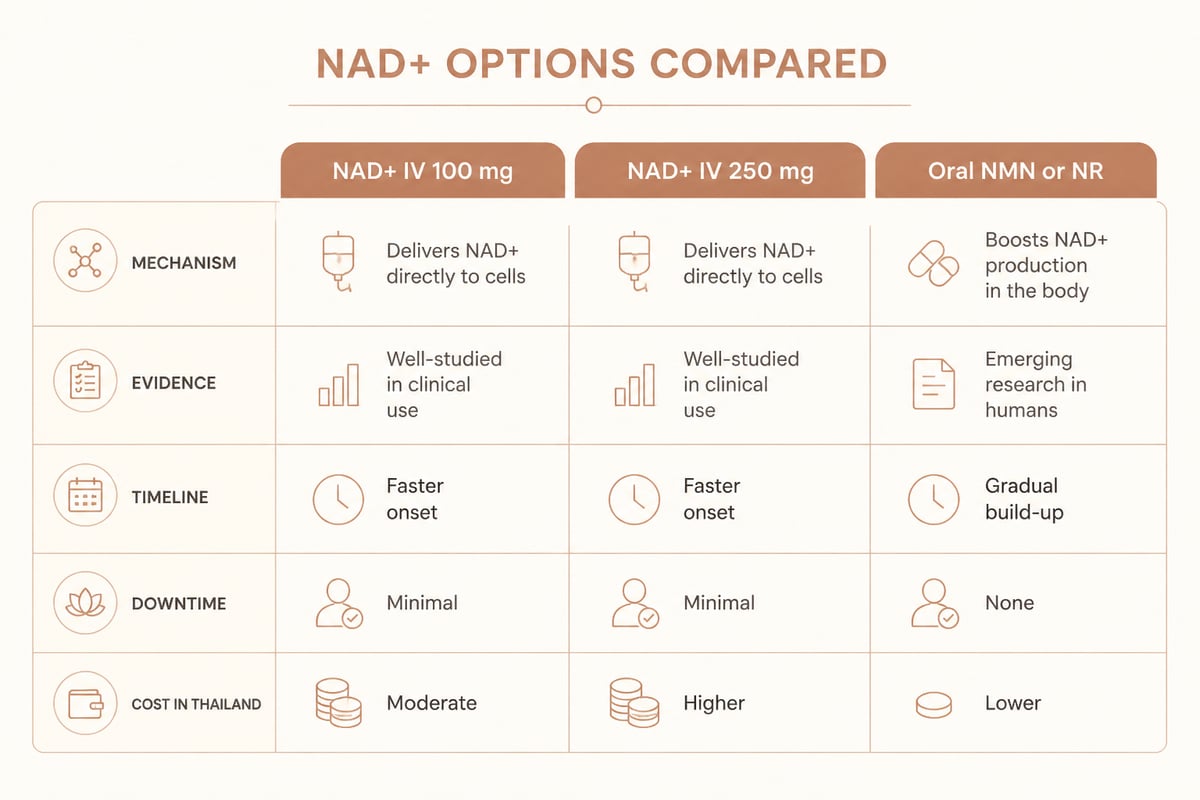
IV NAD+ is one of several ways to raise NAD+ availability, and each route differs in mechanism, evidence and cost. The table sets them side by side.
| NAD+ IV 100 mg (THB 6,000) | NAD+ IV 250 mg (THB 8,500) | Oral precursors (NMN, NR) | |
|---|---|---|---|
| Mechanism | Direct NAD+ delivered into the bloodstream; cellular uptake is debated | Same compound, larger amount per infusion | Precursors converted to NAD+ inside cells |
| Evidence | Small pilot studies; no dose-finding trials | Small pilot studies; no dose-finding trials | More human trials, mostly on blood NAD+ levels |
| Timeline | Infusion runs over a period set by the physician | Longer infusion at a comparable tolerated rate | Daily use over weeks |
| Downtime | None expected; flushing or nausea possible during infusion | None expected; flushing or nausea possible during infusion | None |
| Thailand cost | THB 6,000 per 100 mg session | THB 8,500 per 250 mg session | Varies by product |
The two IV products are listed on the clinic's pages as NAD+ IV and NAD+ IV. Every medicine and peptide listed here is dispensed only after a medical consultation at Healthi Life and on a physician's prescription. Prices are published for transparency, not as an offer to supply.
For the oral side of the comparison, see our explainer on NAD vs NMN.
Why infusion rate matters as much as total dose
Infusion rate is the variable most closely tied to how an infusion feels. The 2019 pilot spread 750 mg over six hours, about 3 μmol/min. That slow pace is part of why no adverse events were recorded.
The arithmetic shows why total dose alone misleads. Two guests can receive the same amount. If one infusion runs slowly and the other is compressed into a short window, the second delivers the same amount per minute at a much higher pace, and the body meets it differently. The same logic applies when comparing the 750 mg pilot with the 1,000 mg daily regimen: the larger daily amount is not automatically the harder one, because the rate at which it is given changes the experience. A faster rate delivers the same total dose in less time. It is also the usual cause of the effects people describe during NAD+ infusions:
- Chest tightness or pressure
- Flushing
- Nausea
- Abdominal cramping
These effects are typically reported as transient and tend to ease when the rate is lowered. A physician or nurse adjusts the rate in response. This is one reason an infusion should not be treated as a fixed product with a fixed duration.
Which factors a physician reviews before setting a dose
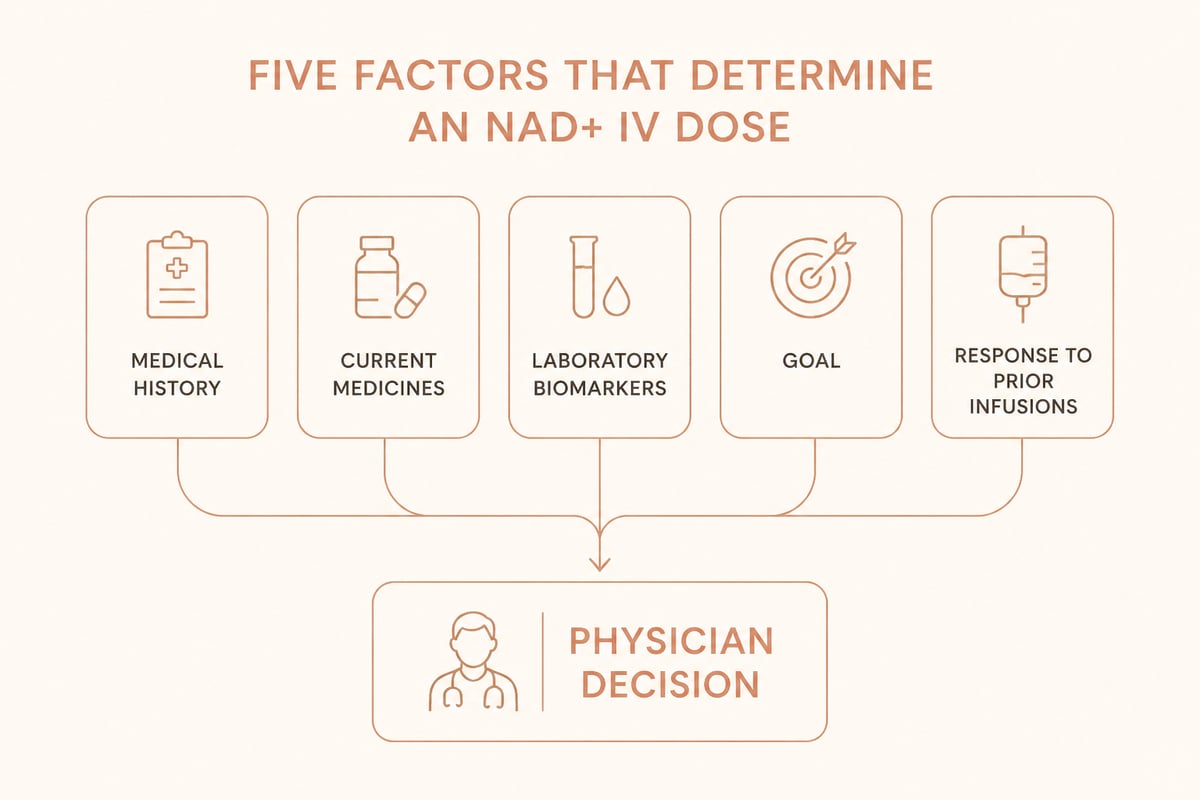
A physician sets a dose from the individual, not from a menu. The data that informs the decision is specific.
- Medical history. Cardiac conditions, blood pressure, kidney and liver function, and prior reactions to infusions.
- Current medicines and supplements. Some interact with NAD+ metabolism or add to flushing and nausea.
- Laboratory data. Baseline biomarkers give the physician something to compare against later.
- Goal. Recovery after travel, a long work cycle, or a broader longevity plan each call for a different conversation.
- Prior response. How earlier infusions felt shapes the next rate and amount.
Without measurement, a dose is a guess. At Healthi Life, the physician measures first, using biomarker panels, and decides after seeing the data. That is the logic of Measure, Understand, Decide.

What is known and not known about safety
The reported safety record is short and comes from very small studies. In the 2019 pilot, no adverse events were observed. In the 2018 study, participants reported mild flushing and transient nausea.
What is not known is considerable.
- Long-term safety of repeated infusions
- Whether benefits outlast the infusion
- How results vary by age, sex or baseline NAD+ status
- Whether higher doses produce meaningfully different outcomes
Absence of reported harm in two very small studies is not evidence of safety at scale. A physician should say so plainly. Anyone with heart disease, uncontrolled hypertension, pregnancy or active illness needs individual medical assessment before any infusion is considered.
How a session is structured
A session follows a consultation, not the other way around. The physician reviews history and data, agrees a plan, and the infusion is given under supervision with the rate adjusted as needed.
In practice, the order is fixed. Before anything is prepared, the physician confirms current medicines, any cardiac or blood pressure concern, and how earlier infusions felt. The product and amount are then chosen, 100 mg or 250 mg in the clinic's range, and the starting rate is set. The rate is not a promise. If flushing, chest tightness or nausea appears, the nurse lowers it, and the infusion simply takes longer. The 2019 pilot ran over six hours, so a session can be a slow event, and the guest should plan time accordingly. Afterward, the physician records how the infusion went, because that record informs the next rate and the decision to continue, change or stop.
This is the difference between a medical infusion and a drip menu. At Healthi Life, the work sits within Recovery & Performance medicine, where every protocol follows a consultation and biomarker review with a licensed doctor.
You can read a fuller account of the process in our guide to what an NAD+ IV drip involves. The clinic's own page on the NAD IV drip in Bangkok describes the service and how to arrange a consultation.
Why a single infusion is the wrong unit of measurement
A single infusion tells you little. A dose is only meaningful against a baseline and a follow-up, and most published studies lack both over any useful period.
Consider what one infusion can and cannot show. A guest may feel unchanged the next day, or notice better energy for a few days. Neither observation separates the effect of NAD+ from sleep, travel, workload or expectation. Several infusions, given with the same rate and recorded the same way, begin to show a pattern. That is why the 2018 study gave six consecutive daily doses rather than one, and why a physician reviews response across a series, not after the first visit.
A sensible approach tracks a small number of measures over months:
- Subjective energy and recovery, recorded the same way each time
- Sleep quality and travel recovery
- Relevant laboratory markers reviewed by the physician
- Tolerability of each infusion
If nothing measurable changes, the physician can stop. That is a legitimate outcome, and a good reason for a program to be physician-led. Physicians at Healthi Life follow guests over time, not a single appointment, so a decision to continue, change or stop rests on trend data.
Common questions about NAD+ IV dosage
Is there an official recommended NAD+ IV dose?
No. The PMC review states no optimal dose has been established by controlled human dose-finding trials. Doses used in practice come from small studies and clinical judgment. A physician decides after reviewing your data.
Does a higher dose work better?
This is not known. No dose-response trials show that a larger amount produces a better outcome. A higher amount may increase flushing or nausea, particularly at a faster infusion rate. A physician weighs the added exposure against any expected benefit.
Why do infusions take so long?
A slower rate is better tolerated. The 2019 pilot ran over six hours at about 3 μmol/min without reported adverse events. Faster delivery is associated with transient flushing, cramping and nausea. The physician sets the rate and adjusts it during the session.
Who should not have an NAD+ infusion?
Anyone with unstable cardiac disease, uncontrolled blood pressure, pregnancy, or an acute illness needs assessment first. Anyone seeking a same-day infusion without a consultation is not a fit for this service. A licensed physician makes the decision after reviewing history and data.
How is the choice between 100 mg and 250 mg made?
The physician chooses from your history, medicines, laboratory results and previous tolerance. The 100 mg product is THB 6,000 and the 250 mg product is THB 8,500. Neither is a default. The choice is made after consultation, and the plan can change.
Your next step is to gather your recent blood work, a list of current medicines and any past infusion reactions, so a physician can judge what is appropriate before any dose is discussed. Healthi Life in Ekkamai, Bangkok is a private, doctor-led house where that review comes first, and you can book a discovery consultation to have a physician go through your data and decide with you whether NAD+ belongs in your plan. This page is for information only and is not medical advice. Medical consultation and prescription are available online and on site at Healthi Life, Ekkamai, Bangkok.
Every medicine named on this page is dispensed only after a medical consultation at Healthi Life and on a physician's prescription. No dosing schedule is published here; the dose is set by the prescribing physician. This page is published for transparency, not as an offer to supply.
- 5.0 Google Rating · 238 reviews
- 2,500+ Guests
- 50+ Countries
- 2025 Regenerative Clinic of the Year in Asia-Pacific — GlobalHealth Asia-Pacific Awards