
How Often Should You Get STD Testing? A Medical Guide

How often should you get tested for STDs? Physician guidance on frequency, which tests to request, and when baseline screening makes sense.
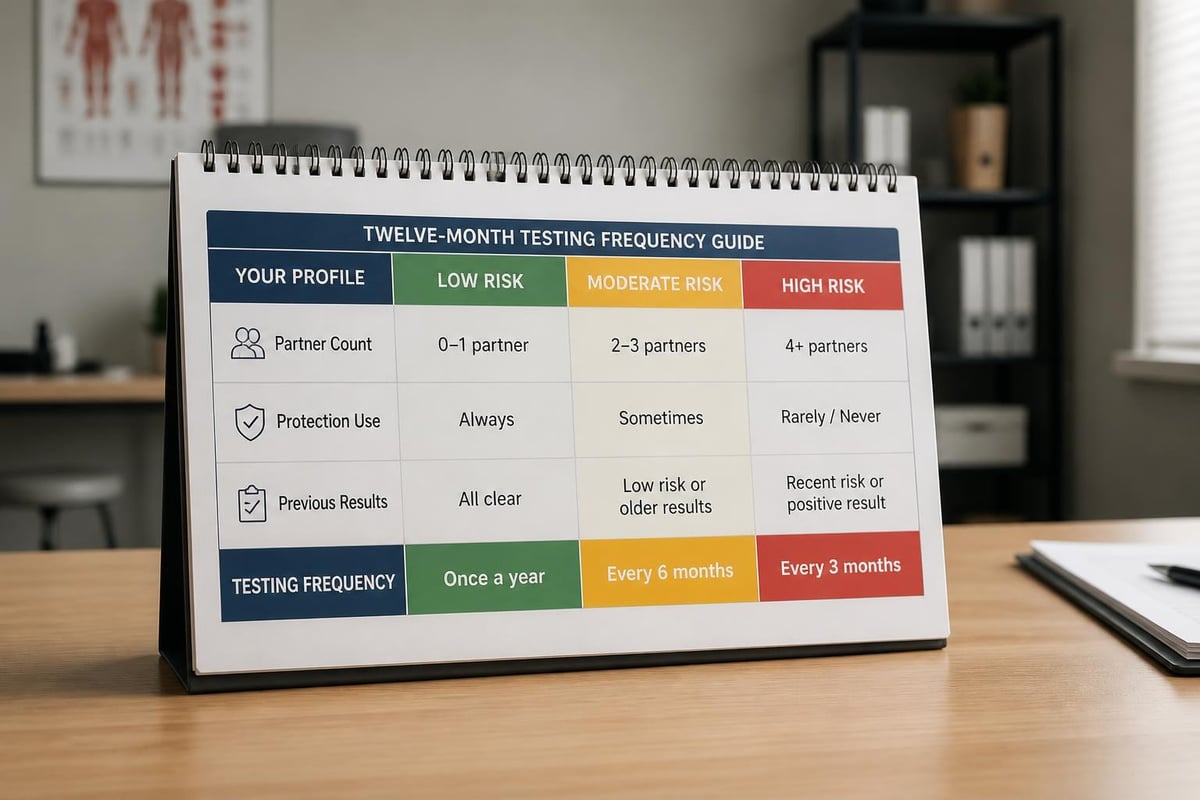
How often to get STD testing depends on your partners, protection and history. Annual testing suits monogamous couples who both tested negative, every six months fits one new partner in a year, and every three months fits multiple partners with inconsistent protection. A physician sets the interval after reviewing your risk.
This page is for general information and does not constitute medical advice, diagnosis, or treatment. Results vary between individuals. Every medicine and peptide listed here is dispensed only after a medical consultation at Healthi Life and on a physician's prescription. Prices are published for transparency, not as an offer to supply. Always consult a qualified physician about your condition. See our full medical disclaimer.
Most people think about std testing once, usually after a specific concern. That approach misses the point. Testing frequency depends on your activity, your partners, and whether you want a baseline or a response. A physician decides after seeing your history and your goals, not a checklist on a public health poster.
Why Testing Frequency Matters More Than Testing Once
A single negative test tells you nothing about your status over time. Many infections have window periods. HSV antibodies can take twelve weeks to appear. HIV can remain undetectable for up to ninety days after exposure. Hepatitis B surface antigen may not show until six weeks post-infection. This guide is published by the Healthi Life longevity clinic in Bangkok.
Testing once and assuming you are clear is not how surveillance works. It is how people miss infections that could have been caught early. The question is not whether to test. The question is when to test again.
Three categories determine your schedule:
- Sexual activity and partner count in the past six months
- Type of protection used consistently or inconsistently
- Previous positive results requiring follow-up or clearance confirmation
The right interval is the one that catches an infection before it causes complications or spreads to another person. That is clinical language. It means testing often enough that you do not waste time or create unnecessary risk.

Annual Testing: When It Is Sufficient and When It Is Not
Annual std testing works for people in long-term monogamous relationships where both partners tested negative before exclusivity and neither has had outside exposure. That is a narrow category. If you are reading this section to justify testing once a year, you probably do not fit it.
The CDC recommends annual chlamydia and gonorrhea screening for sexually active women under twenty-five. That baseline assumes moderate activity and inconsistent condom use. It does not account for multiple partners, travel, or participation in communities with higher baseline prevalence.
| Scenario | Annual Testing Adequate? | Recommended Frequency |
|---|---|---|
| Monogamous, both tested negative | Yes | Annual or as symptoms appear |
| One new partner in past year | Borderline | Every six months |
| Multiple partners, inconsistent protection | No | Every three months |
| High-risk exposure or symptoms | No | Immediate, then repeat per window period |
The mistake is assuming that no symptoms means no infection. Chlamydia and gonorrhea are often asymptomatic in women. HPV rarely shows visible signs before cytology picks it up. Syphilis can present with a single painless ulcer that resolves on its own while the infection continues to progress.
Annual testing is the minimum, not the target. If your physician recommends it, they are assuming you are in the lowest-risk category. If you are not, you are testing too infrequently.
Quarterly Testing: Who Needs It and What It Covers
Every three months is the standard for people with multiple partners, men who have sex with men, individuals using PrEP for HIV prevention, or anyone with a recent positive result that requires confirmation of clearance.
Quarterly std testing is not excessive. It is the interval that matches the window period of most bacterial infections and catches viral infections before they reach advanced stages. It also aligns with re-infection risk when exposure is ongoing.
Quarterly panels typically include:
- HIV combination antigen/antibody test
- Syphilis serology (RPR or VDRL with reflex confirmation)
- Gonorrhea and chlamydia nucleic acid amplification tests (NAAT) from urine or swab
- Hepatitis B and C serology if not previously vaccinated or immune
Some physicians add HSV-2 serology for patients who want a complete baseline. Others do not, because type-specific IgG antibody tests have a false-positive rate high enough to cause unnecessary concern. The decision depends on your history and what you will do with a positive result.
The cost of quarterly testing in Bangkok ranges from 4,000 to 12,000 THB per panel depending on what is included and where it is done. Private labs charge more. Hospital outpatient departments charge less but have longer turnaround times. Advanced Check-Up programs bundle std testing with broader biomarker panels, reviewed in consultation rather than sent by email with no interpretation.

What to Test For: The Difference Between Panels and Single Tests
Public health campaigns push for "full STD panels," but that term has no clinical definition. A full panel at one clinic may exclude HSV. Another may skip hepatitis C. A third may use outdated HIV tests with longer window periods.
You are paying for specific assays. Know which ones you are receiving.
Bacterial Infections
Gonorrhea and chlamydia are detected using NAAT from first-catch urine in men or endocervical/vaginal swabs in women. Pharyngeal and rectal swabs are necessary if you have had oral or anal exposure. Most panels skip those sites unless you request them. That is how throat and rectal infections are missed.
Syphilis requires serology. Rapid tests exist, but they miss early primary syphilis. A standard panel uses a non-treponemal test (RPR or VDRL) with reflex treponemal confirmation if positive. If you had syphilis in the past and were treated, your treponemal test will remain positive for life. Your physician tracks your RPR titer to confirm you are not re-infected.
Viral Infections
HIV testing in 2026 uses fourth-generation combination assays that detect both p24 antigen and antibodies. Window period is eighteen to forty-five days. Older third-generation antibody-only tests are still used in some labs because they are cheaper. They have a longer window period and miss acute infections.
Hepatitis B surface antigen (HBsAg) confirms active infection. Hepatitis B core antibody (anti-HBc) shows past exposure. Surface antibody (anti-HBs) confirms immunity from vaccination. If you were vaccinated as a child, you may not have detectable antibody titers now. That does not mean you are not immune, but some physicians recommend a booster.
Hepatitis C antibody testing is recommended for anyone with a history of injection drug use, blood transfusion before 1992, or high-risk sexual exposure. Positive antibody requires RNA confirmation to distinguish active infection from cleared past infection.
HSV-1 and HSV-2 type-specific IgG serology exists, but it is not included in most panels. Reported sensitivity for HSV-2 ranges from 80 to 98 percent, and is lower for HSV-1. False positives occur, especially with low-positive index values. The clinical utility is debated because most people with HSV-2 never have symptoms, and a positive test does not change management unless you are having outbreaks or need suppressive therapy.
After a Positive Result: Retesting Timelines and Clearance Protocols
A positive std testing result triggers a specific protocol, not a single follow-up test. Treatment duration and confirmation timing depend on the pathogen.
Gonorrhea and chlamydia: Treat with appropriate antibiotics, then retest three months later to confirm clearance and rule out re-infection. Anyone treated for pharyngeal gonorrhea should have a test of cure 7 to 14 days after treatment.
Syphilis: Treated with benzathine penicillin. RPR titers are rechecked at six and twelve months. A failure of titers to fall fourfold within twelve months may indicate treatment failure, and the physician reassesses before any re-treatment.
HIV: A positive screening test requires confirmatory testing with HIV-1/HIV-2 differentiation and viral load. If confirmed, you start antiretroviral therapy and monitor viral load and CD4 count at regular intervals. Viral suppression to undetectable levels takes three to six months on effective therapy.
Hepatitis B: Acute infection is monitored with HBsAg and viral load. Most adults clear the infection within six months. Chronic infection is defined as HBsAg positivity for longer than six months and requires ongoing surveillance and possible antiviral therapy.
Hepatitis C: Confirmed with HCV RNA. Direct-acting antivirals achieve sustained virologic response in more than 95 percent of treated patients in eight to twelve weeks. Sustained virologic response is confirmed by undetectable RNA twelve weeks after treatment completion.
Re-infection is common. Testing once after treatment is not sufficient if your risk factors remain unchanged. Your physician will set a follow-up schedule based on your exposure pattern, not a fixed guideline.
Risk-Based Schedules: Tailoring Frequency to Your Profile
Published guidelines give population-level recommendations. Your physician adjusts them based on your individual risk. That is the difference between a checklist and a medical decision.
If you have had a new partner in the past month, you test now and again after the window period. If your partner recently tested positive, you test immediately and repeat in three months even if the first test is negative. If you are starting PrEP, you test at baseline, then every three months while on therapy.
Sexual health is not static. The interval that worked last year may not apply this year. Your physician reviews your history at each visit and adjusts the schedule.
Examples of Tailored Schedules
A 32-year-old executive with one new partner every six months and consistent condom use might test twice a year. A 28-year-old consultant traveling frequently with multiple short-term partners and inconsistent protection should test every three months. A 40-year-old in a five-year monogamous relationship with no outside exposure since both partners tested negative at the start tests annually or when symptoms appear.
The decision is made in consultation, not from a drop-down menu on a lab website. That is why std testing within a physician-led health program includes interpretation, not just results.
Where Window Periods Change the Timeline
Every std testing protocol accounts for the time between exposure and detectability. Testing too early produces a false negative. Testing at the right interval catches infections when they are treatable and before they cause complications.
| Infection | Window Period | Recommended Retest After Exposure |
|---|---|---|
| HIV (4th gen test) | 18-45 days | 6 weeks, confirm at 3 months |
| Syphilis | 10-90 days | 6 weeks, confirm at 3 months |
| Gonorrhea/Chlamydia | 7-14 days | 2 weeks |
| Hepatitis B | 30-60 days | 6 weeks |
| Hepatitis C | 30-90 days | 6 weeks, confirm at 3 months |
| HSV-2 antibody | 30-90 days | 12 weeks |
A negative test one week after exposure tells you nothing except that you did not have an existing infection before that exposure. You retest at the appropriate interval or you accept that you do not know your status.
Most people test once, see a negative result, and stop. That is not how window periods work. Your physician will schedule the second test. If you are testing without medical supervision, you are responsible for knowing when to repeat.
What Testing Does Not Tell You
No panel detects every pathogen. HPV is diagnosed by cytology (Pap smear) or visual inspection, not serology. Trichomoniasis requires a wet mount or NAAT, not included in standard bacterial panels. Mycoplasma genitalium is tested only when gonorrhea and chlamydia are negative but symptoms persist.
Negative results do not mean you have never been exposed. They mean you do not have a detectable infection at the time of the test. If you had chlamydia two years ago, were treated, and cleared it, your current test will be negative. If you were infected last week, your test may also be negative because it is too early.
Testing also does not replace clinical examination. Some infections present with visible lesions, discharge, or findings on speculum or anogenital exam that warrant immediate treatment before lab confirmation. Your physician decides whether to treat presumptively or wait for results.
Integrating STD Testing Into Ongoing Health Monitoring
Most people treat std testing as an isolated event. You test when you are worried, then forget about it until the next scare. That approach misses the opportunity to integrate sexual health into a broader health baseline.
If you are tracking biomarkers quarterly or annually for metabolic health, adding std testing to that schedule creates a continuous record. You know your status at regular intervals. You catch infections early. You do not rely on symptoms, which may never appear.
Private testing without interpretation gives you a number. Testing within a physician-supervised program gives you a decision. Your doctor reviews results in the context of your history, your current medications, your plans for the next six months. They decide whether you need treatment, follow-up, or re-testing. They adjust your schedule based on changes in your risk profile.
That is the difference between a lab report and medical care. One tells you what the test says. The other tells you what to do.
When Baseline Testing Becomes Continuous Surveillance
Some people test reactively. Others test as part of a health program where every biomarker is tracked over time. The latter approach treats sexual health the same way it treats metabolic or hormonal health: measure, understand, decide.
If you are tracking testosterone, cortisol, HbA1c, and lipid panels every three months, adding std testing to that cadence does not require a separate visit. It becomes part of your baseline. You have a record. Your physician can compare results year over year. If something changes, they catch it early.
This is how high-net-worth individuals manage health in 2026. Not as an annual check followed by eleven months of guessing. As a continuous program where every system is monitored and every decision is made with data, not assumptions.
Testing frequency is a medical decision based on your risk, your history, and your goals. Once a year may be enough for some. Every three months is necessary for others. The right answer comes from a physician who has reviewed your data and knows what you are exposed to. Healthi Life builds sexual health monitoring into physician-supervised programs where testing, interpretation, and follow-up are part of an ongoing protocol, not a one-time event. This page is for information only and is not medical advice. Medical consultation and prescription are available online and on site at Healthi Life, Ekkamai, Bangkok.
Frequently asked questions
Is annual STD testing enough?
Annual testing is sufficient for people in long-term monogamous relationships where both partners tested negative and neither has had outside exposure. That is a narrow group. Annual testing is the minimum, not the target, for anyone with higher exposure.
Who should test every three months?
The article lists people with multiple partners, men who have sex with men, people using PrEP for HIV prevention, and anyone with a recent positive result needing confirmation of clearance. Quarterly testing matches the window period of most bacterial infections.
What is a window period and why does it matter?
A window period is the time between exposure and when a test can detect an infection. For a fourth-generation HIV test it is 18 to 45 days, and for HSV-2 antibodies it is 30 to 90 days. Testing too early can give a false negative, so a repeat test is scheduled.
What does a quarterly STD panel usually include?
Typical quarterly panels include an HIV combination antigen/antibody test, syphilis serology, gonorrhea and chlamydia NAAT from urine or swab, and hepatitis B and C serology if not previously vaccinated or immune. HSV-2 serology is added only in some cases.
When should you retest after a positive result?
It depends on the infection. After treatment for gonorrhea or chlamydia, the article advises retesting three months later, and a test of cure 7 to 14 days after treatment for pharyngeal gonorrhea. Syphilis titers are rechecked at six and twelve months.