
Stem Cell vs PRP for Knee: What to Know Before You Choose

Stem cell vs PRP for knee compared on mechanism, evidence, timeline, downtime and Thailand cost, so you can weigh the options before seeing a physician.
This page is for general information and does not constitute medical advice, diagnosis, or treatment. Results vary between individuals. Every medicine and peptide listed here is dispensed only after a medical consultation at Healthi Life and on a physician's prescription. Prices are published for transparency, not as an offer to supply. Always consult a qualified physician about your condition. See our full medical disclaimer.
Verdict on stem cell vs PRP for knee: PRP has the larger body of randomized evidence for knee osteoarthritis and costs less. Stem cell treatment is newer, with thinner and more variable evidence, and costs more. Neither restores cartilage with certainty. The choice depends on imaging, grade of damage and goals, and a physician makes it.
Stem Cell vs PRP for Knee: Side-by-Side Comparison
The table below compares the two injections on the attributes that most affect a decision. Ranges for evidence and timeline reflect published literature and vary between patients. Healthi Life is a physician-led longevity clinic in Bangkok.
| Attribute | PRP | Stem cell therapy |
|---|---|---|
| Mechanism | Concentrated platelets from your own blood release growth factors that may modulate inflammation and support tissue repair | Cells delivered into the joint release signaling molecules that may reduce inflammation; direct cartilage replacement has not been shown reliably in humans |
| Evidence | Many randomized trials and several meta-analyses for knee osteoarthritis | Smaller trials, varied cell sources and preparations, less consistent protocols |
| Timeline | Benefit reported generally within 3 to 12 months | Gradual; benefit assessed over months, and varies by cell source and joint condition |
| Downtime | Short; light activity usually resumes within days, as directed by the physician | Short for the injection itself; rehabilitation guidance is set by the physician |
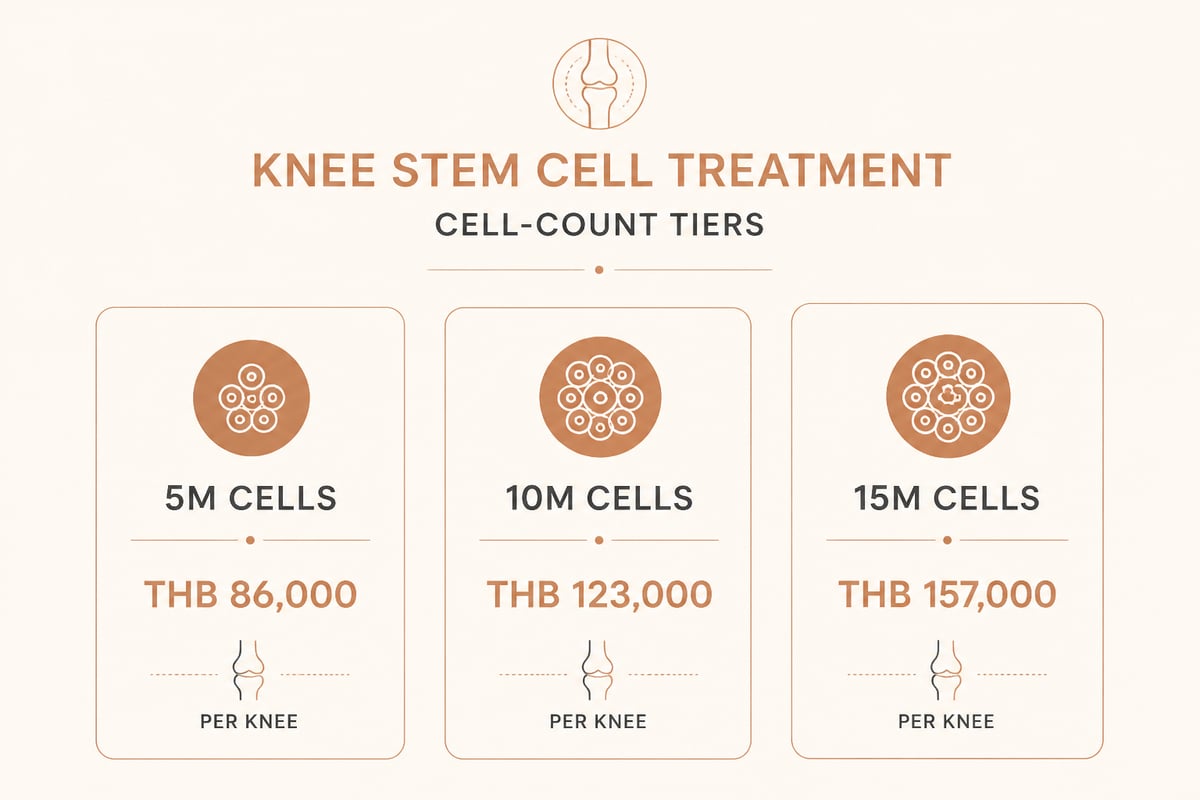
| Thailand cost | Set by the clinic and the number of sessions | THB 86,000 for 5M cells, THB 123,000 for 10M cells, THB 157,000 for 15M cells, per knee |
Every medicine and peptide listed here is dispensed only after a medical consultation at Healthi Life and on a physician's prescription. Prices are published for transparency, not as an offer to supply.
What PRP Is and How It Works in the Knee
PRP, or platelet-rich plasma, is a concentrate of your own platelets suspended in plasma. A small blood sample is drawn, spun in a centrifuge, and the platelet-rich layer is injected into the knee joint, usually under ultrasound guidance.
Platelets carry growth factors and signaling proteins. The working theory is that these reduce inflammatory signaling in the joint and may support the surrounding tissue. The theory is plausible. It is not proven as a mechanism in every patient.
Preparation matters. PRP is not one product. Platelet concentration, the presence of white blood cells, and the number of injections differ between clinics. A 2024 systematic review of 29 studies found that most PRP treatment arms had statistically significant positive outcomes at six months, and that the positive arms had a mean platelet dose of 5,500 ± 474 million, according to the American Journal of Sports Medicine analysis on PubMed. That suggests dose is a variable worth asking about.
What Stem Cell Treatment Is and How It Differs
Stem cell treatment for the knee delivers a concentrate of cells, from bone marrow, fat tissue or other sources, into the joint. The goal is a signaling effect: the cells release molecules that may calm inflammation and influence the local environment.
The word "stem" can mislead. Injected cells are not currently shown to rebuild a worn knee surface to a normal state. What is measured in trials is mostly pain and function, not cartilage regrowth on imaging.
Cell source, cell count and processing method all affect the product. That is one reason published results are harder to compare than PRP results. For a plain-language primer, see this guide on what stem cell therapy is. Legal status in Thailand is covered in this explainer on stem cell therapy legality in Thailand.
Can PRP and Stem Cell Treatment Be Effective for Knee Osteoarthritis?
PRP has the stronger evidence base for knee osteoarthritis, and stem cell treatment has a smaller one that shows promise but less consistency. Neither is a cure, and response varies.
The PRP numbers are specific. A 2024 meta-analysis of 1,993 patients with knee osteoarthritis found PRP had higher odds of a successful outcome than hyaluronic acid (OR 2.19, 95% CI 1.33 to 3.62). It also found higher odds of symptom relief than alternative nonoperative treatments (OR 1.55, 95% CI 1.07 to 2.24). The authors described individual trial conclusions as only slightly robust, per the American Journal of Sports Medicine report on PubMed.
A 2024 review of 29 publications covering 61 randomized trials reported PRP benefit for pain and function in knee osteoarthritis, generally within 3 to 12 months. Reported adverse effects were minor and temporary, according to Military Medicine via Oxford Academic.
What this does not tell you:
- Whether your own knee will respond. Averages describe groups.
- How long the benefit lasts beyond the follow-up window.
- Whether PRP and stem cells together outperform either alone. Trials of combinations are limited.
Where the Evidence Is Thinner
The main gap is standardization. PRP trials differ in platelet dose, injection count and comparison treatment. One trial may inject once and compare against saline, another may inject three times and compare against hyaluronic acid. Stem cell trials differ in source, cell number and preparation. Pooling them is difficult, and the meta-analyses say so. The 2024 analysis, for example, described individual trial conclusions as only slightly robust.
Imaging also limits what can be claimed. Pain scores can improve while MRI shows little change. Trials mostly measure how a knee feels and functions, not whether cartilage thickness changed. A physician reading both is more useful than either alone.
Severity matters too. Results are generally reported for mild to moderate osteoarthritis. Advanced, bone-on-bone disease with deformity is a different problem, and surgical options enter the discussion. That conversation belongs with an orthopedic surgeon.
What Is the Downside of Stem Cell Therapy?
The main downsides are cost, uncertain evidence and variable product quality. Cost is real: at THB 86,000, THB 123,000 or THB 157,000 per knee for 5M, 10M or 15M cells, it exceeds typical PRP.
Evidence is the second limit. Results are less consistent than for PRP, and long-term durability data are limited.
Quality is the third. Cells are a biological product, and handling, laboratory standards and sourcing differ. Short-term risks are generally those of any joint injection: temporary soreness, swelling, and a small risk of infection. Anyone with a bleeding disorder, an active infection or a blood-thinning regimen needs physician review first. Questions to put to any provider are covered in this guide to choosing a stem cell clinic in Thailand.
How Soon Can You Walk After a PRP Injection in the Knee?
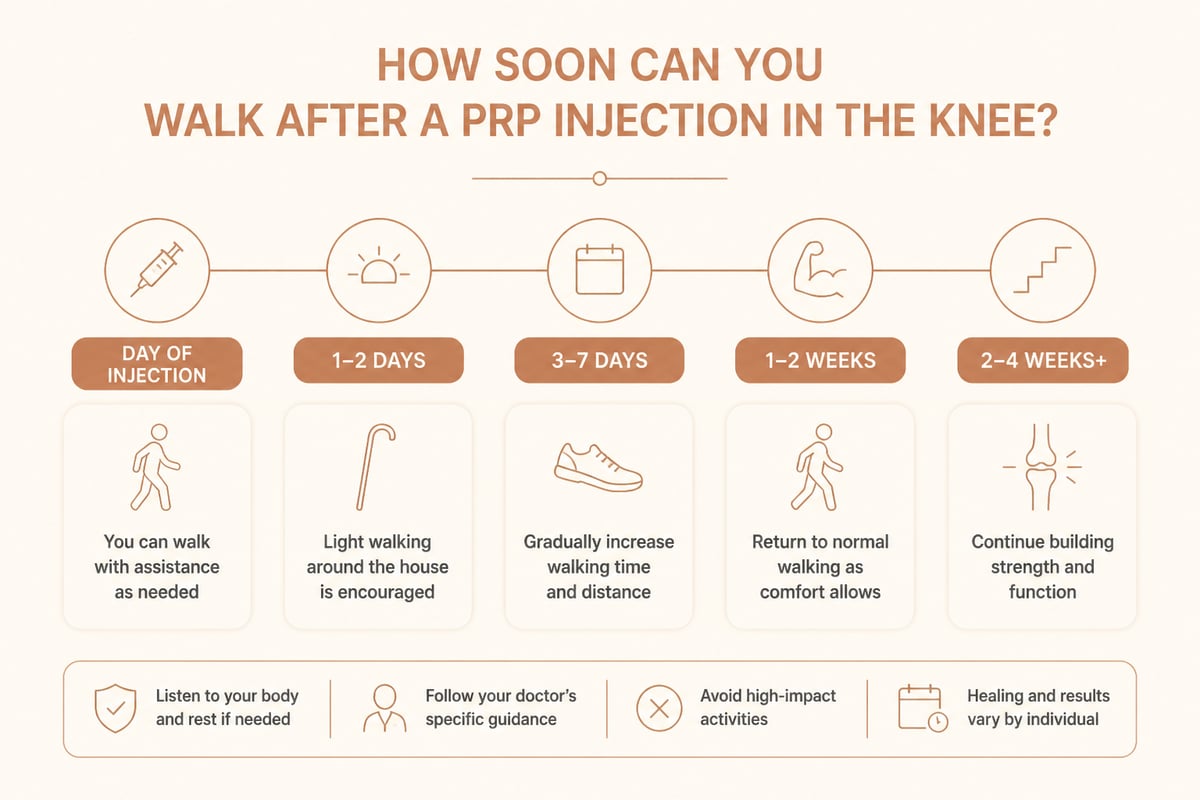
Most people walk the same day. PRP is an outpatient injection, and normal walking is generally possible right away, though the knee may feel sore or stiff for a day or two.
Physicians typically advise a short period of reduced load before returning to running, deep squats or heavy training. The exact guidance depends on the individual joint and is set by the treating physician. Anti-inflammatory medication is sometimes discouraged around the procedure because it may blunt the intended effect, so ask before taking any.
For travelers, this matters for planning. A flight home carries a prolonged-sitting stiffness risk, and a physician can advise on timing.
Is PRP Worth It for Meniscus Tears?
The evidence for meniscus tears is weaker than for osteoarthritis. PRP trials have focused mainly on osteoarthritis, so results there do not transfer cleanly to a torn meniscus. The 29-publication review covering 61 randomized trials reported benefit in knee osteoarthritis pain and function, not in tear healing.
Tear type changes the answer. A degenerative tear in an arthritic knee is often managed like osteoarthritis, because the pain may come as much from the joint lining and cartilage as from the tear itself. A displaced or locking tear is a mechanical problem and may need arthroscopic evaluation. A knee that catches, gives way or cannot fully straighten points toward the mechanical type. PRP does not reposition torn tissue.
The sensible sequence is imaging first, then a decision. An MRI and a physical examination separate a tear that may respond to injection from one that needs a surgeon.
Cost, Cell Counts and What You Are Paying For
Stem cell treatment is priced by cell count, per knee. Published pricing at Healthi Life is THB 86,000 for 5M cells, THB 123,000 for 10M cells and THB 157,000 for 15M cells. These figures are fixed amounts, not starting points.
A higher count is not automatically better. No trial has established that 15M cells outperform 5M in a given knee. The right count is a physician's judgment after reviewing the joint.
PRP is generally less expensive, but cost per session varies, and benefit may require more than one session. Compare total cost over the full course, not one injection.
How a Physician Decides Between the Two
A physician decides after reviewing data. That is the whole principle: measure first, then choose.
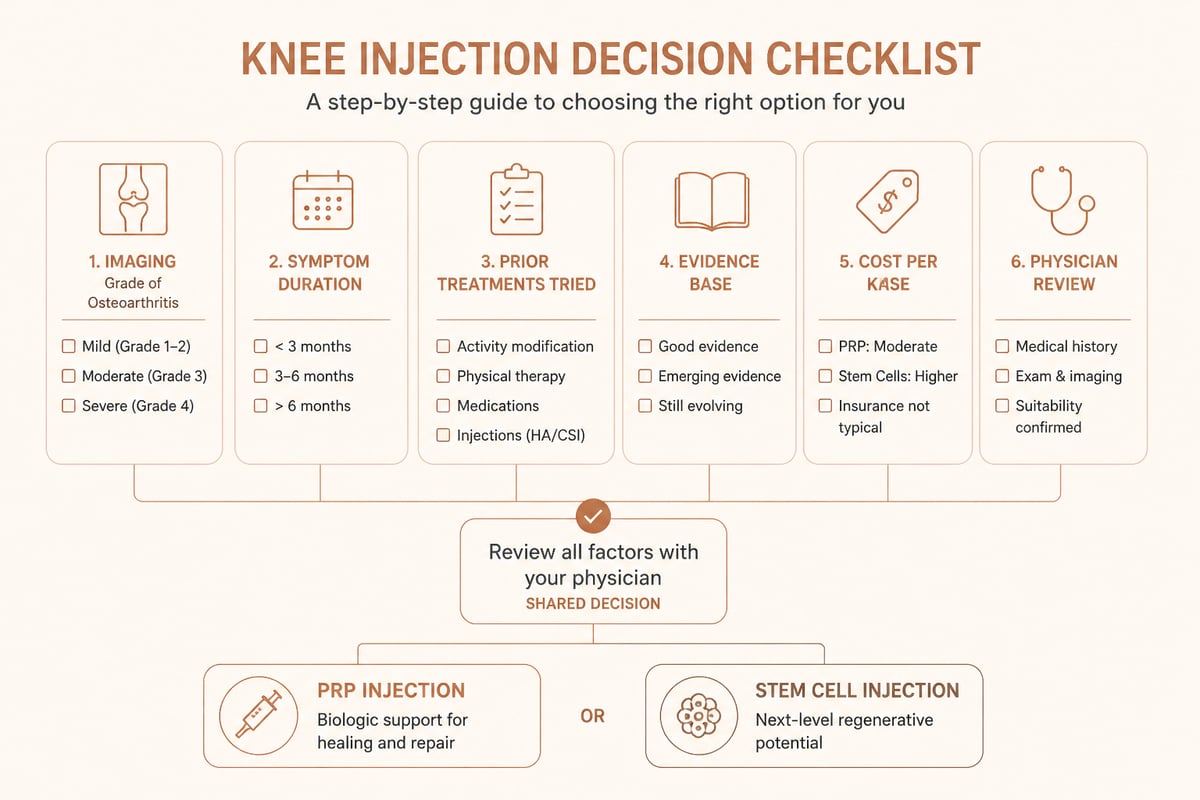
A sound decision usually draws on:
- Imaging. X-ray or MRI grade of cartilage loss, joint space and meniscus status.
- History. Duration of symptoms, prior injections, surgery and response to physiotherapy.
- Systemic health. Inflammation markers, metabolic status, clotting and medications. These shape both safety and likely response.
- Goals. A return to golf and travel differs from a return to competitive running.
- Budget and timeline. Cost per knee, plus how many months you can wait to judge benefit.
At the house in Ekkamai, the sequence follows the same logic. Healthi Life in Ekkamai, Bangkok measures before it treats, using biomarker panels, and a licensed physician reviews the results one-to-one. A joint rarely fails in isolation, so the wider picture is part of the decision. The clinic's stem cell knee treatment is considered only after that review. The same approach applies to the spine, as described in this piece on stem cell therapy for back pain.
Cellular therapy sits within Recovery & Performance medicine, delivered after a consultation and biomarker review with a licensed doctor.
FAQ
Is stem cell treatment better than PRP for a knee?
Not on current evidence. PRP has more randomized trials and more consistent reported benefit in knee osteoarthritis. Stem cell treatment may suit some patients, and the physician decides after seeing imaging and data.
Can PRP and stem cells be combined in one knee?
Some physicians combine them, but trial evidence for the combination is limited. It is a clinical judgment, not an established standard, and it adds cost.
Does either treatment avoid knee replacement?
Neither is guaranteed to delay or avoid surgery. They are nonoperative options for pain and function, most studied in mild to moderate osteoarthritis. Advanced disease is a surgical conversation.
How long does the benefit last?
Trials generally follow patients for 3 to 12 months, so durability beyond a year is less certain. Individual response varies, and some patients need repeat treatment.
Who should not have either injection?
People with an active infection, certain blood disorders, or on blood thinners need physician review first. Anyone needing acute hospital care should seek that instead. A consultation precedes every protocol.
Start by gathering your recent knee X-ray or MRI report and a list of what you have already tried, because a physician can only advise from data. If you want the joint assessed alongside your wider biomarkers, the physicians at Healthi Life can review both, and you can book a discovery consultation to see where a knee injection fits, or does not, in your case.
Every medicine named on this page is dispensed only after a medical consultation at Healthi Life and on a physician's prescription. No dosing schedule is published here; the dose is set by the prescribing physician. This page is published for transparency, not as an offer to supply.
- 5.0 Google Rating · 238 reviews
- 2,500+ Guests
- 50+ Countries
- 2025 Regenerative Clinic of the Year in Asia-Pacific — GlobalHealth Asia-Pacific Awards