
Tesamorelin vs Ipamorelin: What Each Peptide Does

Tesamorelin vs ipamorelin compared: mechanism, evidence, timeline and Thailand cost, with what a physician checks before either is considered.
This page is for general information and does not constitute medical advice, diagnosis, or treatment. Results vary between individuals. Every medicine and peptide listed here is dispensed only after a medical consultation at Healthi Life and on a physician's prescription. Prices are published for transparency, not as an offer to supply. Always consult a qualified physician about your condition. See our full medical disclaimer.
In the tesamorelin vs ipamorelin comparison, the two are different tools. Tesamorelin is an FDA-approved growth hormone-releasing hormone analogue with trial evidence for reducing visceral fat in HIV lipodystrophy. Ipamorelin is a growth hormone secretagogue with limited human data and no approved indication. A physician decides between them, or neither, after reviewing your biomarkers.
How do tesamorelin and ipamorelin differ in mechanism?
Tesamorelin and ipamorelin both raise growth hormone, but they act on different receptors. This guide is published by the Healthi Life longevity clinic in Bangkok.
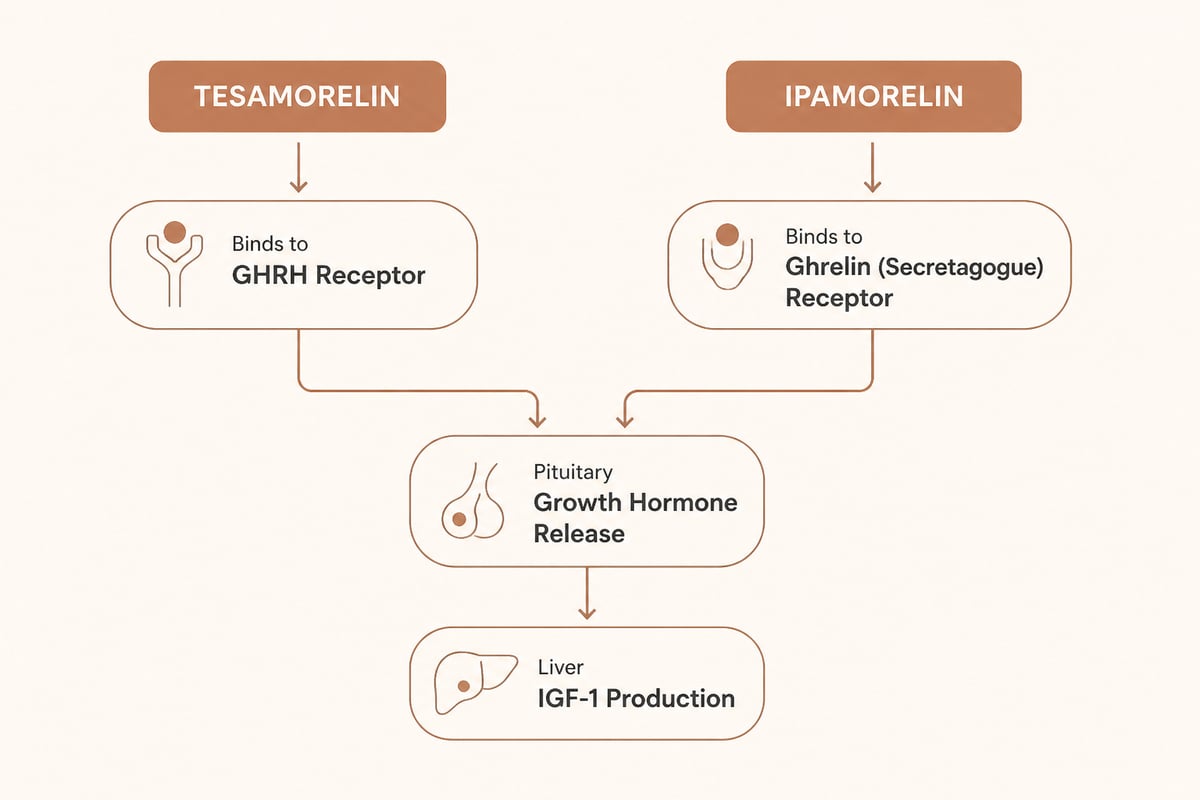
Tesamorelin is a synthetic analogue of growth hormone-releasing hormone (GHRH). It binds the GHRH receptor on the pituitary and prompts the gland to release growth hormone in its natural pulses. Growth hormone then raises insulin-like growth factor 1 (IGF-1) in the liver.
Ipamorelin is a ghrelin-receptor agonist, often called a growth hormone secretagogue. It binds the growth hormone secretagogue receptor and triggers a short pulse of growth hormone. It is considered selective because it has shown little effect on cortisol and prolactin in early studies.
The practical difference is the pathway. One mimics the signal from the hypothalamus. The other mimics the stomach hormone ghrelin. Because the pathways are separate, ipamorelin is sometimes paired with a GHRH analogue. Healthi Life's page on CJC-1295 and ipamorelin describes that combination.
Tesamorelin vs ipamorelin side by side
The table sets the two peptides against the same attributes. Thailand costs are the prices Healthi Life publishes for transparency.
| Attribute | Tesamorelin | Ipamorelin |
|---|---|---|
| Mechanism | GHRH analogue, acts on the GHRH receptor | Ghrelin-receptor agonist, selective secretagogue |
| Evidence | Randomized trials; FDA-approved for HIV lipodystrophy only | Limited human data; no approved indication |
| Timeline | Trial endpoints measured at 26 weeks | No established timeline from controlled trials |
| Downtime | Not reported in the sources reviewed; injection-site reactions possible | Not reported in the sources reviewed; injection-site reactions possible |
| Thailand cost | THB 6,000 | THB 3,500 |
Every medicine and peptide listed here is dispensed only after a medical consultation at Healthi Life and on a physician's prescription. Prices are published for transparency, not as an offer to supply.
What are the benefits of tesamorelin?
The documented benefit of tesamorelin is a reduction in visceral adipose tissue, the deep abdominal fat around organs, in adults with HIV-associated lipodystrophy.
In a randomized trial of 412 adults published in the New England Journal of Medicine, 26 weeks of daily tesamorelin reduced visceral adipose tissue by 15.2%. The placebo group increased by 5.0%.
The same trial reported a change in blood lipids. Triglycerides fell by with tesamorelin and rose by with placebo, with P<0.001 for the reported comparisons.
Tesamorelin is FDA-approved only for HIV lipodystrophy. Use outside that population is off-label. The trial population had HIV and abdominal fat accumulation, so its results do not transfer automatically to healthy adults. Healthi Life's overview of tesamorelin covers the peptide in more depth.
How long does tesamorelin take to show results?
In the pivotal trial, the measured endpoint came at 26 weeks, so the evidence supports a timeline of months rather than days.
That trial enrolled 412 adults with HIV and abdominal fat accumulation. Over 26 weeks, daily tesamorelin reduced visceral adipose tissue by 15.2%, while the placebo group increased by 5.0%. Triglycerides fell by with tesamorelin and rose by with placebo. Those are group averages at one time point. They do not describe the pace of change in any one person.
Visceral fat is not visible on a scale. A person can lose waist inches before a scan changes, or the reverse. Change is confirmed by imaging, typically CT or DEXA, alongside waist measurements and metabolic markers such as triglycerides, fasting glucose and IGF-1. A baseline taken before treatment is what makes any later comparison meaningful.
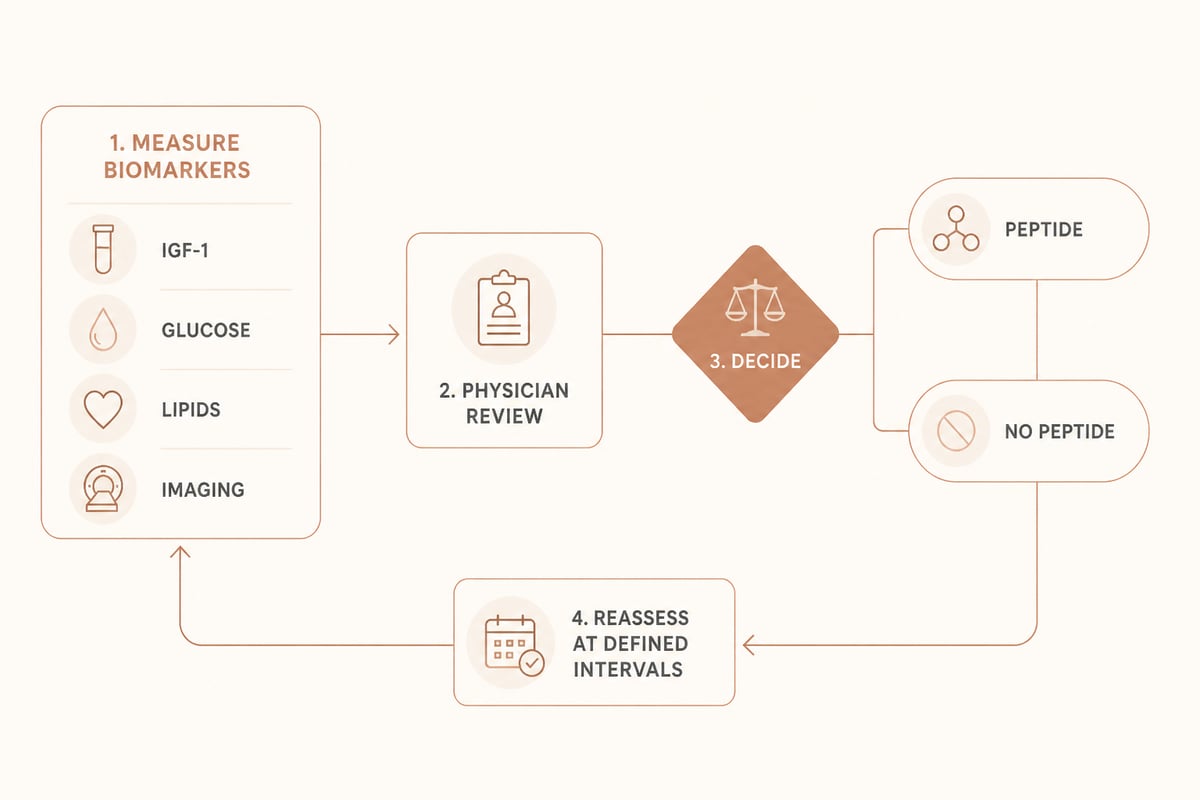
Within the trial's framework, a physician reviews the data at defined intervals and decides whether to continue. A sensible review point is a repeat of the same labs and imaging used at baseline, not a judgment from the mirror.
What is not known: how quickly any single person responds, and whether the effect holds after stopping. In the trial setting, visceral fat is generally understood to return after treatment ends. That is a question for the prescribing physician, not a promise either way.
What does ipamorelin do, and will it build muscle?
Ipamorelin raises growth hormone in short pulses, but there is no strong human evidence that it builds muscle.
Growth hormone and IGF-1 are linked to lean mass in people with true deficiency. That does not mean a secretagogue produces muscle in a healthy adult.
Ipamorelin has no approved indication. Much of what is written about it relies on animal work and small studies. Sleep, resistance training, protein intake and hormone status are better-established inputs for lean mass, and a physician will look at those first.
Is ipamorelin better than CJC-1295?
Neither is better in general. They do different jobs, which is why they are often discussed as a pair.
CJC-1295 is a GHRH analogue, closer in action to tesamorelin. Ipamorelin is the secretagogue. Combining a GHRH analogue with a secretagogue is intended to stimulate two pathways at once, producing a stronger pulse than either alone. The evidence for the combination in healthy adults is thin.
Each has a different practical profile. A GHRH analogue works through the body's own feedback loop, so growth hormone release stays tied to the pituitary's normal rhythm. A secretagogue produces a sharper, shorter pulse. Neither has an approved indication in healthy adults, and neither has long-term safety data in that group.
This is why the comparison cannot be settled in the abstract. The same baseline matters for both: IGF-1, fasting glucose, HbA1c and lipids. A borderline glucose result can argue against either one. A physician may also decide that sleep, resistance training and alcohol intake explain the complaint, and that no peptide is needed.
The real question is the goal. If it is sleep and recovery, a physician may start with lifestyle, labs and a narrower choice. Our note on peptides for recovery and sleep sets out that reasoning. For a related comparison between two other agents, see sermorelin vs ipamorelin.

Which biomarkers should be measured first?
Before either peptide is considered, a physician measures where growth hormone signaling and metabolic health currently stand.
Useful starting data typically includes:
- IGF-1, the downstream marker of growth hormone activity
- Fasting glucose, HbA1c and fasting insulin, since growth hormone can affect glucose handling
- Lipid panel, including triglycerides and ApoB
- Thyroid and sex hormones, which influence the same axis
- Body composition and visceral fat, by imaging where indicated
This is the reason the order matters. A raised IGF-1 or borderline glucose changes the risk side of the decision. Healthi Life measures before treating, using a panel of 150+ lab biomarkers, and a physician reviews the result one to one. The Advanced check-up is where that data is collected.
Safety and what a physician weighs
Both peptides raise growth hormone, so the main questions are about glucose, fluid retention and long-term exposure to higher IGF-1.
Reported effects in trials of tesamorelin can include joint pain, swelling in the extremities, injection-site reactions and changes in glucose tolerance. Ipamorelin has too little human data for a reliable side-effect profile. Quality is a separate concern: peptides sold outside regulated channels vary in purity and content, and buyers cannot verify either.
Cancer history matters in this decision. Growth hormone and IGF-1 are growth signals, and a physician will want a clear screening picture first. Executives and frequent travelers should also tell the physician about time-zone shifts, sleep disruption and alcohol intake, because each affects the same hormonal axis.
How a physician chooses between the two
The choice depends on the clinical goal, the data and the risk profile, so it is made after review and not before.
A physician may reason in this order:
- Is there a documented indication? Visceral fat with metabolic markers out of range points toward the peptide with trial evidence. Tesamorelin has that evidence in a specific population.
- Is the goal general recovery or sleep? The evidence for ipamorelin here is limited, so lifestyle and lab correction usually come first.
- What do IGF-1 and glucose show? Elevated baselines can rule either peptide out.
- What is the plan for review? Any peptide is reassessed against repeat labs, not continued by default.
This is the same logic as the Healthi Life approach: Measure, Understand, Decide. Peptide therapy injections are offered after consultation, and the physician follows guests over months, not a single appointment. The peptide consultation is 2,500 THB. Within Recovery & Performance medicine, protocols sit alongside IV and NAD+ therapy, cellular therapy and private testing, and each one follows a consultation and biomarker review with a licensed doctor. You can read more about Recovery & Performance medicine before booking.
Sourcing and quality questions to ask
Purity, labeling and a prescription are the three checks that matter before any peptide is taken.
Ask whether the product is pharmaceutical grade, who dispensed it and whether a physician prescribed it against your labs. A label that reads "for research purposes only" is a regulatory signal, not a quality mark.
A few direct questions help. Is the dispensing source a licensed pharmacy or a medical practice? Can it name the manufacturer? Is there a batch number and an expiry date on the vial? Is the peptide supplied sterile, with clear storage instructions? A source that cannot answer these should not be used.
Be cautious with certificates of analysis that arrive as a PDF without a traceable batch. They show what a seller chose to publish, not what is in your vial. Cost is also a poor guide. A very low price for an injectable is a reason for more questions, not fewer.
That is a reference point for terminology, not a substitute for a prescription or a medical decision.
FAQ
What is the main difference between tesamorelin and ipamorelin?
Tesamorelin is a GHRH analogue approved by the FDA only for HIV lipodystrophy. Ipamorelin is a ghrelin-receptor agonist with no approved indication and limited human data.
Is tesamorelin or ipamorelin better for fat loss?
Tesamorelin has randomized trial evidence for reducing visceral fat in a specific HIV population. Ipamorelin has no comparable evidence for fat loss. Neither is a general weight-loss treatment.
Can the two be used together?
Tesamorelin and ipamorelin are not usually paired, because tesamorelin already acts on the GHRH pathway. Ipamorelin is more often discussed with CJC-1295. Any combination is a physician decision based on your data.
What does each peptide cost in Thailand?
At Healthi Life, tesamorelin is THB 6,000 and ipamorelin is THB 3,500. The peptide consultation is 2,500 THB. Each is dispensed only on a physician's prescription after consultation.
Do I need tests before starting either peptide?
Yes. A physician reviews IGF-1, glucose markers, lipids and relevant hormones first. Results can change the decision, including a decision not to treat.
Start by booking a peptide consultation so a physician can review your IGF-1, glucose and lipid data before any decision about tesamorelin or ipamorelin. Healthi Life in Ekkamai, Bangkok is a private, doctor-led house where every protocol follows a licensed physician's consultation, and you can use a Book a Discovery Consultation request to begin with your own biomarkers. This page is for information only and is not medical advice. Medical consultation and prescription are available online and on site at Healthi Life, Ekkamai, Bangkok.
Every medicine named on this page is dispensed only after a medical consultation at Healthi Life and on a physician's prescription. No dosing schedule is published here; the dose is set by the prescribing physician. This page is published for transparency, not as an offer to supply.
- 5.0 Google Rating · 238 reviews
- 2,500+ Guests
- 50+ Countries
- 2025 Regenerative Clinic of the Year in Asia-Pacific — GlobalHealth Asia-Pacific Awards