
How Many Stem Cell Treatments Are Needed? A Physician's Guide

How many stem cell treatments are needed depends on the target tissue and your baseline data. Compare face, hair and knee protocols, timelines and costs.
This page is for general information and does not constitute medical advice, diagnosis, or treatment. Results vary between individuals. Every medicine and peptide listed here is dispensed only after a medical consultation at Healthi Life and on a physician's prescription. Prices are published for transparency, not as an offer to supply. Always consult a qualified physician about your condition. See our full medical disclaimer.
For most adults, one well-selected treatment is the starting point, and a physician decides on a second only after reassessing your data. The number needed depends on the tissue treated, your baseline measurements and the response seen at review. No number applies to everyone.
The short answer: one session first, then a review
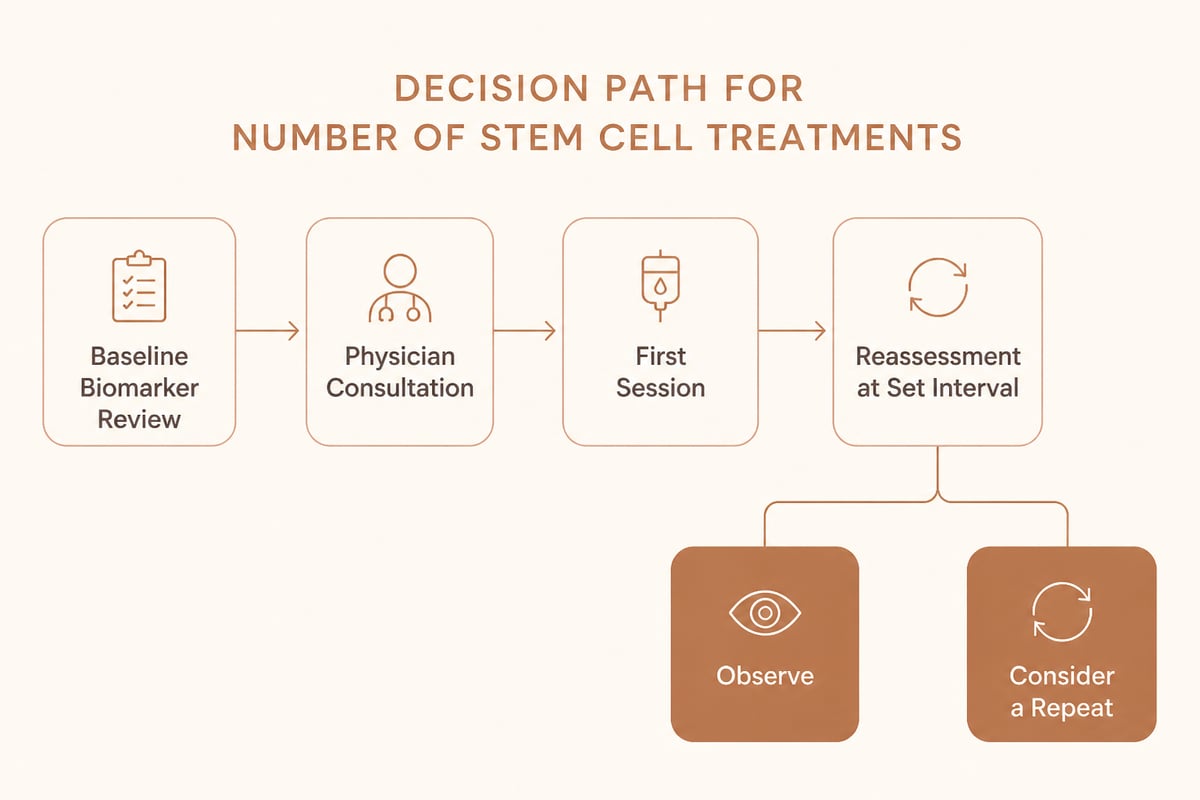
The first session is the standard opening step, and repeat sessions are a clinical decision made after a documented review. A repeat is added when measured change justifies it, and is not scheduled in advance. This guide is published by the Healthi Life longevity clinic in Bangkok.
Cellular therapy is not a single product with a single dose. The count depends on what is being treated and how that tissue responds. Knee cartilage, hair follicles and facial skin each heal on different timelines.
Three points hold across the field:
- A single session is common for joints. Facial and hair protocols are more often planned as a series.
- Response is measured, not assumed. Baseline and follow-up data decide the next step.
- Evidence differs by use. Some indications have trial support. Others rest on early or mixed data.
The ISSCR states that new stem-cell interventions should demonstrate safety and effectiveness in well-designed clinical trials and receive regulatory approval before being offered directly to consumers. That standard is a useful test for any clinic that promises a fixed number of sessions.
Comparison: face, hair and knee at a glance
The table below sets the three most common requests side by side. Cost figures are Healthi Life's published Thailand prices. Evidence, timeline and downtime are general descriptions, and individual response differs.
| Face and hair | Knee (per knee) | |
|---|---|---|
| Mechanism | Cells and their signaling factors act on skin and follicle tissue to support repair | Cells delivered into the joint environment to modulate inflammation and support tissue repair |
| Evidence | Early-stage; smaller trials, mixed protocols | Larger body of clinical research, still variable by cell source and method |
| Timeline | Change is gradual; assessed over several months | Gradual; function is reassessed over several months |
| Downtime | Short; varies by method | Short; a physician advises on activity |
| Thailand cost | 5M cells: 59,000 THB. 10M cells: 89,000 THB. 15M cells: 119,000 THB | 86,000 THB, 123,000 THB or 157,000 THB per knee, by dose tier |
The cell count in the face and hair tiers is a dose choice, not a session count. A higher tier is not a promise of a larger effect. Your physician sets the tier after consultation.
How many stem cell treatments are needed for the knee?
For the knee, many protocols begin with one session per joint, and a repeat is considered only after functional reassessment. Cartilage and the joint lining respond slowly, so early review points can mislead.
The decision rests on measured function: range of motion, pain scores, imaging where relevant and what you can do on stairs or the golf course. A physician compares these against your baseline. If function has improved and is holding, no repeat is needed. If it plateaus with an identifiable reason, a second session may be discussed.
Dose tier matters here. Healthi Life lists knee treatment at 86,000, 123,000 and 157,000 THB per knee. The tier reflects the cell dose chosen, and a second knee is priced separately.
For a deeper look at this indication, see stem cell therapy for osteoarthritis in Bangkok. If your question is about a stiff back rather than a knee, stem cell therapy for back pain covers what is and is not known.
Osteoarthritis is a degenerative process. A treatment may change symptoms and function. It does not reverse age. Your physician will say so at consultation.
How many sessions for face and hair?
Face and hair protocols are more often planned as a short series, because skin and follicle cycles are slow and change appears over months. A series is a plan to be reviewed, not a contract to be completed.
Hair follicles move through growth, rest and shedding phases. Visible change in density takes time to appear. A physician will usually set review points and ask for standardized photographs and scalp assessment. Treatment continues only if the data support it.
The same logic applies to facial skin. Texture, firmness and tone change gradually. Healthi Life offers stem cell hair therapy and a stem cell facial as separate services, each with its own assessment.
Published studies of stem cell hair treatment use different cell sources, delivery methods and outcome measures, and many are small, so no reliable single success rate exists. The physician should explain how success will be measured in your case, and when you would stop.
What decides whether you need more than one?
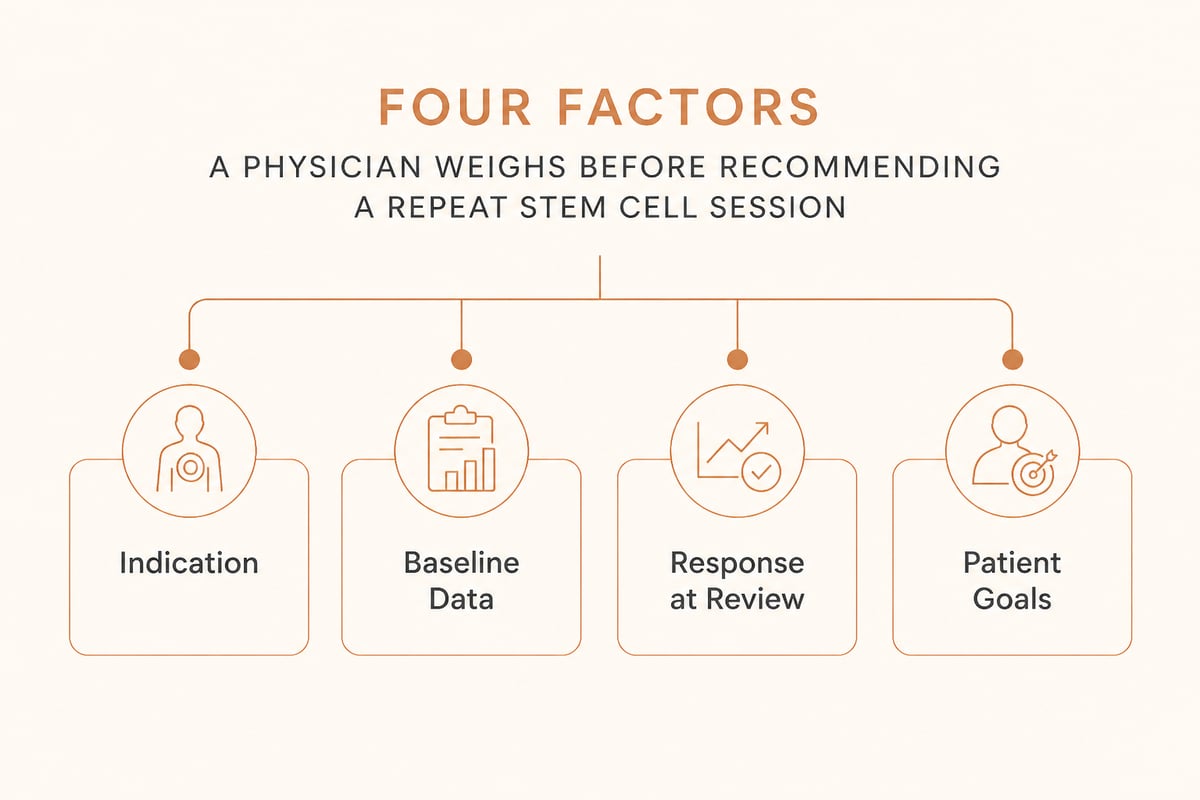
Four factors decide whether a repeat is justified: the indication, the baseline data, the response at review and your goals. None of them is a calendar date.
- The indication. A joint with early wear behaves differently from one with advanced loss of cartilage.
- The baseline. Without a starting measurement, a later change cannot be judged. This is why Healthi Life measures first, using a panel of 150+ lab biomarkers, before recommending any treatment.
- The response. A physician reads the follow-up against the baseline. A small change inside normal variation is not a response.
- Your goals. A reasonable aim for a founder who travels weekly differs from that of a recreational athlete.
Systemic health also matters. Inflammation, metabolic control, sleep and recovery capacity influence how tissue responds to any regenerative input. This is part of why the work sits inside an ongoing program rather than a one-off visit.
Cell source and handling add another variable. Fresh and frozen preparations are not interchangeable. The differences are set out in fresh vs. frozen stem cells.
What happens if I have a second stem cell transplant?
A second stem cell transplant carries its own risk profile, and the answer depends on which kind of procedure is meant. The term covers two very different things.
In hematology, a transplant replaces a diseased blood and immune system, usually for cancers of the blood. A second transplant there is a hospital procedure decided by a transplant team. It is not what an outpatient longevity clinic provides, and anyone facing that situation needs their treating hematologist.
In regenerative medicine, a second session is a repeat of a lower-intensity procedure. The decision follows the review described above. The ISSCR notes that serious adverse events have followed some unproven interventions and that long-term safety remains undetermined for most cell-based interventions. A repeat therefore needs a reason, not a habit.
If you have had a prior treatment elsewhere, bring the records to your consultation. A physician cannot judge the next step without knowing what was given, when and with what result.
How much do repeat treatments cost over time?
Cost over time is the price per session multiplied by the number of sessions a physician actually recommends, which is why the starting figure alone tells you little. Compare the full plan, not the first invoice.
Healthi Life publishes its Thailand prices for transparency. Face and hair: 59,000 THB for 5M cells, 89,000 THB for 10M cells, 119,000 THB for 15M cells. Knee, per knee: 86,000, 123,000 and 157,000 THB.
Stem cell treatment for type 1 diabetes is an area of active clinical research, and no established, approved outpatient treatment with a standard price exists. Anyone offering it as routine care should be asked for the trial registration and regulatory approval.
Questions of legality and clinic standards matter as much as price. Read is stem cell therapy legal in Thailand and how to choose a stem cell clinic in Thailand before you compare quotes.

What are the different types of stem cells?
Stem cells are grouped by origin and by what they can become. The main groups are embryonic, adult (tissue-specific) and induced pluripotent stem cells.
- Embryonic stem cells can become almost any cell type. They are used in research and raise ethical and regulatory questions.
- Adult stem cells reside in tissues such as bone marrow and fat. They are more limited in what they become and are the group most often used in regenerative practice.
- Induced pluripotent stem cells are adult cells reprogrammed in the laboratory to behave like embryonic cells. They are largely a research tool.
- Mesenchymal stromal cells are a subset of adult cells found in several tissues. Much of the clinical literature on joints and skin concerns this group.
If your interest is in the signaling factors cells release rather than the cells themselves, exosomes vs. stem cells draws the distinction.
Measuring the response before you decide
A response is measured against a baseline, and the measurement plan should exist before treatment starts. Without it, you are guessing.
For a joint, that plan may include a functional assessment, pain scores and imaging. For skin and hair, it includes standardized photographs and a scalp or skin assessment. Blood markers of inflammation and metabolic health provide context.
This is the logic behind Healthi Life's approach: Measure, Understand, Decide. A physician reviews your data with you and then recommends, or declines to recommend, treatment. Physicians follow guests over months and years, not a single appointment, so a response can be read across several review points rather than one.
Healthi Life's cellular therapy sits within Recovery & Performance medicine, alongside the testing that informs it. Guests who want the wider picture may begin with the Check-Up Foundation at 10,500 THB, which sets the baseline before any regenerative decision.
For broader context on regenerative research, StemCells21 describes its work in regenerative medicine and immunotherapy and may be a useful reference for readers comparing the research landscape.
When one session is the right answer, and when none is
One session is the right answer when your data show a clear target and a reasonable chance of benefit. None is the right answer when they do not.
A physician should be willing to say no. Reasons include an active infection, an untreated cancer risk, unrealistic goals, or a problem better handled another way. For some knee complaints, stem cell vs. PRP for the knee may favor a simpler option. For some hair concerns, stem cell vs. hair transplant sets out when surgery fits better.
Peer-reviewed literature supports caution. A PubMed search on mesenchymal stem cells and knee osteoarthritis returns trials with differing cell sources, doses and outcome measures, which is why results cannot be pooled into one promised course.
Every protocol at Healthi Life is designed and supervised by a physician, and a consultation comes first. Anyone who needs same-day treatment without that consultation, or who requires acute hospital care, should look elsewhere.
Frequently asked questions
How many stem cell treatments are needed for lasting results?
No fixed number exists. Many people begin with one session, and a physician decides on any repeat after reviewing measured change against baseline. Lasting benefit is not guaranteed, and the duration of effect varies by tissue and person.
Can I have stem cell treatment more than once?
Yes, a repeat is possible when a physician finds a clinical reason. The decision follows a documented review. Long-term safety of repeated cell-based interventions is not fully established, according to the ISSCR.
How long before I know whether it worked?
Joints, skin and hair respond slowly, usually over months rather than days. Your physician sets review points in advance and compares them with your baseline. Early impressions are unreliable.
Is the cell dose the same as the number of sessions?
No. The dose, such as 5M, 10M or 15M cells for face and hair, describes how many cells are given in one session. The number of sessions is a separate decision made at review.
What should I bring to a consultation?
Bring prior imaging, lab results, a list of medications and records of any earlier cellular treatment. The physician needs them to judge what is appropriate and whether to proceed.
Every medicine and peptide listed here is dispensed only after a medical consultation at Healthi Life and on a physician's prescription. Prices are published for transparency, not as an offer to supply.
This page is for information only and is not medical advice. Medical consultation and prescription are available online and on site at Healthi Life, Ekkamai, Bangkok.
The most useful next step is to gather your recent imaging and lab results so a physician can set a baseline before any cellular decision is made. A consultation is where the plan is built, including whether treatment is advisable at all. To discuss your own case with a physician, Book a Discovery Consultation at Healthi Life in Ekkamai, Bangkok.
Every medicine named on this page is dispensed only after a medical consultation at Healthi Life and on a physician's prescription. No dosing schedule is published here; the dose is set by the prescribing physician. This page is published for transparency, not as an offer to supply.
- 5.0 Google Rating · 238 reviews
- 2,500+ Guests
- 50+ Countries
- 2025 Regenerative Clinic of the Year in Asia-Pacific — GlobalHealth Asia-Pacific Awards