
Stem Cell Therapy vs Hair Transplant: Which Works for You

Compare stem cell vs hair transplant on mechanism, evidence, timeline, downtime and Thailand cost, and learn which fits your pattern of hair loss.
This page is for general information and does not constitute medical advice, diagnosis, or treatment. Results vary between individuals. Minoxidil is a prescription medicine, dispensed and administered only after assessment by a licensed physician. This page is medical information, not an advertisement or an offer of treatment. Every medicine and peptide listed here is dispensed only after a medical consultation at Healthi Life and on a physician's prescription. Prices are published for transparency, not as an offer to supply. Always consult a qualified physician about your condition. See our full medical disclaimer.
In the stem cell vs hair transplant question, the two do different jobs. A transplant moves permanent hair into bald areas surgically. Stem cell therapy aims to support follicles that are still alive, and its evidence is still limited. Healthi Life does not perform hair transplants. A physician decides after seeing your data.
Stem Cell vs Hair Transplant: The Comparison at a Glance
The table below sets the two approaches side by side on five attributes. Thailand cost figures for stem cell hair therapy are the Healthi Life prices for 5, 10 and 15 million cells. A transplant cost depends on the surgeon, the graft count and the clinic, so it is not given as a single number here. Healthi Life is a physician-led longevity clinic in Bangkok.
| Attribute | Stem cell hair therapy | Hair transplant |
|---|---|---|
| Mechanism | Injected cells and growth signals aim to support existing follicles | Follicles from a donor area are moved to thinning or bald skin |
| Evidence | Early and limited; the American Academy of Dermatology calls stem-cell treatment for female-pattern hair loss experimental | Established surgical procedure with long clinical use |
| Timeline | Varies by person; assessed by your physician over follow-up | New hair usually appears around four months, with full results in 10 to 18 months, per the NHS |
| Downtime | Short, procedure-dependent; your physician advises | Usually one day of surgery, 1 to 2 weeks off work, and careful graft protection for two weeks, per the NHS |
| Thailand cost | 5M cells: 59,000 THB. 10M cells: 89,000 THB. 15M cells: 119,000 THB | Set by the surgical clinic; the NHS cites a UK range of £1,000 to £30,000 |
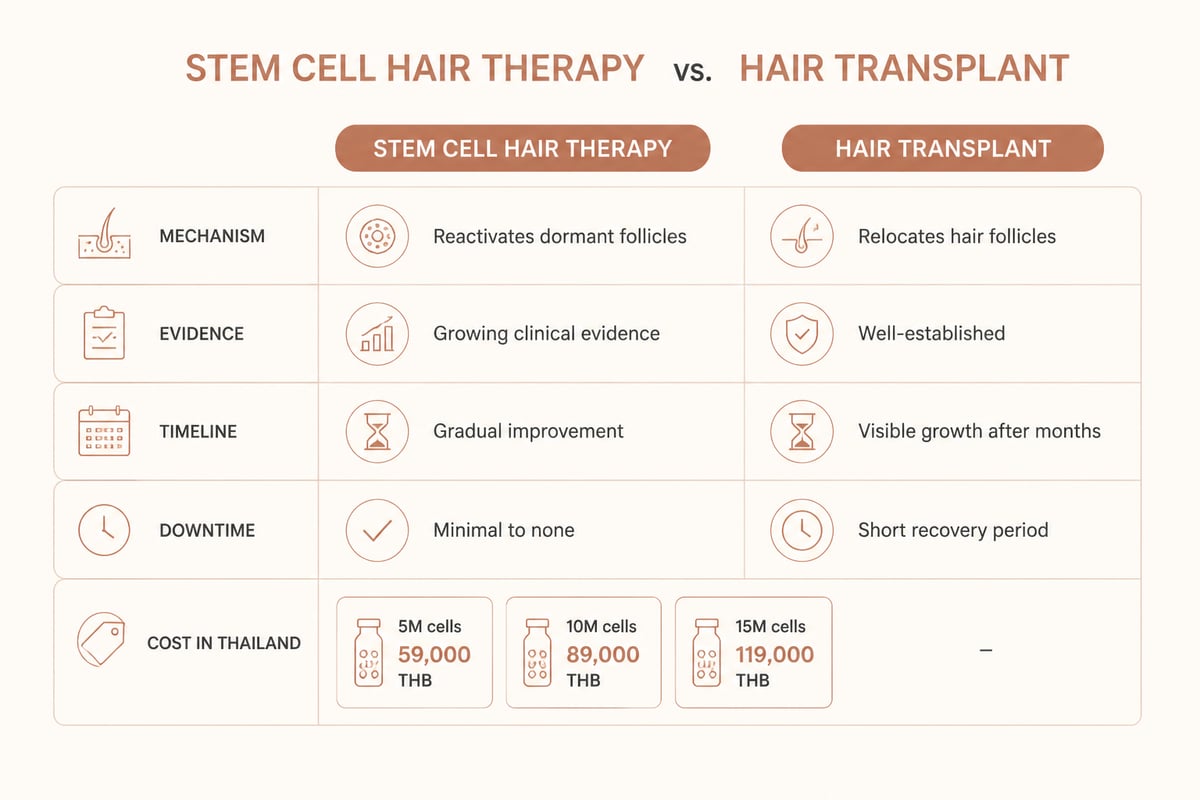
A table cannot say who each option suits. The sections below do.
How Each Approach Works
A hair transplant relocates follicles; stem cell therapy tries to change the environment around follicles you already have.
In a transplant, a surgeon takes follicles from a donor area, usually the back and sides of the scalp, and places them in the thinning zone. These follicles tend to resist the hormone sensitivity that drives common pattern baldness. The hair that grows is your own, and it behaves as donor hair does.
Stem cell hair therapy works on a different premise. Cells, often drawn from your own tissue, and the growth signals they release are delivered to the scalp. The aim is to support follicles that have miniaturized but not died. It does not create new follicles. If you want a plain-language overview of the cells themselves, the Healthi Life explainer on what stem cell therapy is covers the basics. A related question is whether cells or their secreted vesicles do the work, which the article on exosomes vs stem cells addresses.
Healthi Life offers the second approach only. Its hair loss treatment in Bangkok is regenerative, physician-led and non-surgical. We do not do hair transplants. If surgery is the right answer for you, a physician will say so and you will need a transplant surgeon.
What the Evidence Supports
The evidence for a transplant is strong for the right patient. The evidence for stem cell hair therapy is early.
The NHS states that a hair transplant is generally suitable for permanent, hereditary baldness and is not usually suitable for other causes such as alopecia areata. The American Academy of Dermatology adds two conditions: enough healthy donor hair, and skin in the thinning area that can grow hair. It also notes that hair loss can continue after surgery, and that medication may help slow it.
For stem cell treatment, the picture is different. The AAD describes stem-cell treatment for female-pattern hair loss as experimental and says more studies are needed to establish safety and effectiveness. Small clinical studies are indexed on PubMed, and a physician can walk you through what they do and do not show. They do not settle the question.
What this means in practice:
- A transplant has a track record. Its limits are donor supply and ongoing loss.
- Stem cell therapy has plausible biology and early data. No result is promised or predictable.
- Neither addresses the cause of hair loss on its own.
Which Pattern of Hair Loss Fits Which Option
The pattern and stage of your hair loss decide the fit more than any preference for surgery or injections.
Consider these broad scenarios. A physician makes the actual call.
- Established baldness with a stable, dense donor area. A transplant is the option built for this. Stem cell therapy cannot rebuild follicles that are gone.
- Early thinning with miniaturized but living follicles. This is where supportive therapy is most often discussed, usually alongside proven medicines. The AAD's overview of male-pattern hair loss treatment lists minoxidil and finasteride, with expected effects and side effects.
- Diffuse thinning with a systemic cause. Thyroid disease, iron deficiency, hormonal change, chronic stress and poor sleep can all thin hair. Treating the scalp without finding the cause misses the problem.
- Patchy loss such as alopecia areata. A transplant is usually not suitable. This needs a dermatology diagnosis first.
The AAD page on diagnosing and treating hair loss makes the same point: the cause comes first, the treatment second.
Measuring Before Choosing
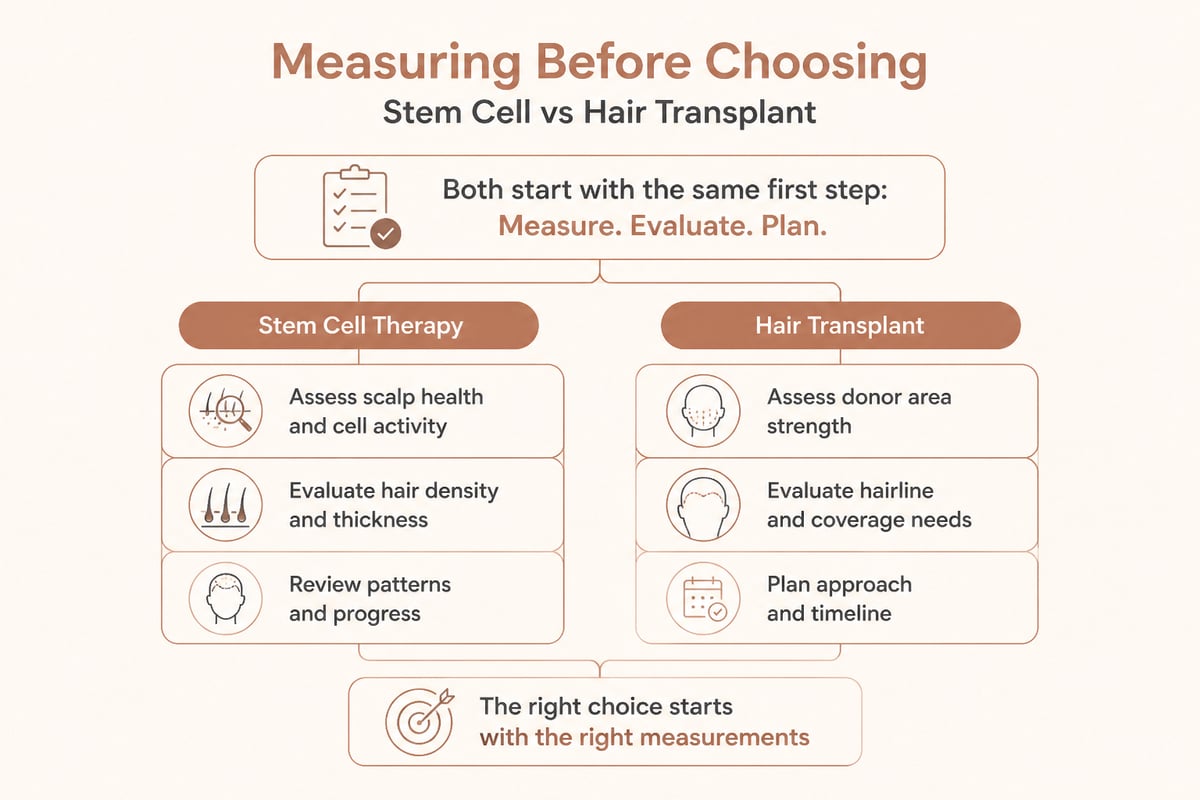
Hair loss can be a signal from elsewhere in the body, so a decision between these two options should follow measurement, not precede it.
For an executive who travels across time zones, sleeps unevenly and carries sustained stress, the scalp may be reporting a systemic issue. A transplant moves hair; it does not correct low ferritin, thyroid dysfunction or hormonal imbalance. Stem cell therapy does not either.
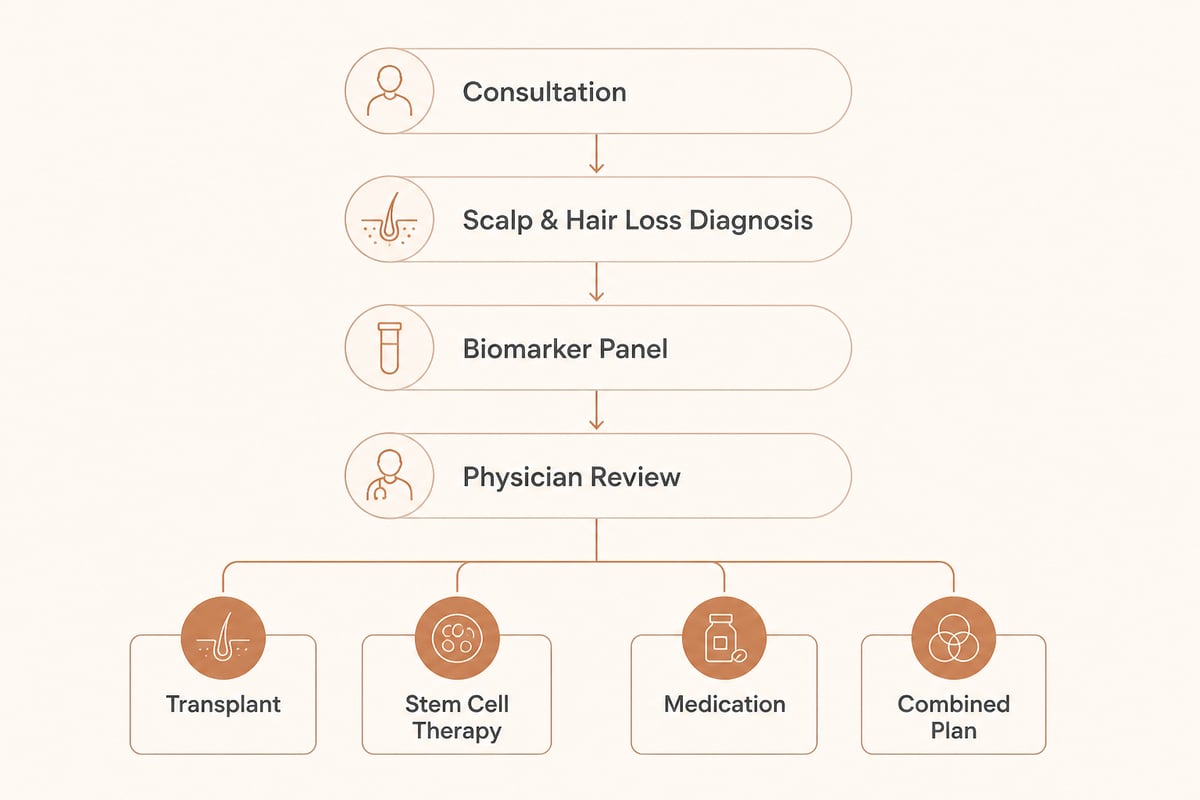
Healthi Life works on a simple sequence: Measure, Understand, Decide. A physician reviews a lab biomarker panel before recommending a protocol. That panel can show thyroid function, iron stores, hormones and inflammatory markers that bear on hair. The result is a plan built on data, followed over months by the same physician. This sits within the clinic's Recovery & Performance medicine service, alongside skin and hair care.
Healthi Life has served over 2,500 guests from 50+ nationalities and holds a 5.0 Google rating across 238+ reviews. It was named Asia-Pacific Regenerative Clinic of the Year 2025. None of that changes the evidence on hair. It describes the setting in which the decision is made: a private house, a licensed physician and a longer view than a single appointment.
Cost, Time and Downtime in Practice
Stem cell hair therapy at Healthi Life is priced at 59,000 THB for 5 million cells, 89,000 THB for 10 million cells and 119,000 THB for 15 million cells. The right quantity is a physician's decision after consultation.
A transplant is priced differently. The NHS notes UK costs of £1,000 to £30,000 depending on the extent of hair loss, the procedure type and the quality of the clinic and team. Quotes for surgical hair restoration vary with graft count and surgeon. Ask any surgeon for a written graft estimate and what follow-up is included.
On time, the two paths differ sharply. Per the NHS, transplant surgery usually takes one day. Patients may need one to two weeks off work and should protect the grafts carefully for the first two weeks. New hair usually starts around four months after the procedure, and full results are expected between 10 and 18 months. Stem cell therapy involves a shorter procedure, but the timeline to any visible change is individual and not guaranteed.
Every medicine and peptide listed here is dispensed only after a medical consultation at Healthi Life and on a physician's prescription. Prices are published for transparency, not as an offer to supply.
Risks, Limits and Who May Not Be a Candidate
Both options carry limits, and some people are not candidates for either.
Transplant risks include scarring at the donor site, infection, shock loss of existing hair and results that look unnatural if the hairline is poorly designed. Continued loss behind the transplanted area can leave an uneven look, which is why the AAD stresses medication to slow ongoing loss.
For stem cell therapy, the main limit is the evidence itself. Some people should not proceed without specific clearance or at all, and a physician screens for these:
- Active infection or skin disease in the treatment area
- Active cancer or a recent cancer history
- Uncontrolled chronic illness
- Pregnancy or breastfeeding
- Bleeding disorders or blood-thinning medication that cannot be adjusted
- Hair loss with an undiagnosed cause
Legality and clinic quality matter too. Rules on cell-based treatment in Thailand are covered in the article on whether stem cell therapy is legal in Thailand, and a framework for vetting providers is in the guide to choosing a stem cell clinic in Thailand. Complementary options, including exosomes for hair loss, are a separate discussion for your physician.
What the Combination Question Looks Like
Many patients ask whether the two can be combined. The honest answer is that it depends on the stage of loss and the physician's judgment, and the evidence for combining them is thin.
Some surgeons use platelet or cell-based adjuncts around a transplant. Healthi Life does not perform the surgery, so any combined plan would involve a separate surgical team. A physician can coordinate the medical side: lab work, medication review and timing. What no one can do is promise that an adjunct improves graft survival or density in your case.
A reasonable order of operations for most people:
- Establish the diagnosis and the cause.
- Start proven, low-risk treatment where it applies.
- Reassess at a set interval using photographs and, where useful, trichoscopy.
- Consider surgery or regenerative therapy only if results are insufficient and you are a suitable candidate.
FAQ
What is the difference between stem cell transplant and stem cell therapy?
A stem cell transplant, such as a bone marrow transplant, replaces a diseased blood-forming system and is a hospital-level treatment for conditions like leukemia. Stem cell therapy for hair is a far smaller, outpatient procedure that aims to support scalp follicles. They share a name, not a purpose or a risk profile.
Should I get a hair transplant?
It depends on your diagnosis, your donor hair and your goals. A transplant is generally suited to permanent, hereditary baldness with enough healthy donor hair, per the NHS and the AAD. Get the cause of your hair loss confirmed first, and consult a surgeon for a graft estimate.
Who is not a candidate for stem cell therapy?
People with active infection in the treatment area, active or recent cancer, uncontrolled chronic illness, pregnancy or bleeding disorders are generally screened out or need clearance. Hair loss with an undiagnosed cause should be investigated first. A physician makes the final decision after reviewing your history and results.
Can stem cell therapy replace a hair transplant?
Not on current evidence. Stem cell therapy cannot recreate follicles that have died, so it does not replace surgery for advanced baldness. It is discussed mainly for early thinning, and its effectiveness is still being studied.
Does Healthi Life perform hair transplants?
No. Healthi Life does not perform hair transplants. It offers physician-led stem cell hair therapy and the testing that guides the decision, and a physician will tell you if surgery is a better fit.
If you are weighing this choice, the next step is a diagnosis: book a scalp assessment and a lab panel before you commit to surgery or injections. At Healthi Life in Ekkamai, Bangkok, a licensed physician reviews your data and explains what each option can and cannot do, so you can arrange a Book a Discovery Consultation and decide with the full picture in front of you.
Every medicine named on this page is dispensed only after a medical consultation at Healthi Life and on a physician's prescription. No dosing schedule is published here; the dose is set by the prescribing physician. This page is published for transparency, not as an offer to supply.
- 5.0 Google Rating · 238 reviews
- 2,500+ Guests
- 50+ Countries
- 2025 Regenerative Clinic of the Year in Asia-Pacific — GlobalHealth Asia-Pacific Awards